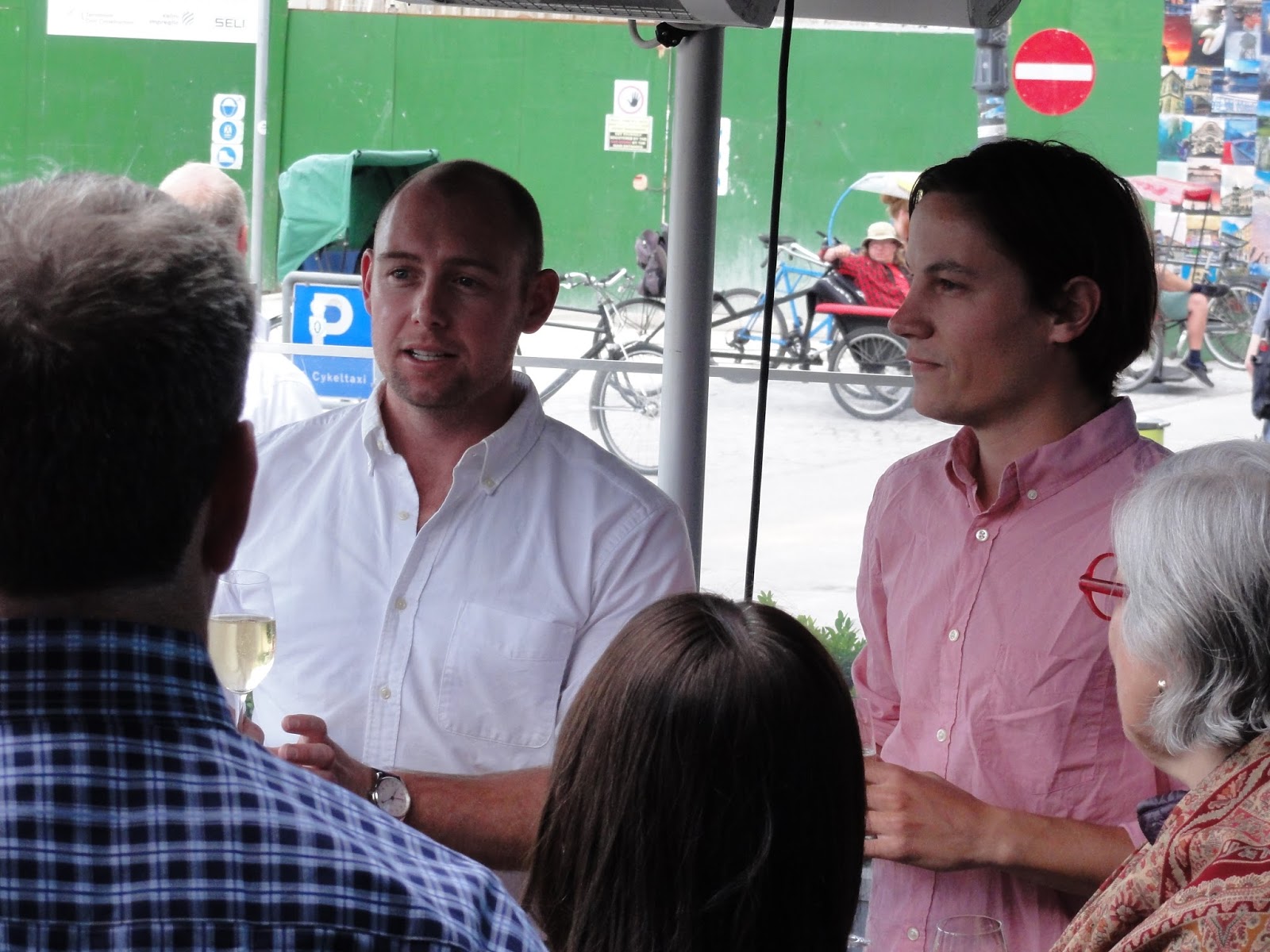
This one is a business trip, and since someone has to do it -- attend the semi-annual meeting of the insurance captive, Generations Group, of which Schewel Furniture is a member-owner -- it might as well be your scribe, accompanied of course by the lovely JSG, who can produce a carry-on, backpack, and passport faster than a flight attendant can say "Welcome aboard."
Incorporated to provide workers' compensation, general liability, and vehicle collision coverage for Schewel and its twenty-nine similar-sized partner companies, the captive -- so-called because it is owned by, or captive to, the policyholders -- offers cost savings that a commercial carrier cannot match.
The underwriting gains from invested premiums are retained by the captive rather than by an independent insurer, and are thus available to be distributed to the owners. At around thirty percent, the administrative overhead of captives is about ten percentage points lower than that of independent insurers. The potential for the return of unused premium is a considerable incentive for the owners to reduce losses through the implementation of stringent risk management programs. Finally, if the captive is domiciled, or licensed, offshore -- like Generations Group, which is in the Cayman Islands -- its profits are subject to taxation only once, when they are passed through to the owner companies and not at the corporate level.
An additional if less tangible benefit is the opportunity to network with an eclectic assortment of entrepreneurs, whose enterprises run the gamut from residential and commercial construction, building material sales, real estate development, sanitary product distribution, and pickle manufacturing to golf caddie management, breakfast biscuit preparation, and competitive dog show superintending.
Offshore captives are required by law to meet outside the U. S. -- but not necessarily in their domicile -- and Generations Group usually alternates between Canada and the Caribbean, most recently Toronto and San Juan. Once every five years or so the meeting is held in conjunction with four other captives who share the same supra-management group, thereby creating the critical mass for an owners' conference at some exotic locale -- like the Hotel Arts Barcelona, where business is speedily dispensed with on Day One and the attendees can turn to more pleasurable and edifying pursuits.
Self-improvement is the order of Day Two, teed up by one of ten most inspirational people in the world, according to the Wall Street Journal, Chad Hymas, who was paralyzed from the neck down fifteen years ago when a two-thousand-pound bale of hay crushed his spine; until calamity struck he had been an ordinary elk farmer tending his herd and living the dream he had harbored since his youthful infatuation with those stately animals.

For two hours, before a spellbound audience, Chad maneuvers his wheelchair back and forth across the stage, occasionally pausing to peck at his laptop and summon a photo onto the two large screens that flank him as he weaves a narrative quilt of personal experiences that elucidate and amplify his precepts for "Leaving a Legacy"; it's a marvelous feat to behold, since his gnarled, twisted hands hang like dead fish.
Put your family first, always. To be a superior leader (or "guide"), support your associates in word and deed without being asked and when they least expect it. Act with urgency, or you won't act at all. Focus on what you have, not on what you have lost. Exalt and encourage others, because people remember how you make them feel, not what you say.
He begins with Father's Day. Propped up between his two teenage sons (lest he fall over), he savored breakfast in bed -- strawberry waffles topped with whipped cream and syrup -- and two simple but eloquent cards: a homemade one decorated with an elk from his ten-year-old (adopted) daughter, who scored her love for Dad on this special occasion at 101, compared to Mom's 100 (and Chad's own previous record high of 80); and a Wal-Mart gem from the boys proclaiming him the "Best Dad in the World," to which they appended the testimonial that "when they grow up, they want to be a guide just like him."
Chad points out an exemplary guide standing in the wings. He's one of the housekeeping staff, Mohammed, who exhibited outstanding leadership by seizing the moment and arranging a rooftop dinner for Chad with hotel management; we notice how Chad makes Mohammed feel like a hero by recognizing his effort in front of the entire assemblage.
Chad spent sixty-three days in the hospital after his accident. On the sixty-fourth his father and brother showed up, dressed him in camouflage, drove him out to their farm, deposited him near a watering hole, poured elk urine over his head (releasing a telltale scent), and let loose their mating calls. But the joke was on them. For five years afterward Chad was too depressed to go looking for elk again ("I just sat there," he says) -- until his father telephoned one more time. "We're packing your favorite lunch. We'll be building a campfire and talking about you. We're taking your two boys whether you come along or not." Which is when Chad realized he couldn't afford to waste any more time and snapped his favorite photo from a file of 60,000. It sits framed in glass in his office, is plastered on his luggage, and lights up his computer screen at his initial keystroke: his younger son all decked out in dirty camouflage, wranglers, and boots, poised to espy his first elk.
Chad has a ringside parking spot reserved for his wheelchair in his sons' high school basketball arena, and in spite of a whirlwind schedule, he has never missed a game. He came close a few years ago when at a company retreat in Greenland he got an unexpected call from the older one, Ace. "I'm starting my first varsity game tomorrow night" was the bittersweet message, since there was no way Chad could get home in less than thirty hours. He explained his predicament to the CEO, who could not alter the agenda but did accommodate him with a sudden, startling decision; he flew Chad by private plane to Toronto, where he caught a flight to Salt Lake City, landing in time to make the tip-off with twelve minutes to spare. When Ace saw his Dad, he gave him the "thumbs up" sign, then ran across the court and held up Chad's own thumbs, a tableau that became legendary in the school's annals.

From his father Chad learned the importance of acting boldly when others choose to avoid or ignore an uncomfortable situation. He relates an incident from his own high school past about an intellectually disabled girl named Melanie who was subjected to constant teasing and denigration by him and his peers -- until the day his father brought pizza to the packed cafeteria, took a slice over to Melanie, touched her arm, and engaged her in conversation. Three thousand stunned witnesses had a change of heart, and voted Melanie an honorary cheerleader; soon she would manifest twirling skills warranting television coverage by four local stations. And years later Chad's son and a buddy would make him proud when they escorted two special education students to Homecoming.
.

On July 11, 2003, Chad set out to push his wheelchair five hundred miles from Salt Lake City to Las Vegas. He made good progress for four days over relatively flat terrain before encountering a steep ascent that slowed him to a "turtle's pace" of two miles in fourteen hours. By Day Eight, traveling at night to compensate for asphalt temperature that had risen to 122 degrees, Chad was sick, exhausted, questioning the meaning of this tortuous exercise, and ready to give it up, although he was only eighty-seven miles from his goal, having counted off over four hundred green mile markers. "Sure, you can quit now," said his father, "but why don't you try counting those yellow stripes down the middle of the road, which can measure your success just as effectively as the mile markers?" And so he did, 1100, 1800, 3000 stripes, until he reached Apex Junction, where the State Police shut down the highway, enabling him to coast downhill and complete his eleven-day marathon. "The difficult takes time," says Chad. "But the impossible takes a little bit longer."
Slowing down the inexorable hands of Father Time may be a difficult task, but it is by no means impossible, says our next next speaker, Todd Whitthorne. A healthy lifestyle can compress the morbidity curve, adding six to nine years to life expectancy and postponing a decline in one's functional capacities by as many as twenty years. Each of us has a choice, or as Led Zeppelin intoned in "Stairway to Heaven": "Yes, there are two paths you can go by, but in the long run there's still time to change the road you're on." No less a sage than Leo Tolstoy offered similar words of encouragement a century-and-a-half earlier when he wrote: "The position we occupy is not as important as the direction we are moving."

Of the top ten causes of the global metric "Years Lived With Disability" -- back pain, depression, anemia, neck pain, diabetes, hearing loss, migraine headaches, pulmonary disease, anxiety, and musculoskeletal disorders -- except for anemia, the prevalence of each has increased since 1990, with diabetes leading the way, up 136 percent.
The percent of the U. S. population with diabetes stands at 9.3 (29 million people), but eighty-six million more are prediabetic (90 percent of whom don't know it) and are at a high risk for Type 2 diabetes without changes in their diet and activity level. In 2012 diabetes and its related complications accounted for $245 billion in medical costs and lost work and wages.
In the U. S. today, 35 percent of adults (and twenty percent of teenagers) are obese. They consume 42 percent more in health care dollars than adults who are at a healthy weight, racking up about $180 billion annually in preventable medical billings. In addition, obesity costs employers $4.3 billion in job absenteeism and $500 per worker in lost productivity per year. Worker Compensation claims run five times higher for obese employees than they do for the non-obese.
The twofold solution lies first in sensible nutrition, says Todd, whose repertoire of facts, statistics, sound bites, and gentle recommendations leaves us all regretting those sumptuous Hotel Arts Barcelona buffets. We should have skipped breakfast, saving ourselves four hundred calories. Were we reacting to genuine hunger (the body's need for sustenance) or merely satisfying our appetites, our mind's craving for gratuitous titillation of our palates? Why is Todd looking directly at me when he admonishes us to moderate our pace of ingestion, since our stomachs have no taste buds?
While it's easy (and flippant) to say, "If it comes from a plant, eat it; if it's made in a plant, throw it away," adherence to such maxims seems a lost cause when twenty percent of our calories are consumed in a car; when Arby's, Taco Bell, Burger King, and KFC dominate the roadway and television screen; when the Holiday Inn Express promotes Pancake Night; when Ph.D's earn accolades for concocting peanut butter and bacon shakes; and when fat, sugar, and salt are altering the biological circuitry of brains overdosing on french fries, ketchup, corn syrup, and other poisonous substitutes for vegetables and roast chicken.
Todd suggests enhancing one's diet daily with two supplements: 2000 IU's of Vitamin D, which can boost the immune system and prevent osteoporosis; and 1000 mg of Omega-3 fatty acids (fish oil), which can lower risk for heart disease and stroke.
If Todd's second remedy, physical activity, won't produce meaningful weight loss -- one pound contains 3500 calories -- its virtues are indisputable. Aerobic exercise for the mind and body is the one sure way to make yourself healthier; the evidence is clear that it can significantly reduce or cure fatigue, snoring, heartburn, insomnia, depression, headaches, impotence, and anxiety. A fit fifty-something doubles his chance of living to age eighty-five.
Todd recommends 150 minutes a week of moderate exercise, including weight lifting, but says for those less committed the "Scientific 7-Minute Workout" can be as effective as endurance training. It consists of twelve extremely intensive activities employing only body weight, a chair, and a wall, each performed in rapid succession for thirty seconds followed by ten-second rest intervals: jumping jacks, wall-sit, push-up, abdominal crunch, step-up onto chair, squat, triceps dip on chair, plank, high knees running in place, push-up and rotation, and side plank.

As a fitness fanatic (but a problematic eater who can't cook and unless he's dining out subsists on processed food), I of course heartily endorse Todd's prescription for "Leaving the Campground Cleaner." But exercise is first an avocation and second a habit, which is why I am swift to extol its physical and psychological benefits, yet always careful to avoid a didactic tone. No matter the level of intensity, the regimen is too strenuous and the change in behavior too radical for any person to undertake unless he decides indeed that "the pain is worth the gain" and develops a passion as seductive and obsessive as playing golf or watching football. There's a reason 95 percent of Americans are too sedentary.
Stepping up next to reveal the shocking truth about the current drug epidemic is a tag team with an impressive resume. Coined by New York Magazine "the most famous narc in America," Bob Stutzman spent twenty-five years as a Special Agent with the Drug Enforcement Administration, at one time had a $5 million contract on his head, was the subject of the Netflix film "Narco" for his role in hunting down Pablo Escobar, survived four gunshot wounds, and brought to justice the criminal who killed his best friend and partner. Judge Jodi Switalski is a former Detroit felony prosecutor (and Olympian volleyball star) who presides over a successful sobriety, drug, and domestic violence court.

Like a tenacious bulldog with a gravelly baritone, Bob's on a mission, launching a barrage of statistics so frightening it stretches the boundaries of credibility. One hundred twenty persons die every day from drug overdoses, over half of which are prescription drugs. Seventy-one percent of students describe their high schools as drug-infested. Attending college increases one's chance of becoming a drug or alcohol addict by a factor of three. Every day over sixteen hundred females are raped as a result of drug or alcohol use. While drug use is actually down slightly since 1992, the number of persons classified as dependent has doubled from nine million to eighteen million.
Twelve years and three months is now the average age at which young people begin their drug careers, compared to fifteen-and-a-half in the 1960's. It is not uncommon for fourth graders to take a drink or "try a joint" at the urging of a friend or sibling and then step up easily to "huffing" -- inhaling Pam spray or Sharpie felt tips -- and smoking the dangerous, hallucinatory plant Salvia, which can be picked up at Home Depot or ordered online.
Bob is not as favorably inclined to the legalization of marijuana as I am. For adults, he says, losing depth perception for forty-eight hours after a few puffs is no better or worse than the effect of alcohol. For kids, however, chronic use can be devastating, changing the cellular structure of their brains and shrinking their IQ's ten points.
LSD's back, says Bob, although in a more deadly variant, psylocybin, a compound occurring in a species of Central American mushrooms. Its "magical" trips can evoke terrifying thoughts, fears of insanity and death, and an inability to distinguish fantasy from reality. Even worse are the recurring delusions or "flashbacks" experienced by users long after their ingesting the drug.
Opioids present different problems from those associated with older, conventional drugs. The most popular means of consumption is to "parachute," or swallow crushed pills, so that the chemicals hit the blood stream in eight seconds. The consequent "high" engenders feelings of warmth, safety, and well-being which one person likened to "being in my mother's arms." Unbeknownst to him, one's best friend can be addicted to opioids, just as a stoned Rush Limbaugh broadcast for three years to an unsuspecting public. In 2008 the most hit-upon internet photo was a body bag containing opioids' most famous victim: twenty-nine-year-old Heath Ledger, who couldn't separate himself from his "Joker" persona and succumbed to ambien, xanax, and oxycontin.

Bob hands off to Judge Jodi, who extracts from her robe her own portfolio of horror stories. K2 (synthetic marijuana) was the culprit in the case of Dickie, who, she says, "couldn't feel the pain" of slitting his throat, so he shot himself in the face. After vaping the designer drug flakka, Tucker beat his father to death with a baseball bat, shouting, "My brain is bleeding!" A woman who feared for her life because of her grandson's use of K2 killed him preemptively in self-defense. Painkillers are turning injured athletes like Page into addicts; Judge Jodi knew she was at risk, sentencing her to one day in jail for possession of paraphernalia, but couldn't save her from a subsequent prescription drug overdose.
The Judge passes the baton back to Bob, who wants to correct some common misconceptions. Contrary to what was depicted in the otherwise accurate television series "The Wire," eighty-six percent of drug addicts are white. Per capita, white adults use drugs at a 70 percent higher rate than blacks (for white high school students that number is 100 percent), although blacks are four times more likely to be arrested on a drug charge.
What might once have been considered safe havens offer no relief from this scourge. Drug use in suburban and rural areas is on par with that in big cities. It's eighteen percent higher in private schools than in public schools. Players in team sports have a higher rate of substance abuse than those in individual sports and non-participants (and football has the highest rate), thereby putting the lie to the frequently heard refrain, "My son doesn't have a problem; he plays ball." Medical and MBA degrees from the University of Pennsylvania couldn't prevent the self-inflicted death of John on his first day off after three weeks in residency at Mt. Sinai Hospital.
Bob does offer some advice for families on how to avoid being struck by such tragedy. Postpone as long as possible a child's exposure to and first use of a drug, because the younger the age when it happens, the more likely he or she will become an addict. Emphasize the evils of tobacco, which also is a predictor of progressing to harder substances. And sit down to dinner with children five to seven nights a week, and listen to, but don't judge, their best and worst adventures of the day.
"Where are all the pills coming from?" is almost a rhetorical question. Twenty percent of patients walk out of their physician's office with a prescription for opioids, usually for sixty doses. In 1992 six million scripts were written for opioids; in 2014 that figure had grown to 270 million. More often than we would like to believe, kids will check the medicine cabinet in their friends' homes; if they're wondering which pill will get them high, they've been directed by the internet to "take the one with the 'warning' label."
Well, after nearly four hours of lectures on the evils of gluttony and substance-induced euphoria, we're off to indulge ourselves in both in a rather incongruous sunset to our day of enlightenment. Our destination -- one hour by bus from Barcelona -- is the magnificent Cavas Cordoniu, a winery complex that includes vineyards, production facilities, restaurant, multi-level banquet hall, private residence, and storage cellar. Dating back to the sixteenth century, it's the oldest family business in Spain and worldwide the seventeenth-oldest as well as the second largest maker of bottle-fermented sparkling wine.

And it's delicious, whether of the white or rose variety, glasses of which overflow the twenty or so large tables bordering the spacious courtyard where our party of four hundred socializes, imbibes, samples the tasty seafood hors d'oeuvres, and admires the grounds and the view. We're about to head indoors when JSG points out a series of trams -- several carts linked together and pulled by a small tractor -- dropping off and picking up riders, then whizzing off on some mysterious tour which is drawing a crowd. It's like musical chairs, but we finally locate two seats and hop aboard.
We motor down several long ramps, interrupted by a hairpin switchback or two, before landing in the bowels of the property. It's chilly, dank, and gloomy, with barely enough light to make out on either side of us floor to ceiling storage racks, some empty, others filled with familiar dust-covered shapes. We're in Cordoniu's famous underground, Cava caves so to speak, nineteen miles of corridors housing forty million bottles of the bubbly, although I'm not sure the proprietors ever take inventory.

I'm reminded of the juvenile drinking ditty, "One hundred bottles of beer on the wall," and sure enough our guide pulls one down, not to pass around but to demonstrate the manufacturing process. After primary fermentation and blending, the wine is put in bottles with yeast and a small amount of sugar, stopped with a temporary cap, and stored horizontally. During secondary fermentation, which can last up to three years, carbon dioxide is trapped in the wine in solution. After aging, the bottles are gradually rotated to a downward vertical position so that the dead yeast or lees settles in the neck. A small portion of liquid is frozen, the plug of ice with the lees is removed, the wine is topped off with a dose of sugar (which varies according to the sweetness desired), and the bottle is recapped.
By the time we get back to the surface there are no seats left on the ground level of the banquet hall where the buffet is spread out. Health guru Todd would no doubt regard that as fortuitous: it not only requires us to engage in strenuous physical activity climbing the stairway, it also suppresses our calorie intake since, after one bulging plate of paella, pasta, and salad, a return trip hardly seems worth the effort. Later on we do make our way down to the dance floor, as I can't resist rockin' an' rollin' to a medley -- Waterloo, Dancing Queen, Take a Chance on Me -- popularized by my newest favorite singing group, the 1970's Swedish stars known as "ABBA."
None the worse for all the revelry, we're up at 8:00 AM the next morning to catch a cab for a day-long excursion which JSG's careful research has determined is the most promising of a pot luck draw: to the medieval town of Girona and then to Figueres, site of the Salvador Dali Museum. Our tour bus departs at 8:30 from the terminal at the Placa de Catalunya, "a twenty-minute ride from here," says the hotel concierge, which leaves us plenty of time as we settle in behind our driver, another Mohammed, although he's altogether of a different sort from his namesake of yesterday. He's friendly enough, but somehow runs into three traffic jams while following a circuitous route through some parts of the city we'd rather not see right now before depositing us at our destination a frustrating five minutes too late.
Well, there's still tomorrow, we console ourselves with, and since we're not far from one of Barcelona's main attractions, it's simply a matter of switching Days Three and Four.
During our wandering through the area a few days ago we'd seen the provocative facade which eclipses its neighbors like a misplaced Disneyland castle: Antoni Gaudi's Casa Battlo. At this hour there's no waiting line for the wonders that lie behind it.
In 1904, by the time the fifty-four-year-old Gaudi was commissioned by wealthy industrialist Josep Battlo to renovate his newly-purchased home on the prominent Passeig de Gracia, his reputation as a master of Catalan Modernism and a creative genius was well-established. Incorporating elements of the Oriental and neo-Gothic movements that had influenced him in the years after his 1878 graduation from the Barcelona Architecture School, Gaudi took the lyricism, subjectivity, overt ornamentation, and plastic constructional language of Modernism in a direction that was totally original and beyond emulation.

Gaudi sought to express through architecture the organic shapes of nature he observed in his explorations of the nearby mountains of Montserrat and Pareis and the caves of Mallorca and Colibato. His studies led him to the consistent usage of ruled geometrical forms, which he identified in rushes, reeds, tree trunks, and the human skeleton. For example, the interior of La Sagrada Familia is envisioned as a forest, with tree-like pillars divided into branches supporting a series of intertwined hyperboloid vaults.

Gaudi was the first to apply to common architecture the catenary curve -- an engineering device formerly limited to suspension bridges -- thereby adding great strength to his structures.
Gaudi's internal conception of space enabled him to visualize his designs in three dimensions and dispense with traditional plans in favor of casts or intricate and innovative models. For the Church of Colonia Guell, on a scale of 1:10, he crafted the columns and arches he wanted to achieve by inverting the floor and suspending from it strings (which represented the catenaries) tied to bags of birdshot (which represented the weight-bearing points of the building).

Gaudi employed the same technique in planning the fantastical main facade of the Casa Battlo, sculpting plaster models that would prefigure its unusual curved shapes. Overlaid with stunning, colorful combinations of stone, glass, iron, and ceramics that vibrate in the sunlit interplay of light and shadow, it has been likened to the impressionist water lilies of Claude Monet.

The wave-like effect was created by removing sections of the original wall and then covering one-hundred-eighty square meters of surface area with trencadis, broken pieces of glass and ceramic work collected from various sources and applied with limestone mortar. Gaudi integrated the ground, main, and first floors into a single rostrum; composed of flowing lava-like sandstone, its five curved openings are sealed with colored windows crowned by stained glass medallions and divided by eight bone-like columns. The facade's nine balconies feature balustrades perched on shell-shaped platforms and fashioned from single pieces of wrought iron carved to resemble Venetian masks.

Passing through the wrought iron barred doors of the front entrance, we are each outfitted with an audio guide and a device which resembles a mini-ipad but is actually a looking glass into the past. When viewed through its magical lens, every room appears furnished and decorated just as it was one hundred years ago.

We enter the cave-like general vestibule, where a blending of materials efficiently channels traffic between levels: inlaid marble flooring, wood and iron apertures and banisters, stucco-clad curved ceilings, and alternating flat and volumetric rectangular tiles in grey, sky blue, and lapis emblazoning the lower walls.

On the main floor, a reception hallway leads through double doors of iron grill work and wood to the Battlo family apartment; we are in a grotto, where the walls seem to have been eroded by wind and rain and a turtle shell skylight enhances the marine ambiance. A chimney room which served as Battlo's office transitions us from the public to the private areas of the house; here the undulating walls are plastered with gold leaf mosaics that cleverly camouflage the mushroom-shaped hollowed-out fireplace.


In one darkened bedroom a replica of the casa sits upon a table. Imitating our fellow tourists, we aim our ipads toward it, and are treated to a personal five-minute sound and light show, during which the whole process of construction and renovation is depicted as if the building were a living organism that moves and mutates, as its various faces are washed away by spectral waterfalls.
The dining room is situated in the rear of the flat; again curved forms predominate, and the oceanic theme is emphasized by a ceiling from which large drops of water are extruded and by the weather-softened dual column which accentuates the door to the back patio. The latter runs the entire breadth of the building, and is paved with familiar kaleidoscopic trencadis and ceramics recovered from the original structure. Above it rises the rear facade, which is draped with fifty-two windows and five levels of serpentine railed terraces, all conveying energy and lightness to the ensemble.

Our eyeballs bulging, is it possible that even greater delights await us? Climbing a simple winding staircase, we emerge from one of the two stairwells that anchor either end of the gloriously-landscaped roof terrace; linked by a large glass and iron skylight, each is capped by an arrangement of eight twisting chimneys clad in delicately colored trencadis. Two smaller chimney sets stand watch on opposite sides of the terrace. Transcending architecture, these organic forms, silhouettes, and textures are rendered as artistic works of substantial merit.

Crowning the edifice is a striking undulating roof that on the Passeig de Gracia facade is covered with glazed tiles in shades of red, blue, and green. Along the edge of this surface runs a spine-like composition of tubular and helmet-shaped ceramic pieces in a series of dual color combinations. A trencadis cylindrical base supports a four-armed cross atop bulbous tower; when the latter was broken in transit, Gaudi demurred calling for a replacement as he considered the cracks to have considerable aesthetic value.


The exit leads past a display of -- appropriately -- furniture pieces, mainly chairs (which I believe are reproductions), specially designed for the house by Gaudi. Crafted from ash, a wood that is durable and flexible, their rounded forms blend perfectly with the architectonic spaces they were assigned to and anatomically adapt to the postures of the body. Strikingly original is a double bench, in which two corner seats share an armrest.

Whatever exorbitant budget Monsieur Battlo allocated to his new home, one can be certain it was exceeded. Precise in technique and demanding in workmanship, Gaudi never hesitated to make changes in midstream, regardless of cost and often without asking permission of his client.
There's plenty more of him in this city, yet it's mere seasoning to the main course. Wrapping around a corner few blocks away is the modernist apartment complex, La Pedrera.

Another building in motion, its greystone facade -- which is self-supporting, another Gaudi innovation -- rises from the street like a sinuous open quarry sculpted by wind and water; elaborate wrought iron balcony railings swirl like seaweed washed up on the shore.

Here the roof terrace is a three-dimensional maze where we meander up and down steps, through covered passageways, and around chimneys, statues, and silhouettes that remind us of medieval monks or knights, some in natural sandstone, others sheathed in trencadis and broken glass. In the attic below, spread out in a vast interior beneath two-hundred-seventy brick catenary arches, which eliminate the need for columns and partitions, is the Espai Gaudi, an exhibit depicting Gaudi's life and work, including many original drawings and models.
Objects on our map appear closer and less elevated than the reality. Our long, arduous uphill trek in search of Gaudi's imaginative Park Guell leads us to the cross at its highest point and a panoramic view of Barcelona and the bay. From there we amble along the main viaduct and down to the arcade where unusual slanting columns bear the weight of the road above it. Supporting natural stone birds' nests and pine trees create the illusion that the whole structure was carved out of the mountain itself.

By the time we land at the twin Hansel-and-Gretel gingerbread-style entrance pavilions around 2:00 PM, tickets to the monumental zone are sold out, leaving us breathlessly longing for its "don't miss" contents: a mosaic-encrusted salamander crawling among similarly accoutered walls and fountains; the Sala Hispotila, a forest of eighty-six Doric columns inspired by ancient Greece, some perpendicular, some leaning; and a tiled bench resembling a mythical sea serpent curving around the terrace above it.

Other than a cursory circumnavigation, I am resigned to missing Spain's biggest draw, La Sagrada Familia, described by one critic as the most extraordinary church building in the history of art. Its anticipated completion date is 2026, which would be the centenary of the death of Gaudi, who himself worked on the project intermittently for forty years. The late afternoon sun, shadows, and impenetrable crowd obscure the grandeur of the two finished facades: the Nativity Facade, an astonishing sculpted tapestry, replete with ornate figures and symbolic scenes from nature; and the more austere Passion Facade, intended to portray the sins of man and the suffering of Christ in bare stone and harsh straight lines. If the interior will forever remain even a greater mystery to me, JSG, having managed to explore it a few days ago while I was in business meetings, is now qualified to extol its magnificent appointments: unique columns that evolve from four sides to eight to sixteen to circular as they rise to the ceiling; comprehensive, abstract, raised ornamentation; elaborate curved balcony and stairway iron railings.

Following the deaths of his niece and his two closest friends, Gaudi took refuge in his work and his Catholic faith, and devoted the last ten years of his life to La Sagrada Familia. A lifelong bachelor -- he had been rebuffed thirty years earlier by his only romantic interest -- he turned increasingly reclusive, shunning the dandy attire, immaculate grooming, gourmet meals, social happenings, and expensive carriage rides of his youth in favor of frugality, slovenliness, and shabby clothing. On June 7, 1926, as he was on his way to the Saint Felip Neri Church for his daily prayer and confession, he was struck by a tram and knocked unconscious. No one assisted the disheveled old man who lacked identity papers. A police officer eventually transported him to the Santa Creu Hospital, but by the time the chaplain of La Sagrada Familia recognized him, even the most expert medical attention could not revive him. He died three days later.
For dinner that evening, JSG astutely plucks from a bevy of options, El Cangrejo Loco (The Mad Crab), located at the end of the Olimpic Port Pier, a pleasant ten-minute stroll from our hotel. Neither of our fresh seafood platters disappoints: monkfish, swordfish, sea bass for me, prawns, mussels, crayfish, squid for JSG, washed down with beer and sangria.
Having determined to leave nothing to chance or the schemes of taxi drivers, we set off on foot the next morning for the Placa de Catalunya with forty-five minutes to spare; we arrive ten minutes sooner than if we had been chauffeured there by the wily Mohammed.
The city of Girona lies at the base of the Pyrenees about sixty miles northeast of Barcelona. Although currently a vibrant modern community boasting remarkable art nouveau architecture and a picturesque waterfront lined with colorful shops and restaurants, its principal attraction is the medieval old town, which has its roots in the pre-Roman era.

Speaking with a heavy accent that requires close attention, our charming female guide leads us past cobblestone open squares and along narrow walled pathways, pointing out the major points of interest: a lioness guarding the gate, which all who pass by are supposed to kiss; the eighty-six steps rising to the Gothic cathedral of Santa Maria; remnants of fortifications built in the first century by the Romans and rebuilt thirteen hundred years later; the Arabic baths, dating from the twelfth century and the best preserved Romanesque complex in the country; and the Jewish ghetto, or Call.

As she recounts several hundred years of Jewish history in about ten minutes, I'm wondering whether my fellow travelers are as intrigued as I am by the ancient mikvah, by the former residence of the thirteenth century Great Rabbi of Catalonia, Nahmanides (who was promptly identified by a local synagogue scholar as the town's most renowned citizen when I informed him of my visit), and by the woeful tale of the persecution and expulsion of the Jews from Spain in 1492. Afterward she turns us loose for just enough time to ferret out a couple of espressos and a bikini sandwich (so named, I speculate, either for its ham and cheese ingredients or its miniature dimensions).
We re-board our bus for another one hour ride north to the city of Figueres, birthplace of Salvador Dali but, more importantly, the site of the personal theatre-museum which he conceived in 1961 and continuously reconfigured until his death in 1989. The venture sprung from a request by the newly-appointed mayor that Dali donate a painting to the local Museum of Emporda; Dali flamboyantly replied that instead he would donate an entire museum, resurrecting the Municipal Theatre which had been destroyed by fire in 1939. Its remains, he said, would be highly suitable, "firstly, because I am an eminently theatrical painter; secondly, because the Theatre is opposite the church where I was baptized . . . and thirdly, because it was precisely in the vestibule room of the Theatre that I held my first painting exhibition."

Born in 1904, Dali studied in his home town until 1922, when he entered the Royal Academy of Fine Arts in Madrid. Accused of fomenting unrest, he was expelled in 1926, whereupon he moved to Paris, met Picasso and Miro, and embraced the surrealism that would earn him his greatest accolades. He developed and articulated a "Paranoic-Critical Method" for accessing the subconscious by which the artist cultivates a genuine delusion yet remains aware that his reason and control is suspended. During this period he produced one of his most recognizable works, The Persistence of Memory, employing for the first time his image of a soft, melting pocket watch, which suggests a relative conception of time rather than one rigid or predetermined.

In 1929 he became romantically involved with a Russian immigrant ten years his senior, Gala, who would become his wife (in 1934) and his lifelong muse, inspiration, and financial manager.

In 1936 Dali moved to Paris; before long, however, he fell out of favor with the French Surrealists, who could not tolerate his neutral politics (most of them were Communists), his branching into a more traditional style, and his increasing commercialization and opportunism. At the outbreak of World War II, he fled to the United States, where his extravagance and ubiquity would make him world famous. He applied his name and talents to a variety of art forms: designing jewelry, clothes, furniture, retail store window displays, and stage sets for plays and ballets; collaborating with photographers and film makers; and publishing an autobiography.
In 1948, implicitly accepting the Franco dictatorship, Dali returned to Spain; he would spend the next three decades experimenting in his painting with many novel processes and media, including optical illusion, negative space, visual punning, pointillism, holography, and foreshortening. His intensifying interest in science, religion, and mathematics prompted him to invent a technique he labeled "Nuclear Mysticism," in which he sought to synthesize Christian iconography with images of material disintegration.
A master at self-promotion, Dali emphasized his ostentatious, imposing persona with a long cape, walking stick, haughty expression, upturned waxed moustache, and the memorable comment: "Every morning upon awakening I experience a supreme pleasure: that of being Salvador Dali."
Whether interpreted as spontaneous antics or calculated performances, his outrageous behavior knew no limits. He arrived for a lecture carrying a billiard cue, leading a pair of Russian wolfhounds, and wearing a diving suit and helmet in which he almost suffocated. While working on a window display, he became so incensed by unauthorized changes that he shoved a decorative bathtub through the plate glass. He autographed books lying in a bed wired to a machine that monitored his brain waves and blood pressure. He was known to avoid paying tabs at restaurants by drawing on the checks he wrote, assuming correctly that the proprietors would not cash such valuable pieces of art. He often spoke in a bizarre combination of French, Spanish, Catalan, and English. He frequently traveled with a pet ocelot, and appeared in public on a number of occasions -- the Dick Cavett Show, for example -- with an anteater.
The Figueres Theatre-Museum is more than a repository; it is the embodiment and culmination of the life and work of this eccentric genius.

Dali wanted the pilgrimage to his spiritual center -- his crypt lies beneath the museum stage and cupola -- to begin in the outdoor leisure space, the Placa Gala-Salvador Dali, where he would introduce his vision and concepts and illustrate the great passions of his career: Catalan thought; science; academic art; and innovative art.

In front of the main facade, the golden egg-shaped head of philosopher Francesc Pujols rests tilted on a hand in a pose recalling Rodin's The Thinker; a classical influence is implied by his toga-clothed body and the marble bust of a Roman patriarch. In the adjoining square, an apple ball suspended from a pendulum dangles from the grasp of a sculptured Homage to Newton. Nearby are three sculptural tributes to Ernest Meissonier, the artist most admired by Dali; one sits on tall pedestal of huge tires. Dali completed the setting with one of his own creations: a grinning cardboard monster head balanced atop an egg with doll figures for its pupils and teeth and a television set implanted in its forehead.
Eggs are everywhere; they are the artist's method of looking back into the womb, where prenatal gestation, the result of love, engenders hope for mankind.
On the top of the building and on the lower balcony are statues -- male and female -- holding loaves of bread, Dalinian crutches, and bulging hydrogen atoms; one wears a diving suit, signaling to visitors that they are about to be submerged in the depths of the unconscious.

We walk through the vestibule into the courtyard garden and are greeted by, according to Dali, the largest surrealist monument in the world, the Rainy Taxi, a Dionysian festival in which we are both witnesses and participants. A gorgeous 1930's Cadillac convertible -- which is both fossil and mobile machine -- grabs our attention; behind the cracked glass windows we see two plaster passengers and a chauffeur bathed in an eerie green light and intermittently doused by indoor showers. Astride the bonnet stands a full-figured Queen Esther. Behind the car rises another towering column of oversize tires supporting a marble bust of Francois Giradon, a black sculpture -- the Slave -- by Michelangelo, and a sailboat of Gala's resting on crutches. Simulated drops of water hang from the keel, and atop the mast is attached an umbrella, which opens with the donation of a coin, producing the aforementioned rain.
The surrounding walls are covered with a profusion of decorative elements: twenty-one gilded art deco mannequins, whose impassiveness contrasts with the carnival-like atmosphere; a chorus of angels in the form of washbasins, whose whiteness mirrors the purity of the soul; and a series of four grotesque monsters constructed of snails, shells, tree trunks, branches, rocks, and old stone, ecstatically contemplating the spectacle below them.

Ascending the ramps from the courtyard, we reach the impressive stage of the old Municipal Theatre and gaze upward at its capstone, the stunning geodesic cupola. Dali remarked on the occasion of the death of the architect, Perez Pinero, that he had built nothing "more glittering and personal than this roof," and that its transparency and reticular design gave it the the sensation of multiple structures, which "end up being synthesized into a glorious and everlasting light."
The murals on either side of us are suggestive of the Sistine Chapel. To our left two enormous hands -- one with the pointing finger of the Creator -- reach toward each other while holding a white sheet; to our right a muscular figure with a cube head is wringing out a dripping blue cloth like a rainmaker. Below him hangs Dali's brilliant photographic oil, Gala Nude Looking at the Sea, the first use of digital imaging in painting. The small-formatted face of Abraham Lincoln in the lower left is a clue that we are to step back eighteen meters in order to see his full portrait superimposed on the same canvas.

Straight ahead, blanketing the entire wall, is a composition Dali created for the ballet Labyrinth based on the myth of Theseus and Ariadne. Behind an enormous female bust with a hollow solar plexus -- Dali believed knowledge resided in empty spaces -- emerges a phantasmagoric landscape depicting the journey from the calm sea of birth to the jagged coast of death.

Two galleries on this level -- the red-velvet-upholstered Treasure Room and the Fishmongers' Crypt -- contain important works in a variety of themes: The Basket of Bread, a much-studied example of realism, which Dali construed as "the total enigma" and most satisfying to his imagination; Leda Atomica, conjoining elements of mythology and mathematics, all weightless, floating in air; Port Alguer, a view of Cadaques which contrasts an impressionist harbor with a structuralist urban montage; The Spectre of Sex Appeal, in which the boy Dali, dressed as a sailor, confronts the fantastical monster of sexuality amid the imposing landscape of his childhood, the rocky Cap de Creus; and Soft Self Portrait with Grilled Bacon, in which Dali's amorphous face rests on a pedestal beside a slice of bacon, a symbol of organic matter and daily breakfasts.

Both Sex Appeal and Self Portrait are supported by crutches, which represented for the artist death and resurrection.

A stairway brings us to the Mae West Room, wherein Dali has transformed the two-dimensional wash on newspaper Face of Mae West which may be Used as an Apartment into a three-dimensional "dream that can be used as a living room." We mount a few steps and peer through a reducing lens hanging from the belly of a giant camel at an arrangement of weird objects that have magically coalesced into two eyes (photographic enlargements of two pointillist paintings), a nose (a chimney with logs), a coiffure (a huge woven shawl), and a botox-infused pair of lips (a sumptuous armless sofa). Overhead is an upside down bath and in the reception area a Venus de Milo reproduction, to whose "external turgidity" Dali added drawers representing "the subconscious, guilt, mental perfection, faith, hope, charity, and surrealism."

The Palace of the Wind apartment (named after the ferocious Tramontana which blows over Figueres) includes a bedroom, a studio, and the central gallery, the last dominated by the magnificent ceiling painting of the same title. Their feet planted in space, from a foreshortened perspective Dali and Gala pour a shower of gold, both material and spiritual, over Figueres and the spectators. On the left side the couple sits on a quayside rail contemplating the boat on which they have sailed the voyage of life. On the right side appear familiar images: soft clocks, the wheel of knowledge (conceptualized by thirteenth century Catalan philosopher Raymond Llull), elephants with insects' wings, and the soft face of the great masturbator.

One room is devoted to Dali's obsession with stereoscopy -- a mechanical process for perceiving the third dimension -- and optical illusions. Both were two more tools he could employ in pursuit of his lifelong mission: to materialize the phantoms that haunt contemporary man; to give substance to his dreams, desires, fears, and anxieties.

Art appreciation overload is setting in, yet we've got at least a hundred more pieces to peruse. Among the most notable are: Portrait of Gala with Two Lamb Chops Balanced on Her Shoulder, uniting the two things Dali loved the most, with the lamb chops offered in "expiatory sacrifice"; Poetry of America, in which two American athletes of different races clash above a Coca-Cola bottle spilling black ink on a white sheet against a backdrop of an African skin; "Cuant Cau Cau" (When it falls, it falls), another tribute to Francesc Pujols, a Dutch still life transformed into soft clocks, protruding hooks, open table drawers, and strange animals; and The Allegory of Memory (by Dali's friend, Antoni Pitxot), in which the three powers of the soul -- memory, understanding, and will -- are depicted as voluptuous females composed of volumetric rock formations.


One amazing exhibit remains: the jewelry collection, housed in a separate wing of the Museum. Dali designed the pieces on paper, specifying the precise shapes, materials, and colors, and carefully supervised their manufacture in the New York studio of Argentinian gold/silversmith Carlos Alemany. They passed through a number of owners -- including the prestigious Owen Cheatham Foundation (Owen's brother Henry lived in Lynchburg, and apparently arranged a showing at the Fine Arts Center back in the '70's, an amateur historian friend reminded me) -- before being acquired in 1999 from a Japanese entity by the Dali Foundation for 5.5 million euros. Demonstrating his signature iconography, Dali combined gold, silver, platinum, and precious metals to fashion human hearts, lips, and eyes, plant and animal forms, religious and mythological symbols, and anthropomorphic shapes.
One of the most dazzling items is The Royal Heart, about which Dali wrote: "The rubies that beat [in the center] represent the queen, whose heart beats constantly for her people. The pure gold [encasing the center] symbolizes the people who shelter and protect their sovereign."

Sublimity yields to chaos and frustrations borne of weariness. Returned to Placa de Catalunya in Barcelona, we set off in search of dinner, diversion, and our hotel, and encounter a mass Saturday night celebration. Tracing a map route through narrow, twisting, unmarked alleys with poor light and poorer eyesight leads us into either dead ends or impassable squares so crammed with Catalans I suffer a panic attack. Every square foot of La Rambla -- all six pedestrian lanes running three-quarters of a mile -- is as congested as Times Square. Food pickings are slim and mostly inedible at La Boqueria (the City Market); despite my hunger I discard half of my packet of mystery fried seafood, then wash down the aftertaste with a cup of ruby red fruit punch. We confirm the value of free entertainment twice: first, by watching a dismal modern dance routine in which the performers' gymnastics are assisted by overhead cables; and second, by standing in line for one hour for admittance to a huge bulbous tent on the ceiling of which is projected a swirling hallucinogenic sound and light show, with apologies to Senors Gaudi and Dali.
Nevertheless, we are up the next morning rejuvenated and primed for further adventure. What better way to occupy the six hours before our scheduled airplane departure than continue the theme of art, architecture, and self-improvement and check out the Picasso Museum? Alas, it's sold out -- but something to look forward to on our next trip to this fabulous city.