Saturday, July 21, 2012

Fifty Shades of Grey


With apologies to E. L. James and to salivating readers anticipating a titillating expose, other than the caption this occasional piece bears as much resemblance to her mega-selling (twenty million worldwide if one includes the entire trilogy) tale of sexual obsession as my cycling prowess does to Lance Armstrong's.

Although I haven't read this post-adolescent Harry Potter -- nor do I intend to -- despite the enthusiastic endorsement of a male friend who, to protect the innocent, shall remain anonymous, and, when it comes to books, my own mindless proclivity for following the herd, I believe I have gleaned a sense of its content from a bemused scanning of online reviews and a surreptitious browsing in airport news stands. Simply put, if I'm going to waste my time mired in pornographic slime, dare I admit that I prefer more explicit material?

While the relevance of the title of Ms. James's initial volume to my convoluted ruminations will be disclosed in good time, that of its sequel, Fifty Shades Darker, will resonate immediately with sixty thousand Central Virginians (and millions of other recently afflicted souls throughout six mid-Atlantic states).

On the night of June 29, a devastating derecho -- a frontal windstorm generating gusts in excess of seventy miles per hour -- swept through Lynchburg, ripping trees from the ground, sawing off heavy branches, crippling power lines, and mangling homes and automobiles. Not only the lights went out; an oppressive grimness settled over an embattled populace struggling to cope with unrelenting one hundred degree temperatures, widespread food spoilage, and the uncharted waters of technology deprivation. During this most harrowing of weeks, humanity blossomed as thousands rallied in support of their ailing neighbors.

At 9:30 PM, as a wall of wind shrieks around my house and tree trunks shake and bend like slender reeds -- the two in my yard miraculously survive -- a curtain of darkness descends with a suddenness and certitude that portend no temporary interruption. I have just tossed my last shirt into my oversized duffle bag, a stroke of good fortune, since a perfunctory search of my bedroom nightstands fails to unearth from its usual hiding place my household flashlight, which seems to have vanished from the premises at the most inopportune time. A mini-light attached to my key chain provides just enough illumination for me to feel my way to the bed and bury myself beneath the still-cool sheets.

The extent of the havoc wreaked by this storm is a revelation to all but the most jaded war veteran. When I venture out at 6:30 the next morning for a five-mile jog (I don't run anymore) to Riverside Park and back, I gape at the large tree that has fallen onto my neighbor's driveway and battered his roof.  I maneuver around a telephone pole leaning precariously across Langhorne Road and a fallen tree blocking Riverside Terrace. Every yard is littered with twigs, limbs, and verdant debris. A handful of curiosity-seekers, out for no ordinary stroll, are wandering around in shock and disbelief.


Feeling rather useless amidst all the confusion, I return home and spend an hour skimming a thousand leaves off the surface of my pool.

At this point, attentive readers may be wondering why I was packing a duffel bag at the exact moment the dolorous derecho passed overhead. Was I acting in accord with some supernatural premonition that indeed the misery index of the next seven days would soar to a stratospheric level and mandate my immediate escape to some distant location?

Having previously acknowledged on this website my abiding skepticism in the existence of a universal Prime Agent, I was somewhat amused to read of a local citizen's profound gratitude to the Almighty for sparing his family when a tree crashed through his kitchen. As for me, I admit that it is mere mundane coincidence -- pure blind luck -- that JSG and I have scheduled a cycling trip to Ireland from June 30 to July 8, departing Lynchburg the day after power expires and returning the day after it revives.

Not that we are able to avoid all of the collateral damage.

In an uncharacteristic flash of brilliance -- at least with regard to household matters -- I wisely dump the contents of my freezer -- one frozen pizza, a package of veggie burgers, and an ice bin -- but not of my refrigerator, wishfully thinking that my bread, soy milk, orange juice, and cottage cheese might outlast the blackout. (They don't.)

By the time I leave my house to pick up JSG one-half mile away, Langhorne Road has been barricaded by a repair crew. I make a u-turn, intending to approach her street by a circuitous route via Linkhorne Drive, Old Forest Road, Link Road, and Rivermont Avenue, which affords me yet another perspective on the scope of this disaster.


When I reach Oakwood Country Club, I am again stymied, by a huge tree which has fallen across the Avenue just before Virginia Baptist Hospital. Well, if we are planning to cycle forty miles a day, surely we can walk one. JSG sets out from her house with a rolling bag and two backpacks, while I hike down Oakwood Place to meet her halfway and help transport the luggage to my car, both of us sweltering in the early morning ninety degree heat, dressed as we are for the cooler clime of the Emerald Isle (fifty to sixty degrees, according to the Weather Channel).

Once safely aboard our trusty Hyundai Genesis, we manage to navigate our way around and through various orange cones and detours to the city limits and to our city of embarkation, Greensboro, North Carolina; having procrastinated several weeks before making our international reservations, we discovered it offered us a twenty per cent per ticket savings.

Have we been penny wise and pound foolish -- as the Irish might say? Once again, the most unfriendly airline in the skies, United, subjects us to agonizing suspense -- delaying our Greensboro departure one hour, narrowing our interterminal connection window in Newark to a scant forty-five minutes, and testing the patience of the normally imperturbable JSG, who, fearful of missing our overnight to Shannon, bemoans our impecunious decision not to leave a day early. Not to worry.

By the way, on our return, United's woeful reputation remains unblemished. After a four hour layover, not only does our flight from Newark to Greensboro leave the gate ninety minutes late, upon taxiing out on the runway, we abruptly reverse course, motor back to our starting point, and are politely informed that the porters neglected to load the transferred baggage (one reason I never check any). By the time we are again in line, twenty planes and thirty minutes are ahead of us. We land in Greensboro at 8:30 PM instead of 5:30 PM, a sad commentary on the United slogan imprinted on their courtesy napkins: Our planes may change but our priorities never do. To which I must cynically add: like never getting you to your destination on time.

A cursory examination indicates that our daily junkets will neither be as lengthy nor as demanding as those on our previous excursion to the Fruili region of Italy, which I documented on this website in July 2011 under the heading Pedaling Through a Postcard.

Having maintained a competent pace for the duration -- while generally outperforming my companions -- I am smugly dismissive of JSG's repeated exhortations that a rigorous training regimen is recommended. An occasional twenty-mile spin from her house along the Blackwater Creek Bike Trail to Percival's Isle and back will surely suffice, I insist, since, truthfully, no amount of time in the saddle will ever condition my nether parts to the persistent soreness that is endemic to this sport, nor will more expensive pants moderate it, as I have stepped up to the $110 iteration, with no noticeable palliative effect.

Besides, I remind her, we have already survived the worst -- a brutal fifty-miler along the Greenbrier River Trail near Lewisburg, West Virginia. When some friends of ours were the beneficiaries of a free night at the luxurious (and expensive) Greenbrier Resort, they invited us to come along -- at the full rate -- for a pleasant evening together and a scenic ride the next day.


We were advised it would be downhill all the way -- but a three per cent grade over fifty miles is inconsequential, especially along a cinder track, and required steady, strenuous, second-gear pedaling on our cumbersome mountain bikes from start to finish. Neglecting to bring along adequate provisions didn't help the situation. We passed only one rest stop, where we searched in vain for a vending machine and had to hand pump water from a well. Needless to say, after five hours of intense, numbing, throbbing pain, when the last mile marker was mercifully in sight, this novice was famished, parched, exhausted, and horribly bruised.

At least it didn't rain.

Like it does every day in Ireland.

How is it that my dear partner, JSG, a cycling devotee, is so intimidated by any hint of precipitation back home in Lynchburg, yet can't wait to brave the tempest (at least it's not a derecho) that inaugurates our vacation?

Standard operating procedure in these affairs (as a veteran, I speak with authority) is for all tourists to gather en masse outdoors to be introduced to their equipment by their guides; but so daunting is the downpour this afternoon that each of us must be fitted individually under a sheltering porch, while the others remain as warm and dry as possible huddling near a fire in the common room of our hotel.

Fortunately, we only ride twelve miles -- six out and six back -- but it's hardly the "warm up" advertised. The temperature is a chilly fifty-five degrees. The rain soaks my shoes, my socks, my pants, my shirt, and my brand new authentic water-resistant (but not water-proof) cycling jacket. A headwind continuously buffets us -- in both directions, inexplicably shifting one hundred eighty degrees in conjunction with our own turnaround. Clinging to the unfamiliar left edge of the road, we expect to see oncoming cars bearing down on us; instead they douse us from behind.

Casting a quizzical glance toward my new acquaintances, I believe I can read their minds: for this we paid thousands of dollars?

The next morning, after a hearty breakfast (which soon becomes the norm) of porridge (Irish oatmeal), eggs (poached, scrambled, fried, or boiled), yoghurt, scones, croissants, toast, Canadian bacon, sausage, fish, and gallons of rich, dark coffee, we set off on a gradual climb toward what some friends have described as Ireland's premier tourist attraction -- the Cliffs of Moher. This stunning natural wonder rises seven hundred feet from the Atlantic at its highest point, and is even more spectacular when seen from an off shore cruising vessel -- not part of our itinerary.

It wouldn't matter today, however. Because just as we are becoming acclimated -- or resigned -- to the incessant rain and wind, a third element of terror envelops us, dense fog, which would be distressing enough in itself, until a beastly tour bus creeps up behind me and rumbles by.

Since I can barely discern approaching headlights, I shudder at the thought of my own ghostly invisibility, until a fellow rider praises the luminescence of my lime green jacket, which apparently pierces the gloom like a signal flare.

When we reach the summit of the cliffs, we accept their magnificence as a matter of faith, since there's really nothing to see, so shrouded are we in this opaque cocoon. I suspect we are not the only gawkers to miss the show; some foresighted officials have established an elaborate Visitors' Center, which offers a bird's eye virtual exploration of the topography and a backlit image for photo opportunities so realistic no one back home will ever know the difference.


Actually, for a few lucky sightseers lingering at the observation station, the clouds part momentarily to reveal a breathtaking view -- or so I am told.

Then, as we lean into our descent, as if on cue, the veil lifts, the sun awakens, and gorgeous vistas open up -- rolling green hills crisscrossed by miles of rock walls delineating fields and farms, a landscape that slopes gradually toward a jagged waterfront sculpted by bays and rivers. We pedal past isolated homes, cozy bed and breakfasts, tiny villages displaying a single cafe or pub, at one of which, Vaughan's, beneath the brazen sign "Drink, feak (?), arse, girls," we have lunch: squash soup, beef stew flavored with Guinness, and raspberry cobbler with ice cream.


Some of the country roads are no wider than bike trails and barely able to accommodate one car, much less two passing in opposite directions. Fortunately, traffic is scarce.

Suddenly I am perspiring profusely beneath my all-weather jacket. I stop, take it off, consider stuffing it into my handlebar bag, and then naively tie it around my waist. A mile further on I hear a strange clicking sound -- probably some minor gear malfunction, I assume. It grows louder, and then I feel a slight tug against my shoulders, at first a mere inconvenience, but within a minute or so tight enough to compel me to dismount.

Well, my formerly pristine jacket has become entangled in a brake caliper; when I finally dislodge it, I see that it is coated in grease and ripped in several places, providing plenty of extra ventilation, in the words of more than one presumptive comedian. But the joke's on them; if this tattered windbreaker can stay intact five more days, I resolve to bequeath it to our final Irish hotelier.

The next morning we detour twice before tracking down the peripatetic farmer-philosopher, Shane, who is to be our resident professor as we explore the Burren. Clambering up, over, and around the protruding rocks is no easy undertaking for this crowd, even supported by the polished, wooden walking sticks Shane extracts from his duffel bag like a slick magician, while cautioning us to step carefully and scolding one indoors man for grasping the wrong end.


Speaking rapidly and in a brittle accent hardly English to me, Shane proves to be an inexhaustible resource on the history, geology, flora, and fauna of the region. We learn about four layers of rock (sandstone, limestone, shale, and granite) deposited three hundred million years ago; about clints and grimes (slabs and cracks); about rock wall construction (which is possible at a rate of three meters per hour, if one knows what he is doing); about medieval social mores (according to which women were responsible for providing fuel and shelter, and consequently for cutting down all the trees); and about winter and summer cattle grazing patterns.

He kneels to point out tiny spring gentians, geraniums, sandworts, orchids, and milkweed. He tells us to keep our eyes peeled for rabbits, hares, large lizards (but no snakes), and red squirrels (a wedding gift imported from the U. S. at the turn of the century), but we don't see any. Along the way he disparages organized religion (especially the bishops, all of them, going back a thousand years), marriage (no different from depression, he says), and spendthrifts (much better to invest, he counsels).

When it's all over, we concur that Shane's moniker as the Oracle of County Clare is well deserved.

The sky is overcast, the air misty, chilly, and damp, as we follow a snaking downhill course along the coast toward Doolin, where we will catch a late afternoon ferry to Inishmore, the largest of the Aran Islands. Gazing at the horizon, I am struck by the pervasive greyness of the scene -- the clouds, the water, the terrain, the walls, indeed, fifty shades of grey, each element blending into the others in lighter and darker gradations of non-color.

Even the natives -- the men in their grizzled beards and knitted beanies and the women in their dun woolens and all-weather wraps -- manifest a grey, grim resolve to persevere in the face of their harsh climate and faltering economy.

When I inquire of one seasoned cafe proprietor what his forecast is for the day ahead, his poignant witticism captures in three words the state of a nation and the fortitude of its citizenry: "Rain between showers."

In fairness, not all is bleak in the Emerald Isle. It takes only a brief burst of sunshine to illuminate the lush foliage that blankets the mountains and valleys in "fifty shades of green," and signifies all things Irish. Certainly that title would have been an appropriate one -- were your chronicler not so habitually pessimistic.

The next day -- July 4th -- our escort on the interesting island of Inishmore is an animated young woman named Fionola, as fluent, knowledgeable, and (to me) incomprehensible as Shane; as the mother of three, however, she is not so rough-hewn, and more charming, empathetic, and self-effacing.

Fionola leads us up Jacob's Ladder to the roofless remains of Teampall Chiarain, built in fourth or fifth century as a pastoral retreat. One of our techno-savvy fellow travelers uses an app on his i-phone to validate that one window in fact points due east. Outside, I am dubious of the utility of a sundial in a place where the sun rarely shines. JSG dutifully falls in line with a cohort circumambulating a fish-shaped well, tossing stones in the head cavity, seven times, we are told, the number necessary to assure the fulfillment of one's wish -- while I, ever the skeptic, stealthily retire after three leisurely loops.


Our second stop is the famous Dun Aengus, a massive ringed citadel composed of three semi-circular concentric rock wall enclosures -- at least one of which is five feet wide -- perched on the edge of a cliff  -- half of which may have fallen into the ocean -- towering three hundred feet above the Atlantic. Its mythology is that it was built by a medieval ruler to pacify a younger son jealous of his older brother's fort.

The rocky path ascending to the peak is nearly impassable for those serious cyclists wearing cleated -- as opposed to my tennis -- shoes, one of whom makes the arduous trek in her stocking feet. I suppose it is a worthwhile effort, unless one's cowardly fear of heights keeps him yards away from the unprotected drop, like mine does. JSG, on the other hand, can barely restrain herself; she lies down flat on her stomach, sticks her head over the cliff edge, and, of course, takes a picture.


The third island attraction, the Worm Hole, an Olympic size pool carved out of rock by the ebb and flow of the sea, presents further obstacles for wimps like me. As if scaling walls wasn't difficult enough, halfway there the trail deteriorates into a treacherous expanse of broken, wet stones inviting me to slip, break an ankle, or plunge my foot into a shallow pit of water. I turn back, once again dependent upon JSG's digital images to experience a vicarious thrill.

                                                 
Back on the mainland, the luck of the Irish turns our way. Having shadowed and showered us almost continuously since our arrival, having conditioned us to the rigors of this changeable climate, having denied us even a few hours of pleasurable cycling, the wind and rain decide to abate; suddenly the peaceful solitude and rugged beauty of West Ireland are wondrous to behold.

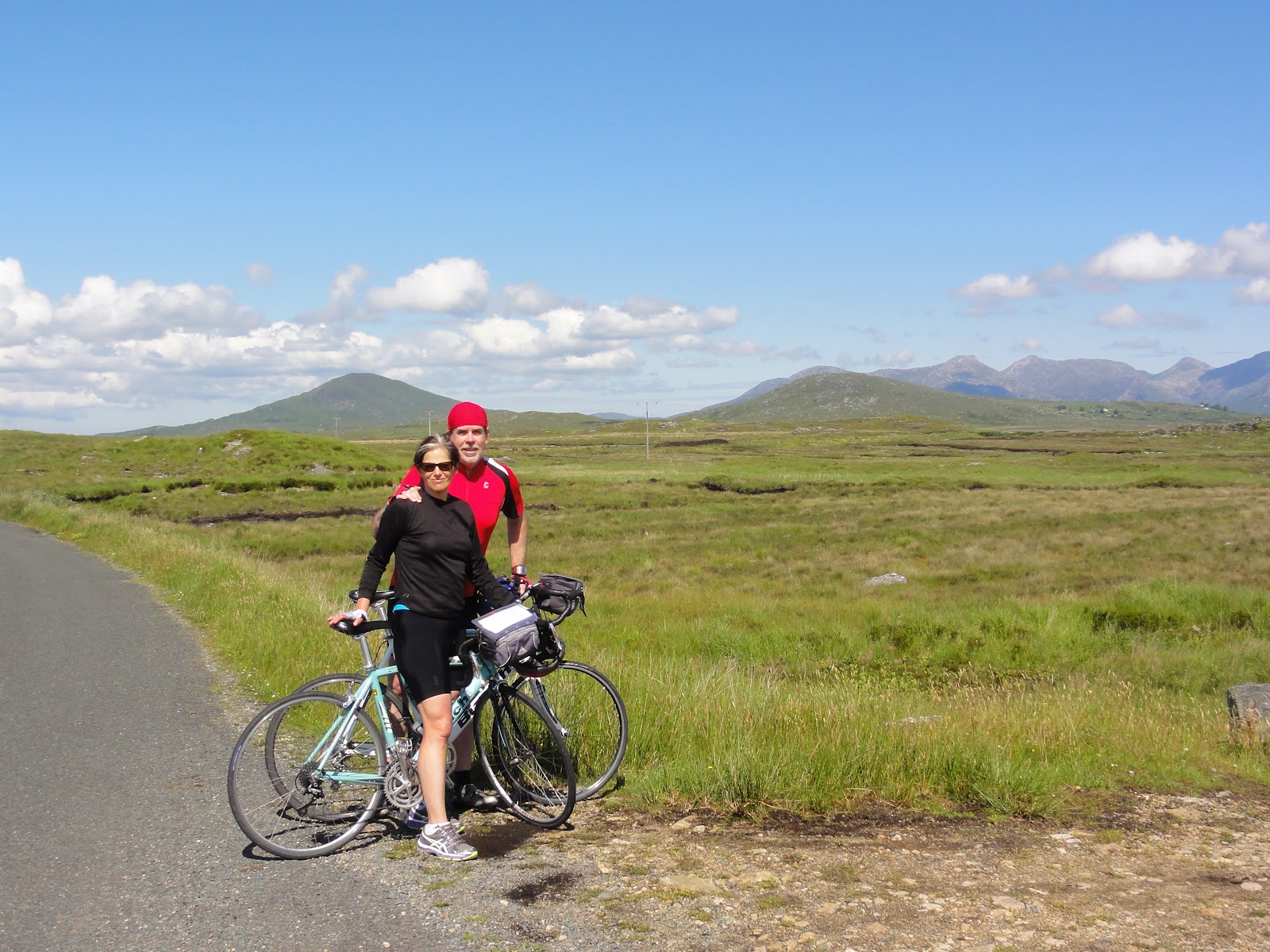
For three glorious days we wend our way through the gentle declivities and modest curves of the Connemara -- enchanted by the crystalline blue of scattered inland ponds, the felicitous harmony of grey-green rock-strewn fields, the unexpected sighting of craggy mountain peaks, the laced network of lakes and rivers flowing to the sea, and the steep ten-mile shoreline of Killarney Harbor, Ireland's only fjord.


When we regroup to refresh our palates and rest our aching body parts, a full menu of Irish delights awaits us:

*The picturesque market town of Clifden, also a dual historical oddity, the site where Guglielmo Marconi built the first long wave wireless telegraph station in 1907 and where Alcock and Brown crash landed in 1919 after completing the first trans-atlantic flight;

*In Roundstone, a visit to the world-renowned shop of the legendary Malachy Kearns, where he and his artisans handcraft Ireland's oldest product, the bodhran, a one-sided circular drum, which, when struck properly on its goatskin surface by a "tipper," emits a subtle, mystical sound;

*An amazing demonstration by sheep farmer Joe Joyce, whose trained border collie dashes up the side of a mountain, ferrets out a half dozen hidden blackface sheep, and, by bounding from side to side and nipping at their feet, directs them downhill through a gate and into a corral, whereupon Joe, wielding a pair of hand clippers, deftly proceeds to remove the fleece, in a single piece, no less, although the wool is worth only one euro per kilogram, compared to the three thousand euros Joe earns for selling one of his dogs;


*An introduction to the thousand-year-old sport of falconry, during which we learn that these noble birds can dive bomb their prey at speeds in excess of two hundred miles per hour, but in captivity are rather tame and skittish creatures, which, when launched by gentle swing of one's arm, will return promptly as if by command to an extended gloved wrist and probe the hand for a well-deserved treat;


*Accommodations at a bona fide castle, Ballynahinch, situated on four hundred fifty acres of private grounds, where our luxurious suite overlooks the Owenmore River and a idyllic walk through the forest allows us to immerse ourselves in the natural habitat and relax after a long day in the saddle;


*Our last night in Galway, along with a hundred thousand others, who swarm into the streets celebrating the last leg of the round-the-world Volvo Boat race, circulate through an ocean of dockside vendors hawking t-shirts, hoodies, hand puppets, sailor hats, jewelry, pizza, fish and chips, gelatin, and milk shakes, and party till the wee hours of the morning in the bar on the second floor of our hotel, negating our need for a wake-up call;


*As the proper complement to our daily consumption of such Irish staples as seafood chowder, salmon, mussels, mashed potatoes, fried potatoes, boiled potatoes, and brown potatoes, frequent and generous imbibing of Guinness stout, which, we learn, is dispensed in three stages, must be allowed to settle two minutes regardless of the intensity of one's thirst, and is often served with the tasty outline of a shamrock decorating the head.

For eight days our travels are enhanced by some very congenial company. The tone is set early on when our guide Henrick informs us that we will be passing through Joyce County, homeland of one of the ancient tribes of Ireland, and, coincidentally, we have a genuine Joyce among us, Ed Joyce, from Manhattan, looking for some long-lost cousins. Well, he tossed me a softball, and, ever the quipster, I can't let the opportunity slide. I profess membership in another tribe, not an Irish one.


And I'm not alone. Half our crowd is also Jewish.

There's Joel and Harriet, also from Manhattan. He's a former investment analyst who wearied of the Wall Street wars, enrolled in rabbinical school four years ago, and is now set to begin his new career teaching in a Jewish day school. When I casually mention that our Lynchburg congregation is looking for a new rabbi, Harriet -- herself an MBA with a resume in the health care industry -- is aghast at the thought, as if such a move would be as demented as cycling in a rain storm.

Then there are the four Dabs, the San Francisco Dabs, whose surname reminds me of a sixties rock group or a hair cream commercial -- Mike, a dentist, Sue, a pediatrician, and their two twenty-something daughters, Jaclyn (not JSG's Jacqueline) and Deb (Dab!). They all have beaming smiles and perfect teeth, which is not surprising, considering Mike's manual dexterity. If he handles his drill, extractor, scaler, and probe as skillfully as his i-phone/camera, sign me up for a root canal.

Ed Joyce, all six foot six inches, was raised a Catholic but converted to Judaism twenty years ago when he married his wife Linda. Maintaining their kosher diet on this trip is no easy task; shunning the ubiquitous stews and shellfish, they test the salmon salad at almost every dining establishment.

Boisterous yet sensitive, Ed reminds of my father, who never met a stranger. He's an attorney who represents Fortune 500 companies suing their insurance carriers for welching on claims -- like the one hundred fifty million dollar award he negotiated for U. S. Steel when two foundries blew up. Linda immediately earns my approbation by brandishing three novels she is reading simultaneously. Yet beneath her studied reserve lurks the flinty determination of a cancer survivor; also an attorney, she litigated a billion dollar life insurance settlement for Holocaust victims.

Poor Ed's accident prone; four years ago, when he was rowing on the Hudson River, a motorboat collision took the life of the friend seated beside him. True to form, our first day out he suffers a bad fall dodging a car pulling out of a driveway. But neither this, nor a burst tire, nor a broken gear cable can slow him down or dampen his good humor -- although the last incident requires our super fit guide Henrik to pedal the damaged bicycle three miles to the next village on basically the front wheel.

Rounding out the package are the Downes from Sacramento. Judy, the gritty seventy-two year old matriarch of the family, still works her son Jack's construction sites; this week, however, despite several valiant start-ups, the inclement weather and a nagging cough dispatch her to the sagwagon. Jack and his girl friend Kristen are high school sweethearts reconnecting for the third time, which, if their inseparability is any indication, should be the charm. Jack's sister Jody is a tall, willowy ob/gyn, as is her husband John, whose crooked gait is a stark reminder of his own horrific biking accident, when, twenty years ago, he flipped over the handlebars and broke his elbow and pelvic bone in two places. Their two teenage daughters, Jordan and Sidney, gamely keep up the pace, with hardly a grimace or complaint.

Keeping us en route, on schedule, and well-stocked with beverages and roadside snacks are our two expatriate guides. The Irishman Henrik is well-versed in his country's history, geography, and culture, and imparts his wisdom at opportune moments in a professional, unobtrusive manner. Several years ago he moved to Italy to race two-wheelers, but, as fate would have it, fell for a local beauty, and now, to support her and a prospective team of youngsters, is organizing an internet company to sell high-end bicycle equipment. His associate, Jessica, is no less adventuresome, having leaped from Kentucky to Italy, where she teaches English to elementary school students.

As JSG and I bid farewell to this land of grey and green -- our eagerly anticipated and seemingly endless vacation having come to an abrupt conclusion -- I reflect upon the remarkable changes that have overtaken my own life.


Three years ago I never thought my marriage, nor my running career, would fracture -- not to equate the two in significance; after all, as my doctor said, one can more easily divest himself of a wife than he can repair an arthritic knee.

Two years ago I never thought I would mount a bicycle, much less ride fifty miles a day in a foreign country. But now, thanks to JSG, I submit there is no better way to travel -- for exercise, sightseeing, education, camaraderie, and the joy of shared experiences.


Saturday, June 23, 2012

Blood and Mud

In a cruel twist of fate, the desultory ruler of all Russia who, by submitting to the imprecations of his military consorts and prematurely mobilizing his army in August 1914, must be deemed most responsible for the ensuing conflagration, three years later became its most prominent victim.

As centuries of repression, a thousand days of  horrendous casualties, and a cold, hungry winter -- especially in the remote capital of Petrograd -- coalesced into seething discontent, opportunistic ideologues seized the moment, humbled the Tsar, and brought the three-hundred-year reign of the Romanovs to an abrupt and ignominious end.

The masses must be fed, and thus "it was a shortage of food which provoked what came to be known as the February Revolution." (Keegan, p. 334)

Large-scale street rioting erupted in Petrograd in late February 1917. By March 8, two hundred thousand workers were crowding the center of the city, smashing shops, and fighting the outnumbered and demoralized police. (Keegan, p. 334) Cossack patrols and troops summoned to restore order joined the mob; together they pillaged the capital's huge armory, stormed the local bastilles, freed all political prisoners, and looted shops and homes like ravenous scavengers. (Marshall, p. 271)

En route from army headquarters, Tsar Nicholas II -- "weary, isolated, incapable of action" -- was given the sobering verdict by his senior military commanders, his brother, Grand Duke Nicholas, and the president of the Duma (the Russian legislature), Mikhail Rodzianko: anarchy was imminent, if not a fait accompli, and he must abdicate. The heir apparent Alexis was a hemophiliac, cursed with a constitution too delicate to bear the onerous responsibilities of despotism; the Tsar passed the crown to his younger brother, Michael, who, fearing for his own life amidst the chaos, himself renounced it. (Meyer, pp. 508-512)

Left without a head of state, the apparatus of government devolved upon two rival authorities: the Duma, dominated by thirty-six-year-old Alexander Kerensky, Minister of Justice, and the Soviet of Soldiers and Workers Deputies, an amalgam of army and industry delegates and the self-proclaimed representative body of all political parties, including the Marxist Mensheviks and Bolsheviks.

The Duma established a Provisional Government; but since the Soviet retained veto power, had infiltrated the army, and controlled the railroads and the postal service, it effectively determined military, diplomatic, and economic policy. (Keegan, p. 336)

The two did agree on one course of action: the war with Germany must be continued -- the Provisional Government because it could rally nationalistic fervor to its own cause, and the Soviet because it feared defeat would sabotage the revolution. The only supporters of immediate peace were the Bolsheviks, and their leaders -- Lenin, Trotsky, Bukharin -- languished in exile. (Keegan, p. 336)


But not for long. A Lenin emissary obtained an audience with German commanders Erich Ludendorff and Paul von Hindenberg, and persuaded them that "the way to get Russia out of the war was to send Lenin to spread poison against the Provisional Government." (Marshall, p. 322) Traveling aboard a sealed train -- with guaranteed extraterritorial rights, no inspection of passports, no examination of luggage, no ingress or egress -- Lenin with thirty-two compatriots arrived in Petrograd on April 16 to great fanfare. "He immediately began maneuvering his followers into an antiwar stance calculated to take advantage of public discontent." (Meyer, p. 537)

On the battlefield, despite desperate efforts to preserve morale, Russian fighting capability was rapidly deteriorating. When Kerensky abolished the death penalty for desertion, a million men threw down their weapons -- lured homeward by the promise of land distribution. Behind the line officers and soldiers were shooting each other.

Nevertheless, on July 1, Kerensky ordered his new commander-in-chief, General Aleksei Brusilov -- the hero of the previous year -- to send his motley army once more against the exhausted Austrians. "For two days all went well and several miles of ground were gained. Then the leading units, feeling they had done their bit, refused to persist, while those behind refused to take their place." When the counterattack came, it was more than the Russian soldiers were able or willing to bear. Looting and rape were rampant, as they broke and fled. (Keegan, p. 338)

"On July 8 the Russian Eighth Army essentially went out of existence . . . By July 19 it was the Germans who were advancing, driving a disorderly mob of Russians before them." (Meyer, p. 562) Within two weeks the aggressors had captured Riga, the most important harbor city on the Baltic Coast.

The debacle ruined Brusilov -- who was replaced by General Lavr Kornilov, an outspoken proponent of the war effort. A discredited Kerensky barely survived an abortive rebellion by dissident elements of the Petrograd garrison who, incited by the Bolsheviks, took to the streets to protest a directive sending them to the front.

In September Kornilov attempted to take power himself; his coup failed when his soldiers refused his orders to march on Petrograd. "His fall ended any chance of sustaining the fiction that Russia was still fighting a war. The Provisional Government lost what remained of its authority in the aftermath, since Kerensky's dismissal of Kornilov cost him what support he retained among moderates and senior officers and earned him none from the left." (Keegan, p. 340)

This atmosphere of mounting chaos revived the fortunes of the Bolsheviks. (Stevenson, p. 288) Between July and October their membership rolls swelled from 200,000 to 300,000, and they secured voting majorities in the Petrograd and Moscow Soviets. In September, with the Germans threatening Petrograd from the northern Baltic, they organized their own Red Guard paramilitary force.

Kerensky mistakenly believed he would prevail in a confrontation with the Bolsheviks -- just as he had in July. When he again announced plans to transfer the Petrograd garrison to the front, its regiments responded with this resolution: "We no longer recognize the Provisional Government. The Petrograd Soviet is our Government." (Marshall, p. 326) When he attempted to close two Bolshevik newspapers, on November 6 Lenin's Red Guards -- obeying his exhortation that the hour demanded action -- seized the post offices, telephone exchanges, railway system, bridges, and banks. The next day they easily occupied the Provisional Government's headquarters in the Winter Palace, where no troops were willing to defend the ministers or Kerensky. (Stevenson, p. 312)

On November 8 Lenin announced the formation of a new government, the Council of People's Commissars; its first acts were to proclaim the "socialisation" of land and to issue an appeal for peace, which would commence with a three-month armistice. (Keegan, p. 341)

Ordered to initiate discussions with the enemy for a cessation of hostilities, General N. N. Dukhonin (Kornilov's successor) refused to comply. The newly-appointed People's Commissar for War, Nikolai Krylenko, rounded up a crowd of mutinous sailors; they sped to Dukhonin's headquarters, tore off his epaulets, dragged him from his railway car, and shot him. It was a defining moment of the embryonic revolution, and a harbinger of the endemic brutality that was to follow. (Marshall, p. 327)

Wary of dealing with insurrectionists who were calling for the workers of all lands to rise against the ruling classes (although they indeed had facilitated their triumph), the Germans and Austrians were reluctant to acknowledge Lenin's Peace Decree. When world revolution failed to materialize, the Germans decided to respond, and in doing so bolstered the Bolsheviks' legitimacy.

"On December 3 their delegation, and those of Austria, Turkey, and Bulgaria, met Soviet representatives at Brest-Litovsk, the Polish fortress town on the River Bug, which had been lost by the Russians in 1915. Discussions, frequently adjourned, dragged on into 1918." Over the objections of General Max Hoffmann and Foreign Secretary Baron Richard von Kuhlmann -- who urged conciliation -- Ludendorff prevailed upon the Kaiser to demand the separation of Poland from Russia, the annexation of the Baltic provinces, and even the division of the Romanov expanse into four independent entities -- a truncated Russian proper, Ukraine, Siberia, and a South East area. (Keegan, p. 341)

Both sides lost patience. Leon Trotsky, now negotiating for the Russians, threw up his hands and walked out in disgust. On February 17, 1918, the Germans terminated the armistice and mobilized fifty divisions on the Eastern Front. Unimpeded, the spearheads advanced one hundred fifty miles in five days, capturing three thousand guns, an army of prisoners, and enough rolling stock to double their capacity. (Marshall, p. 333) Lenin, apprehending the loss of Petrograd and the demise of his fledgling empire, relocated the capital to Moscow. Panic-stricken, he resisted Trotsky's entreaties to recommence hostilities and ordered his delegation back to Brest-Litovsk. (Meyer, p. 620)

On March 3 the Russians signed one of the most punitive peace treaties in history. Under its terms, they relinquished territory that encompassed seven hundred thousand square miles, one-third of their population (fifty million people), rail system, and farmland, half of their industry, and over three-fourths of their iron ore and coal reserves. (Meyer, p. 621)

But the victors suffered more than the vanquished. Their administration of this doomed, unmanageable region would require one and a half million troops -- when every available man, gun, and locomotive was needed on the Western Front. The Ukraine breadbasket never produced more than ten per cent of what had been anticipated, while the hungry occupiers consumed thirty rail cars of food daily. Russia's dismemberment at the hands of a victorious and ruthless enemy became a powerful motivation for Britain and France to fight on, regardless of the cost in blood and treasure, in order to avoid a similar humiliation. (Meyer, p. 621)

"As Imperial Russia tottered toward dissolution," and eventual abandonment of its allies, Germany committed two egregious blunders that would provoke and then propel a much more formidable foe into the cauldron. (Marshall, p. 275)

The fateful act had not been inevitable. During 1916 U. S. President Woodrow Wilson had made a determined but fruitless effort to induce the combatants to enter into negotiations on terms he regarded as fair. In 1915 he had convinced Germany to suspend its program of unrestricted submarine warfare by threatening to use American naval power to preserve freedom of the seas. There was little enthusiasm for war among his fellow citizens, particularly those of German descent, who through the German-American Bund campaigned against it. (Keegan, pp. 350-351)

Sinking merchant shipping in international waters by gunfire or torpedo without warning or assisting the crew in evacuation was a breach of maritime law. Endorsed by Ludendorff, its proponent was Admiral Henning von Holtzendorff, chief of the German naval staff; he contended that not only would sinking six hundred thousand tons of Allied, but largely British, shipping a month quickly bring Britain to the brink of starvation, it was also a strategic imperative, lest Germany's capacity to continue the war be exhausted by blockade and attrition. (Keegan, p. 351)

Indeed, from February 1917, when unrestricted attacks by U-boats resumed, sinkings rose from three hundred thousand tons a month to terrifying levels, reaching eight hundred sixty thousand tons in April -- and only began to decline when convoying was implemented the next month. (Marshall, p. 277)

The political repercussions swiftly mushroomed into uncompromising belligerency. On February 3, President Wilson severed diplomatic relations with Germany. On February 26, he requested permission from Congress to arm American merchant ships -- the same day two American women drowned when a submarine sunk the Cunard liner Laconia.

Two days later, with Wilson's blessing, Secretary of State Robert Lansing, released to the press the infamous Zimmerman telegram, which British Naval Intelligence had intercepted on January 17. In unequivocal language, German Foreign Secretary Arthur Zimmerman, a self-styled authority on American politics and culture, proposed, through his ambassador in Mexico City, a German alliance that would enable a victorious Mexico to reclaim its lost territory in Texas, New Mexico, and Arizona. He also suggested that the President of Mexico solicit Japan to switch sides in order to fight against the United States.

The whole idea was preposterous. "Mexico had no cogent military power. Overrun by revolutionaries, she was on the verge of anarchy." (Marshall, p. 276)

When some officials found the telegram too outrageous to be credible and war opponents denounced it as a fraud, Zimmerman compounded his audacity by blithely verifying its authenticity. (Marshall, pp. 276-277)


On March 18, three American ships were torpedoed by U-boats. Two days later Wilson polled his Cabinet; their unanimity was damning. On April 2, the President told Congress that the country "could not choose the path of submission . . . The world must be made safe for democracy." (Marshall, pp. 280-281) On April 6, the United States declared war on Germany by a vote of eighty-two to six in the Senate, three hundred seventy-three to fifty in the House. (Meyer, p. 521)

"Victory is certain . . . We will win it all within twenty-four to forty-eight hours," said the confident, charming new French commander, Robert Nivelle -- the presumptive hero of Verdun -- in describing his plans to British Prime Minister, David Lloyd George. (Marshall, p. 287)

Since the Somme offered no suitable terrain for an abrupt breakthrough, Nivelle would attack on both sides of the river, aiming at the shoulders of the great German salient pointing southwest. While the British struck from the north at Arras against Vimy Ridge, one million two hundred Frenchmen -- three armies, twenty-seven divisions -- would deliver the death blow, or Mass of Maneuver, across the Aisne River against Chemin des Dames. New artillery tactics "would drench the German defenses with fire 'across the whole depth of the enemy position,' destroying trenches, stunning the defenders," and producing the convulsive "rupture." (Keegan, pp. 322-323)

By the time the Germans intercepted a cable disclosing the time and place of the attack, they were already engaged in one of the most daring, improbable tactical moves of the war. Named for a fiendish dwarf-king in Nibelung mythology, Operation Alberich was no less than a massive withdrawal from the Oise salient, a voluntary abandonment of one thousand square miles of conquered territory, and a brilliant contraction of their defensive front, in that it released thirteen divisions and fifty batteries of artillery for use elsewhere. (Meyer, pp. 492-493)

As they retreated, "the Germans systematically vandalized the landscape, pulling down thousands of homes, felling every orchard tree, burning forests, poisoning wells and reservoirs, demolishing bridges and rail lines, and wiping out roadways." (Marshall, p. 289)

The restructured Hindenburg Line elevated defensive warfare to a standard of invulnerability almost inconceivable even in this theater of stalemate. It consisted of, in order, an unoccupied trench line ten feet deep and twelve feet across; five or more rows of barbed or razor wire, concrete blockhouses manned by machine-gun crews, and underground chambers twenty-five feet deep and impregnable to artillery and bombs; and finally two rows of guns each a mile back and sited on reverse slopes wherever possible. (Meyer, p. 495)

This network was complemented by a doctrine which positioned front line defenders beyond the reach of enemy mortars and light artillery, and reserves even further to the rear, where they could counterattack enemy infantry when they had outdistanced their own artillery coverage. (Meyer, p. 494)

In accord with the "Nivelle system," the preliminary bombardment was shorter in duration but double in weight (twenty-eight hundred guns, over two-and-a-half million shells) to that delivered at the Somme the previous July.


Early on the morning of April 9, the infantry of the Canadian Corps, four divisions strong, "moved undetected to within a hundred and fifty yards of the German defenses through a maze of sewers and tunnels that honeycombed the earth beneath Arras." (Meyer, pp. 530-531) Upon emerging, they advanced swiftly under the protection of a perfectly-timed creeping barrage to a depth of up to three miles, claimed nine thousand prisoners, and stormed the slopes of Vimy Ridge; from the summit, the whole Douai plain, crammed with German artillery and reserves, lay open before them. Then, with victory within their grasp, they became bogged down in knee-deep mud and, inevitably, were halted by a predicated pause. (Keegan, pp. 325-326)

The next day the first German reserves appeared to plug the gap. An Australian division ran up against uncut wire which the handful of accompanying tanks could not penetrate. "An intermission was ordered, to allow casualties to be replaced and the troops to recover . . . When the battle was resumed on April 23, the Germans had reorganized and reinforced and were ready to counterattack in every sector." (Keegan, p. 326)

Field Marshal Douglas Haig labored on for several more weeks, partly to support Nivelle, partly encouraged by his initial success. "By the time it all ended, the Germans had taken one hundred eighty thousand casualties, Haig's armies a hundred fifty-eight thousand. Back in London, Lloyd George could not contain his disgust at the expenditure of so many men for such limited results." (Meyer, p. 532)


Scoffing at the pessimistic prognostications of his army group commander, General Alfred Micheler, and Minister of War Paul Painleve, the bombastic Nivelle launched his own attack against the southern shoulder of the salient at 6:00 o'clock on the morning of April 16. "From start to finish it was a contest between an offensive of the most conventional kind -- more than a week of intense artillery preparation, massed formations of infantry slogging in plain view -- and the Germans' new defense in depth: wide, deep trenches, acres of treacherous wire, well-protected machine guns, and reserves positioned far beyond the reach of Nivelle's batteries." (Meyer, pp. 534-535)

Even if the assault forces should reach their objective, they would be too weary and battered to resist the fresh troops looming before them. (Keegan, p. 327)

An encouraging jump-off soon disintegrated into a massacre too reminiscent of the Somme. Cold rain turned to sleet, and then snow -- obscuring the field and slowing the pace of the advance. "Machine guns -- scattered in shell holes, concentrated in nests, suddenly appearing at the mouths of deep dugouts or caves -- took a murderous toll on troops struggling up the rugged slopes." The creeping barrage, by which the infantry should have been protected, soon left them behind -- and dangerously exposed. "Men pulling themselves up by clinging to the stumps of trees were impeded by wire obstacles of every conceivable variation." (Keegan, p. 328)

Tanks might have broken the wire, but, of the one hundred twenty-eight Renault two-man models thrown into the fight -- the first to be so deployed by the French -- thirty-two were blown to bits, twenty-eight failed mechanically, and the rest bogged down in the mud. (Keegan, p. 329)

Well-rested German reserves sent the French vanguards reeling back to their starting point.

Nivelle had predicted a penetration of eight thousand yards the first day; but when darkness fell, his line had advanced only six hundred. On the third day the Chemin des Dame road, crossing the ridge, was reached, but the decisive high ground remained unobtainable.

Nivelle had promised to shut down his offensive if a breakthrough was not achieved in forty-eight hours, but like so many deluded generals who had traversed the same ground before him he stubbornly persisted -- for ten days, at a cost of two hundred thousand men. Finally, French President Poincare ordered an end to the bloodbath, sacked Nivelle, and replaced him with Henri Petain. (Keegan, p. 329)

Dispirited, disgusted, demoralized, French soldiers "rioted, threw down their rifles, and set up committees to replace their officers. In some cases they deserted their stations en masse and ran off rearward, stood their ground sullenly, or fell in so drunk they could not march." (Marshall, p. 292)

Whatever the movement was called -- mutiny, strike, or, in the government's euphemistic phraseology, "collective indiscipline" -- it was a spontaneous declaration by the troops that they could no longer subsist in intolerable conditions nor continue to be sacrificed to no purpose. (Meyer, p. 541)

Petain acted quickly and firmly, while maintaining an admirable balance between severe punishment and compassionate leniency. Ringleaders were identified, arrested, and brought to trial. Approximately five hundred were sentenced to death, although only forty-nine were executed. Hundreds of others were imprisoned or exiled to French colonies. (Meyer, p. 541)

On the other side of the ledger, Petain did not ignore the abuses that had sparked the rebellion. His men were demanding better food, decent shelter for those not on the front line, fairness in the granting of leave, and an end to the pointless offensives that had squandered so many lives. He promised to address those demands, and he saw to it that his promises were kept. (Meyer, p. 541)

Whether because of his initiatives, or simply because it was so thoroughly shaken, the French Army did not attack nor actively defend any of the sectors on the Western Front -- of which it held two-thirds -- between June 1917 and July 1918.

Two and one-half million soldiers had been killed on that Front; total casualties had reached an astronomical seven million. The one man not discouraged by the carnage was British Field Marshall Sir Douglas Haig. (Marshall, p. 299)

Fueled by reports from his consistently optimistic intelligence chief, General John Charteris -- Germany was riddled with strikes and unrest, troop morale was falling, the army was on its last legs -- the indomitable Haig believed a major victory was within his grasp. (Hochschild, p. 277) He and his staff devised a plan that would combine a new offensive out of the Ypres salient with an amphibious landing along the Belgian coast. Compelled to surrender its U-boat ports, Germany would be exposed on two fronts.

Haig needed an anchor for his Ypres attack and a hammer to convince doubters that his strategy was feasible; Second Army commander Sir Herbert Plumer gave him the Messines Ridge, from which German artillery spotters had long dominated the area.

By May Plumer's tunneling companies had driven forward under the ridge nineteen galleries -- some half a mile long and a hundred feet deep -- and packed the end chambers with a million tons of explosives. On the morning of June 7, after a week of bombardment by the heaviest concentration of artillery on any front up to that time, the mines were detonated. (Meyer, pp. 556-557) "Lloyd George, working in his study at 10 Downing Street, heard the rumble and felt the quake." (Marshall, p. 300-301)

Plumer's nine infantry divisions stormed the ridge, which had been transfigured into giant craters seventy feet deep, overwhelmed the shell-shocked survivors -- more than twenty thousand men had been killed or maimed -- and took possession of the remnants of the German trenches with negligible casualties. (Meyer, p. 558)

The success at Messines Ridge did nothing to ease Prime Minister Lloyd George's conscience. "He summoned Haig to a June 19 meeting with his recently created Cabinet Committee on War Policy." (Meyer, p. 558)

He was relentless in his interrogation and criticism. "He wanted to know why the generals believed a Flanders offensive could succeed this time, what their estimate of casualties was, how the enemy's forces were disposed, and what the consequences of failure might be." (Meyer, p. 559) He lobbied for delay -- since the Americans were coming -- and proposed a series of small attacks rather than a possible repetition of the Somme. In the end, he yielded without being convinced; unable "to impose his strategical views on his military advisers, he was obliged to accept theirs." (Keegan, p. 358)

The requisite bombardment began on July 15. For two weeks, along fifteen miles of front, three thousand guns -- more than double the density at the Somme -- fired off four million shells weighing sixty-five thousand tons -- four times the quantity at the Somme; the German Fourth Army incurred thirty thousand casualties before the British moved single step. (Meyer, p. 571)

The Flanders position was one of the most formidable on the Western Front. "From the low heights of Passchendaele, Broodseinde, and Gheluvelt, the enemy front line looked down on an almost level  plain from which three years of constant shelling had removed almost every trace of vegetation." Nine layers of defense awaited the oncoming hordes: a line of listening posts, three of breastworks sheltering the first resisters, a battle zone of machine gun posts and pillboxes, and finally counterattack units ensconced in concrete bunkers alongside artillery batteries. (Keegan, p. 358)

To this impenetrable barrier nature had added another ghastly complication: the water table on the plain was less than two feet below ground. The heavy rains of late summer would frequently flood the area, churning it into a bottomless, gluey, muddy mess. To make matters worse, Haig's bombardment destroyed the few remaining canals and drainage ditches, and hollowed out thousands of craters that quickly filled with water. (Meyer, p. 555)

As a result, one gruesome fact was to separate Passchendaele from the great paroxysms of bloodshed that preceded it: "in addition to falling victim to German fire, thousands of British soldiers, nowhere near the sea, drowned." (Hochschild, p. 285)


"The offensive went off at 3:50 A.M. on July 31, with seventeen Entente divisions advancing and seventeen waiting in the rear" -- a total of nearly half a million men. "Ten divisions of Hubert Gough's Fifth Army were the battering ram, their assignment to force the Germans back and set the stage for reserves to come forward." (Meyer, p. 575)

Those units managed to fight their way through the first German zone and into the second, penetrating as far as two miles at some points. Then, at two in the afternoon, the Germans opened fire with field guns positioned on elevated ground to the north and south of the newly-created salient. "To the rain of shells was added a ferocious downpour which soon turned the broken battlefield to soupy mud." (Keegan, p. 361) The British suffered heavy losses and were forced to pull back. (Meyer, p. 575)

"Rain was falling in torrents when Haig resumed his attack on August 2. With the Flanders drainage system in ruins, every hole filled with water and the ground became a morass to a depth no man's foot could reach." (Meyer, p. 576)

"Guns could barely be moved, and mules and horses pulling ammunition wagons sank up to their stomachs and had to be dug out. Ambulances carrying wounded soldiers skidded off slippery roads . . . Cold-weather greatcoats that were not waterproof absorbed mud and water like a sponge, adding up to thirty-four pounds to their weight." Wounded men who crawled into shell holes for safety were buried under water. (Hochschild, pp. 285-286)

To the fear of drowning was added new horror: mustard gas. "No mask was proof against it. It burned through clothing,worked its way into flesh, destroyed vision and choked out life." (Marshall, p. 322) "The worst off were soldiers who had breathed droplets in the air, for their blisters were internal, gradually swelling to seal throats and bronchial tubes fatally shut, a process that might take as long as four or five weeks." (Hochschild, p. 287)

On August 4, with the number of French and British casualties up to sixty-eight thousand, Haig finally ordered a halt until the rain stopped and the ground could dry out. (Meyer, p. 576)

Haig was determined to continue no matter how high his losses mounted or how soaked the battlefield became. A series of assaults on the Gheluvelt Plateau which gained little ended the first phase of the Third Battle of Ypres. In three and a half weeks troops had advanced two miles -- under "constant exposure to enemy view in a landscape swept bare of buildings and vegetation, sodden with rain and in wide areas actually under water, onto which well-aimed shellfire fell almost without pause." (Keegan, p. 365)

The weight of the campaign now shifted to the wily veteran, Sir Hubert Plumer, and his Second Army. Plumer adopted a "bite and hold" approach, in which, after a long, intense bombardment, soldiers would advance in fifteen hundred yard stages -- not far enough to trigger a counterattack -- capture the thinly-manned forward ground, and hastily entrench themselves. These tactics produced remarkable successes at Menin Road on September 20, at Polygon Road on September 26, and at Broodseinde on October 4. (Keegan,p. 365)

The last was a day of disaster for the Germans. Desperate to counter Plumer's scheme, they positioned substantial numbers in a strong forward line to block any easy initial gains. Having a mere handful of days to construct adequate defenses, they were slaughtered wholesale by Plumer's barrage, as were their reserves, also located well within artillery range. (Meyer, p. 580)

Deliverance came from the heavens -- a downpour that turned Flanders into "an enormous shallow lake; every shell hole and piece of low ground filled to the brim." Plumer and Gough advised shutting down the campaign, but Haig would not hear of it. Since Plumer was now deployed along a line that would be difficult to hold during the coming winter, and a withdrawal to higher ground was for Haig unthinkable, the only acceptable course, he declared, was to push forward to Passchendaele Ridge. (Meyer, pp. 581-582)

"Virtually every British division in the Ypres salient having been reduced to tatters, the lead role would be assumed by divisions from the Commonwealth" -- ANZACS (Australians and New Zealanders) and Canadians." (Meyer, p. 582)

In what was called the First Battle of Passchendaele, the ANZACS tried on October 12 to reach the trenches and pillboxes on the highest point of ground east of Ypres, one hundred fifty feet above sea level, the last obstacle between the British and the German rear. The conditions were impossible. Standing water or mud covered everything. Guns, an entire railway, pack mules all sunk out of sight; shells disappeared without exploding because the surface had become too soft to activate their fuses. "Caught in front and flank by machine-gun fire, the ANZACS eventually retreated to the positions from which they had set out on that sodden day." (Keegan, p. 367)

Ordered to attack the ridge on October 26, Canadian Corps commander Sir Arthur Currie predicted it would cost him sixteen thousand men; he overestimated by three hundred. In four separate assaults, the last on November 6, under pounding rain, his troops finally drove the Germans off a large enough portion of Passchendaele Ridge for Haig to claim a Pyrrhic victory. Nearly seventy thousand of his soldiers had been killed in the muddy wastes of the Ypres battlefield and over one hundred seventy thousand wounded -- to conquer four and a half miles. (Keegan, pp. 367-368)

The patently meaningless sacrifice of the Canadians prompted their Prime Minister, Sir Robert Borden, to seize Lloyd George by the lapels and shake him. (Hochschild, p. 287) But it was left to Lloyd George to pronounce the fitting epitaph on this hellish swampland: "Blood and mud, blood and mud, they can think of nothing better." (Meyer, p. 571)

Haig was not done. On November 20, near Cambrai, east of the old Arras battlefield, he sent nineteen divisions and the largest force of tanks yet assembled against a thinly defended section of the Hindenburg Line. "Within four hours the attackers had advanced in many places to a depth of four miles at almost no cost in casualties."

But the commander of the division assigned to the center of the formation, General G. M. Harper, did not like tanks; he believed they attracted enemy artillery fire, and thus he kept his infantry too far to the rear to cover those in his sector. Many were destroyed by trained sharpshooters. While on the left and right the whole German position had been penetrated, a clear-cut breakthrough was stymied. (Keegan, pp. 370-371) "On November 30 a counterattack by twenty German divisions recovered almost all the lost ground." (Meyer, p. 587)

With the Russians in revolution, the French in disarray, the British mired in Flanders, a fourth Allied army would effectively capitulate before the nightmarish clock ran out on 1917. Italy had been lured into the Entente by the promise of territorial spoils in Trentino, Istria, and Dalmatia; even before disaster struck, it had paid mightily for its greed. Its army was ill-equipped, untrained, and ineptly led; its Chief of Staff, the imperious, tyrannical General Luigi Cadorna, seriously advocated the shooting of every tenth man in units that failed to perform to his satisfaction.

The object of Cadorna's series of campaigns, the bridgehead of the Isonzo River at the fortress city of Gorizia, was guarded in the north by the Bainsizza plateau and on the south by the Carso plateau -- "a howling wilderness of stones sharp as knives." Thus, while the Italians usually outnumbered their Austrian foes, often by as much as two to one, their statistical superiority was negated by a mountainous terrain which constricted operations and allowed the Austrians to dominate the elevated positions. It was a topographical problem that defied solution; for the Italian Army every maneuver became a backbreaking struggle upgrade. (Marshall, p. 173-174)

There had been four Italian offensives in 1915 -- the First, Second, Third, and Fourth Battles of the Isonzo -- "all staged in the same area, all monotonously ineffective, all mournfully wasteful." For a few worthless acres of soil, in repeated forlorn attempts to scale the towering crags and gain the Ljubljana Pass, the Italians had spent the blood of a quarter million soldiers. (Marshall, pp. 174-175)

Two more Battles of the Isonzo (the Tenth and Eleventh, all told) in May and August 1917 had cost Cadorna another two hundred eighty thousand casualties. Austria's losses had been commensurate. Warned by his generals that his army was unlikely to survive another Isonzo, Emperor Karl appealed directly to Kaiser Wilhelm for reinforcements. Ludendorff appropriated infantry, artillery, and aircraft from units stationed in the Baltic, Romania, and Alsace-Lorraine, and reluctantly created a new German Fourteenth Army. He sent it southward under the veteran Otto von Below with orders to stabilize the Italian front. (Meyer, pp. 583-584)


Cadorna had left himself dangerously exposed to entrapment. "By pushing across the Isonzo, but not far enough, he had left two bridgeheads in the enemy's hands, which offered them the opportunity to drive down the valley from north and south and link up behind the whole Italian Army." He had kept "his front line full of troops, where they were most likely to be cut off, and positioned his reserves too near the rear, whence they would have difficulty arriving at the front in the event of a crisis." (Keegan, p. 347)

Italian gas masks were known to be ineffective. A preliminary bombardment of mustard gas followed by explosives wreaked havoc in the Italian trenches. Then, on the morning of October 24, two point divisions attacked north and south along the Isonzo toward Caporetto. Employing innovative infiltration tactics, the Germans and the Austrians pierced the steep defile of the river valley, bypassed enemy strongholds, and carved out an enormous fifteen-mile gap in the Italian front. (Keegan, p. 348)

Among those in the vanguard was company commander Erwin Rommel. Thrusting beyond his flanking contacts, he broke through a key height in the Italian rear, and eventually captured an entire regiment singlehandedly. (Keegan, pp. 348-349)

Four Italian divisions were isolated and surrounded. Larger concentrations of troops north and south were threatened by the deep German penetration. By the third day of the battle the whole front had collapsed. Hundreds of thousands of soldiers streamed down from the mountain in headlong retreat. The Austrians were astonished to encounter organized units marching toward them into captivity. (Keegan, p. 349)

"Below's instructions were to proceed no farther than the Tagliamento River, which flows southward into the Adriatic west of the Isonzo, but his forces attained that objective so quickly that they pushed on in hot pursuit." The Italians continued to flee until they reached the Piave River twenty miles beyond the Tagliamento. There, on November 3, Below, having outrun his lines of supply and facing the onset of winter, ordered a halt. (Meyer, p. 584)

He had advanced eighty miles in eleven days, collected two hundred sixty-five thousand prisoners, conducted one of the war's most spectacular campaigns, toppled a government, and inflicted irreparable harm to the reputation of the Italian Army, from which it was never able to recover. It was the crowning blow to Italy's Great War misadventure, whose final toll was six hundred thousand lives. (Meyer, p. 585)

Though battered and exhausted, the Entente Powers could look westward to their potent new ally for renewed energy and fresh manpower. The looming question for the new year was whether Germany could muster enough of their own in time to render the advent of America too little and too late.

REFERENCES

Hochschild, Adam. To End All Wars: A Story of Loyalty and Rebellion 1914-1918. New York: Houghton Mifflin Harcourt, 2011.

Marshall, S. L. A. World War I. Boston: Houghton Mifflin Company, 1964.

Meyer, G. J.  A World Undone: The Story of the Great War. New York: Delacorte Press, 2006.

Keegan, John. The First World War. New York: Alfred A. Knopf, 1999.

Stevenson, David. Cataclysm: The First World War as Political Tragedy. New York: Basic Books, 2004.


Monday, May 28, 2012

Europe is Mad

Despite the previous year's series of "disappointments punctuated by disasters" -- the rout of Serbia, Russia's loss of Poland and Galicia, the ghastly slaughter on the Western Front which had accomplished little -- the Entente Powers entered 1916 optimistic that the tide of the Great War could be turned in their favor. (Meyer, p. 363)

Italy, hoping to acquire territorial spoils in exchange for opening a new front, had been enticed to declare war on Austria on May 23, 1915. The battered Russians were restocking their ranks with fresh conscripts, and by spring would have two million men in the field, most of them adequately equipped thanks to a notable manufacturing expansion. The French had increased their output of shells, field guns, rifles, and explosives sixfold, and by skillful reorganization and deployment of soldiers from the rear had formed twenty-five new divisions. (Keegan, pp. 275-276) With nearly a million men on the continent -- a number that was growing at the rate of one hundred thousand a month -- "the little army with which Britain had begun the war" had metastasized beyond recognition. (Meyer, p. 364)

It was an inevitable statistical inferiority that guaranteed ultimate exhaustion and a death sentence should the German leadership continue to pursue a defensive strategy, no matter how effectively it was conducted

Concluding that Russia's "offensive powers" had been shattered and that she was on the verge of revolution and collapse, in a letter to Kaiser Wilhelm on Christmas Day 1915, Chief of the General Staff Erich von Falkenhayn maintained that Great Britain -- the world's dominant industrial and maritime power, and now Germany's archenemy and principal threat -- must be persuaded by a demonstration of brute force that victory was beyond its grasp and that it should lay down its arms. (Meyer, pp. 366-367)

He proposed the resumption of unrestricted submarine warfare to deprive Britain of vital foodstuffs and supplies and a concentrated operation designed to remove her "nearest and most important ally, France, from the war." (Meyer, p. 368) While he understood "that the fortified front could not be decisively penetrated," Falkenhayn argued "that France's will could be broken in one great battle of attrition . . . a battle so terrible in its dimensions, so shattering in its impact on both camps," that her people would be convinced that further resistance was futile. (Marshall, pp. 235-236)

Falkenhayn's plan was to lure the French into a German killing machine where they would "bleed to death" --  "to threaten some piece of ground they would do anything to hold," even in the face of overwhelming artillery. Such a "vital point" was the fortress of Verdun -- an isolated spear point jutting into the German line only twelve miles from rail supply. It had been a bone of contention between the two countries for many years, a cherished symbol of nationalism the French would fervently defend. It lay conveniently in the path of the German Fifth Army, which was commanded by Crown Prince Wilhelm, upon whom all accolades for victory would devolve. (Meyer, pp. 368-369)

The preliminary logistics were prodigious, and made even more remarkable in that they remained largely invisible to the French, which in part can be attributed to the hilly, wooded countryside and the cloudy winter weather of the region. Between late December and early February Falkenhayn amassed on the east bank of the Meuse River a hundred and fifty thousand men and over eight hundred guns, some capable of throwing one-ton projectiles. Five new railway lines were constructed across the Fifth Army's occupied zone to deliver weapons and ammunition. Thirteen hundred trains hauled in 2.5 million shells. (Meyer, pp. 372-373)

Falkenhayn's diabolical plan was not to capture Verdun but to bring the French within range of his artillery and then "bleed them white." His perverse logic was dismissive of the quick breakthrough that might compel them to retreat. Thus he would limit the first day's attack to a narrow front of only five to seven miles; he would wait until the end of the day to engage his infantry; and he would advance on the east bank of the Meuse only. He ignored his subordinates' contentions that the French were more vulnerable on the west bank and that his troops would be exposed to enemy artillery situated there. (Meyer, pp.373-374)

"Verdun was no longer an entrenched camp." (Marshall, p. 239) Having seen the speed with which the Germans had destroyed the fortresses at Liege and Namur, French commander Joffre had lost faith in such fortifications and had gradually stripped Verdun of guns and manpower. Only the warnings of aged General Herr, military governor of the region, and the meticulous preparations of Lieutenant Colonel Emile Driant, commander of two battalions in the hilly Bois de Caures, directly opposite the German lines -- both of whom had detected intensified enemy activity -- enabled the French to mount an effective resistance. Herr was able to muster thirty-five thousand men at the anticipated point of attack; Driant's thirteen hundred would bear the brunt of it. (Meyer, pp. 369-372)

Other than nationalistic sentimentality for this architectural landmark and historical anachronism, there was no reason to expend an army to defend Verdun. It had ceased to be "an indispensable anchor of the allied front . . . The north-facing forts would have been useless to the Germans. There were no great stores of materiel present to change hands." (Marshall, p. 242)

In fact, "historians have argued that the French would have wiser to abandon Verdun, fall back on the hill country to the southwest, and oblige the Germans to settle for a symbolic victory of minor strategic value." Meyer, pp. 380-381) Instead both were sucked into a maelstrom that in its length, cost, brutality, and sheer pointlessness became a microcosm of the war itself. (Meyer, p. 380)


Beginning early on the morning of February 21 and continuing into the next day, over a six-mile front, two million shells were thrown at the narrow triangle defined by Brabant, Ornes, and Verdun -- fired at the rate of 100,000 rounds per hour, mixing shrapnel, high explosives, and poison gas, obliterating the French forward trenches. (Marshall, p. 244)

"During the first day's bombardment an estimated eighty thousand shells fell on the Bois des Caures; on the second morning thousands more came screaming down." Finding his position nearly surrounded, Driant ordered a withdrawal, during which he was shot in the forehead. (Meyer, p. 381) Only seven wounded lieutenants and one hundred Chasseurs would survive his command. (Marshall, p. 244)

French deaths exceeded twenty-three thousand in the first five days compared to fewer than two thousand reported by the Germans. It was a rare instance of defenders suffering substantially heavier losses than their attackers. Falkenhayn's tactics seemed to be working. (Meyer, p. 383)

Displaying an astonishing willingness to die rather than surrender or retreat, the French held their ground for three days. Then, on February 24, the Germans stormed their secondary system of trenches, occupied the town of Samogneaux on the right bank of the Meuse, and advanced three-and-a-half miles, stopping only when the bastions of Fort Douaumont and Fort Vaux blocked their way. The next day Douaumont fell to a lone German sergeant who took its fifty-six defenders by surprise and captured them. (Meyer, pp. 384-387)

French reinforcements continued to arrive, but were dispersed into the fray helter-skelter. "They were quickly shot up without accomplishing anything . . . The French were in such disarray, and so demoralized, that they would have been routed if hit with sufficient force." But Falkenhayn stubbornly refused to release his main reserves. An ammunition dump blew up, costing him four hundred and fifty thousand shells. Some of his giant howitzers fell silent under a barrage from French guns left intact on the west bank of the river. (Meyer, pp. 384, 386, 387)

The general whom Joffre sent to inspect the deteriorating situation, Noel-Edouard de Castelnau, was a firm adherent of the doctrine that national territory should never be relinquished. He ordered to Verdun "a man who, more than any other in the French Army, was capable of organizing an effective defense while at the same time protecting his troops from unnecessary destruction," Henri-Phillippe Petain. An infantryman who had made himself an expert in the science of artillery, he was a war leader unique in his willingness to share the dangers of combat and in his unwillingness to sacrifice lives needlessly. (Meyer, p. 388)

Immediately Petain began moving men and guns back into the strongholds Joffre had all but abandoned, positioning them and coordinating their fire to inflict maximum damage on the German assault troops. "He ordered an end to hopeless attacks on lost positions. He installed a 'line of panic' where the French could make a last stand should the Germans break through." (Meyer, p. 388)

"Petain saw that his main task was to establish adequate communications . . . Serving the decisive front were only one branch line and a narrow-guage railway -- this to supply one-half million troops and 150,000 draft animals. It couldn't be done. So Petain rebuilt the road from Bar-le-Duc, later called La Voie Sacree (the Sacred Way), and introduced into warfare the supplying of a fighting front via motor convoys manned and loaded to deliver like a moving belt." (Marshall, p. 247)

"At the peak of the conflict, trucks arrived in Verdun at the rate of one every fourteen seconds . . . at any given time as many as many as fifteen thousand men were at work keeping the roadbed in usable condition. Upon unloading, the trucks would be filled with men -- not with the wounded only, but with soldiers" being sent to the rear for rest and recuperation, part of Petain's plan to maintain a constant rotation of units into and out of the combat zone. "In time more than three-fourths of the entire French army -- 125 divisions -- would move through Verdun." (Meyer, pp. 390-391)

"The actions taken by Petain, coupled with the Germans' lack of reserves, changed the character of the fight. On February 27, barely forty-eight hours after standing on the brink of taking the city, the Germans for the first time captured no new ground." The next day melting ice and snow turned the frozen earth to mud and made the movement of guns and shells nearly impossible; soon forward units of German infantry found themselves under the same withering fire they had inflicted on the enemy only a week earlier. (Meyer, p. 390)

"The German Fifth army hit hard again on March 6. But the line of attack had changed." Since no success had been achieved on the narrow front on the east bank of the Meuse, Falkenhayn bowed to the entreaties of the Crown Prince and his Chief of Staff, Konstantin von Knobelsdorf; he agreed that the offensive must be broadened to the west bank, where, behind the heights of La Mort Homme (the Dead Man) and Cote 304, the French were hiding their lethal artillery. (Marshall, p. 247)

Petain was waiting for him, with sixty thousand fresh and well-provisioned troops. The Germans managed to take possession of a woodland called the Bois des Corbeaux and to overrun two lines of defense directly adjacent to the Meuse, but Le Mort Homme and the high points nearest it remained in French hands. (Meyer, pp. 399-400)

"On the ravaged ground of the east bank, after again throwing masses of infantry against reinforced French defenses and murderous artillery fire, the Germans found themselves reeling under the magnitude of their losses and unable to advance." (Meyer, p. 399) "The ruins of the village of Vaux changed hands thirteen times during the month of March, and yet the fort itself lay tantalisingly beyond German reach." (Keegan, p. 283)

In a struggle that had captured the imagination of the world, the two sides were bleeding each other white in futile efforts to take or defend a few square miles of ground that had no strategic import other than a colossal symbolism. (Meyer, p. 400) In his memoirs, Crown Prince Wilhelm would describe Verdun as "the mill on the Meuse that ground to powder the hearts as well as the bodies of our soldiers." (Meyer, p. 405) By the end of March the Germans had lost 81,000 men, the French 89,000.

Petain's valiant exploits made him a national hero but his defensive posture did not sit well with Joffre. In April he was replaced by Robert Nivelle, the dashing figure who had won fame in 1914 by repulsing a German attack at the gates of Paris. Nivelle and the general he brought with him, Robert Mangin -- labeled the "Butcher" by his own men for his indifference to casualties -- immediately earned Joffre's approbation by taking the offensive and by discontinuing Petain's system of rotating divisions through the front line. (Meyer, pp. 404-405)

In the far South Atlantic, the explorer Ernest Shackleton arrived at a whaling station on South Georgia Island, having miraculously survived a year and a half stranded on the fringes of the Antarctic continent. "When was the war over?" he asked the first man he encountered. "The was is not over," the man answered. "Millions are being killed. Europe is mad. The world is mad." (Meyer, p. 406)

On April 9 the Germans launched an "enormous, convulsive" assault on both banks simultaneously. "Before sending their infantry into action, they fired off seven trainloads of artillery shells." They reached what they thought was the crest of La Mort Homme, only to discover that the real summit lay just beyond their reach. Twelve days of drenching rain saved the French from surrendering this critical position. By now their casualties had risen to one hundred thirty-three thousand, the Germans' to one hundred twenty thousand. (Meyer, pp. 405, 414)

On May 8 the Germans captured Cote 304 -- whose batteries protected La Mort Homme -- but only after thirty-six hours of bombardment by five hundred guns along a single mile of front and three terrible days of fighting at close quarters.

A vast ammunition detonation inside Fort Douaumont which killed six hundred fifty German soldiers led the French to believe it was in a weakened state. Beginning on May 17, Mangin's three hundred heavy guns fired a thousand tons of explosives onto a quarter of a square mile centered on the fort. The ensuing assault "broke into the fort's inner chambers. The Germans regrouped, however, and after days of hellish underground combat, drove the attackers out. The failure was so complete and the costs so high -- more than fifty-five hundred troops and 130 officers killed out of twelve thousand, another thousand taken prisoner -- that Mangin was relieved of command." (Meyer, p. 420)

The Germans finally took possession of Le Mort Homme at the end of May, and gathered themselves for the climactic east bank offensive that would carry them to Verdun. Fort Vaux fell on June 7 following six days of brutal combat and a defense so heroic that Crown Prince Wilhelm presented the captive French commander, Major Raynal, a sword to replace the one he had lost; Raynal had surrendered only because his men were literally dying of thirst. (Meyer, p. 427)

That left only one small barrier, Fort Souville, between the Germans and their long-sought objective. On June 22 they softened up the fort with a preliminary artillery barrage that was as savage as ever and ended with the release of a new weapon: phosgene gas, which killed every living thing, even insects and plants. "There are clouds of smoke, the air is unbreathable. There's death everywhere," wrote a French lieutenant. (Meyer, p. 428)

The next day Falkenhayn threw his last reserves into the attack: thirty thousand men on a front of just three miles against a stronghold that, if reduced, would leave them only two and a half miles from the central citadel. Indeed they broke through, only to come under murderous fire on both flanks while aircraft strafed them from above. "The forward edge of the advance got to within twelve hundred yards of the crest of the last ridge before Verdun, but that was as far as it could go. At the end of two days of horror for the men on both sides, the Germans had to give up." (Meyer, p. 429)

"Since February 21 about twenty million shells had been fired into the battle zone . . . Forests had been reduced to splinters, villages had disappeared . . . Over two hundred thousand men had been killed and wounded on each side . . . To both armies Verdun had become a place of terror and death that could not yield victory." A final effort by Germans on July 11 again reached Fort Souville but was again beaten back. (Keegan, p. 285)

After three more months of stalemate, on October 19 Nivelle unleashed a merciless five-day bombardment, having assembled six hundred pieces of artillery and fifteen thousand tons of shells for the operation. It was February in reverse, as the demoralized Germans, huddling under an intermittent freezing rain, watched their defenses blown apart around them. (Meyer, p. 465)

In the ensuing assault, led by Mangin, now back in favor, the French -- concealed in mist, shielded by creeping barrage -- retook in one day positions on the east bank of the Meuse that the Germans had spent four and a half months and expended thousands of lives to capture. "When Fort Vaux fell nine days later . . . France was prepared to believe that at Verdun its army had won one of history's great victories." But the hills regained were without strategic value, as was the seizure on December 18 of eleven thousand Germans and 115 guns -- the meaningless last gasp in this marathon of destruction. (Meyer, p. 465-466, 469)

"The fight for Verdun -- a prize that would have cost the French little if they had lost it and gained the Germans little if they had won it -- was finally at an end." (Meyer, p. 429)

On May 31, in the midst of this ongoing holocaust, near Jutland, a peninsula on the Danish coast, the British Grand Fleet and Germany's High Seas Fleet met in history's largest naval encounter -- until the advent of the next world war. "No sea had ever seen such a large concentration of ships or of ships so large, so fast, and so heavily armoured." (Keegan, p. 270)


Storming into the North Sea with an array of one hundred ships, German commander Richard Scheer's plan was to lure a contingent of British cruisers southward away from the protection of its dreadnoughts. Unbeknownst to him, British intelligence had decoded his radio messages, and his counterpart, Admiral Sir John Jellicoe, was heading in his direction with one hundred and fifty ships and predominance in every category.

On encountering the weaker German battle cruisers, Vice-Admiral Sir John Beatty made a run to the south. Meeting the main enemy force, he turned back to the north, drawing the German dreadnoughts toward Jellicoe's Grand Fleet. Scheer, pounded by superior British fire, at first ordered a retreat, then reversed course to come to the assistance of a damaged cruiser. "Ten minutes of gunnery, in which the Germans endured twenty-seven hits by large-calibre shells, the British only two, convinced Scheer to turn away again to the darkening eastern horizon . . . Many ships remained to cover his flight, including his squadron of vulnerable pre-Dreadnoughts," and in a series of dusk and night cross-water actions both they and the British cruisers and destroyers engaged suffered severe damage. (Keegan, p. 272-273)

Both sides claimed victory. But the British -- while still in control of the North Sea -- had been outgunned and outmaneuvered, and had lost three more ships and thirty-five hundred more sailors than the Germans. (Meyer, p. 421)

"As a direct result of Verdun, the war in the east flared back into action." Honoring a commitment made to his allies at Chantilly in December 1915, on March 18 Tsar Nicholas ordered an attack at Lake Naroch near the Lithuanian capital of Vilna, where his one million men northern and central army groups outnumbered the enemy two to one. (Meyer, p. 400)

Offsetting their advantage, they were ill-trained and ill-equipped, poorly led by a pair of cautious, jealous, and incompetent commanders -- the two Alexei's, Evert and Kuropatkin -- and hampered by a snow cover that melted into a knee-deep slush and refroze. After overrunning the Germans' first two lines, they broke down in less than a week, eventually sacrificing one hundred thousand men, including twelve thousand who froze to death when the temperature plunged overnight. (Meyer, p. 402)

On April 28 the Germans counterattacked and regained in one day all the territory they had lost. Their astonishing success was due to a new battlefield technique devised by Georg Bruchmuller; days of heavy shelling were replaced with "a shorter, shockingly intense bombardment that, when the infantry advanced, moved ahead of it like a protective wall." Rejecting the conventional artillery tactics of the Western Front, the "creeping barrage" would prove to be one of the war's most important tactical innovations. (Meyer, p. 408)

Not surprisingly, Evert and Kuropatkin were  reluctant to resume the offensive; they were overruled by Chief of Staff Alexeyev and the recently-appointed commander of the southern front, General Alexei Brusilov. Heir to a military tradition and of noble descent, Brusilov's resume was nothing short of brilliant. At the start of the war he had driven the Austrians out of Galicia. In May 1915 he had directed a two-hundred-mile fighting retreat through the Carpathian Mountains and saved his army from encirclement. (Meyer, p. 407)

Brusilov seized his new opportunity with imagination and aggressiveness. He would attack along a two-hundred-and-fifty mile front to prevent the enemy from massing at critical points; he would neutralize their artillery and clear away barbed wire with a limited one-day bombardment; and he would advance his reserves to within seventy-five yards of contact so they could exploit openings as soon as they appeared. (Meyer, p. 423)


 "The result, on June 4, was a success of almost incredible magnitude. The Austro-Hungarian Fourth Army disintegrated when hit; more than half, seventy-one thousand men, were killed, wounded, or captured. The Seventh was wrecked even more, losing one hundred and thirty-three thousand men. It was the same almost everywhere; after three days Brusilov found himself in possession of three hundred thousand prisoners." (Meyer, p. 423)

"It was the greatest victory seen on any front since the trench lines had hardened on the Aisne two years before." (Keegan, p. 306) The complete destruction of the Austro-Hungarians was in Brusilov's grasp, yet it ultimately eluded him for lack of manpower. When his compatriot to the north, Evert, failed to send his inactive divisions southward in support or to engage the Germans opposite him in a timely manner, the latter were themselves free to move against Brusilov. (Meyer, p. 424) When Evert finally did attack on July 2, even a three-to-one numerical superiority could not prevent a disaster similar to the one at Lake Naroch; he lost eighty thousand men, five times as many as the defenders.

Brusilov resumed his offensive in August; he captured forty thousand prisoners and three hundred thirty guns in four days, and then turned northward to threaten the Austro-Hungarian fortress at Kovel. He had inflicted one million casualties, advanced his front thirty to sixty miles, destroyed half the Austrian army, obliged Falkenhayn to suspend operations at Verdun, and achieved worldwide notoriety, but, inevitably, gutted of supplies, his engine ran out of steam. (Stevenson, p. 136)

His triumph had cost him three hundred thousand men and consumed huge quantities of ammunition and supplies, which his war ministry could not replenish, and which, if it could, he had no means of transporting to the front. (Meyer, pp. 426-427)

Brusilov's success encouraged Romania to enter the war as an ally; unfortunately, he could do nothing to guarantee its security against a German intervention or a Bulgarian attack. Assailed on three sides, the Romanians were driven in full retreat to the remote eastern province of Moldavia, having squandered three hundred thousand men and abandoned half their country and millions of tons of valuable oil and grain to the Germans. Brusilov was compelled to extend his line two hundred miles to the east and south to prevent his ally's total collapse, a dispersion of troops that effectively ended his extraordinary campaign. (Meyer, p. 467)

"If it had been possible to win the war in the west by sheer force, by overpowering the enemy with manpower and firepower, the Battle of the Somme would have been synonymous with victory -- instead of debacle. The British and the French attacked a German army that they outnumbered by a wide margin. They had an equal advantage in artillery and total control of the air." (Meyer, p. 435)

But "the simple truth of 1914-1918 trench warfare was that the massing of large numbers of soldiers unprotected by anything but cloth uniforms, however they were trained, however equipped, against large masses of other soldiers, protected by earthworks and barbed wire and provided with rapid-fire weapons, was bound to result in very heavy casualties among the attackers." (Keegan, p. 293)

Thus, on the morning of July 1, 1916, when "the men of the British Fourth Army, the majority citizen volunteers going into action for the first time, rose from their trenches at zero hour and advanced in steady formation, they were almost everywhere checked by uncut barbed wire and shot down." Only five of seventeen divisions crossed the German line of defense; the rest came to grief in the purgatory of no man's land. (Keegan, p. 294)

It was not for lack of preparation. By the middle of June, the mastermind of the undertaking, General Sir Douglas Haig, had delivered to the site half a million men, three million shells, and fifteen hundred pieces of artillery -- one gun for every seventeen yards of the eighteen miles along which the attack would occur. Behind the Somme, stretching back twenty-five miles, he had fashioned an enormous military encampment. Seven thousand miles of telegraph wire and one hundred twenty of water pipe had been laid underground. Tunnels had been burrowed beneath the German entrenchments and packed with explosives. (Meyer, p. 436)

But the Germans had not been idle. Digging thirty feet into the dry, chalky soil, they had created an underground city, reinforced with concrete and steel, impervious to artillery fire, provisioned to withstand a siege, equipped with electric lighting, running water, and ventilation, and linked to the rear with telephone cable and communication passageways. (Meyer, p. 438)

The British plan for the initial assault was thirty-one pages long. Five days of bombardment (later reduced to three due to a rainstorm) would pour more than a million and a half shells on the German lines, after which, according to Fourth Army commander, General Sir Henry Rawlinson, "nothing could exist."

"British troops were to move forward across no man's land in successive waves . . . each wave would advance in a continuous line 100 yards in front of the next, at a steady pace of 100 yards a minute." (Hochschild, p. 196) "Every unit was told what points it would reach in the first hour and exactly where it would be at the end of the day." (Meyer, p. 438) Ahead of the leading wave, a "creeping barrage" of artillery fire would prevent any Germans still alive from emerging from their shelters to resist the oncoming hordes. (Keegan, p. 291)

So confident were Haig and his subordinates of the destruction their bombardment would wreak that they did not allow their inexperienced infantry to "fire and move," to lay down and cover with rifle volleys those ahead of them, for fear of slowing the advance; instead the recruits were instructed "to keep moving forward upright and in straight lines." (Keegan, pp. 290-291)

The shattering of Haig's and Rawlinson's expectations would be immediate and calamitous. The German position was far stronger than British intelligence had estimated -- indeed almost impregnable. At least twenty-five percent of the British shells failed to detonate. Two-thirds of those that did explode fired shrapnel, which was virtually useless against machine gun emplacements built of concrete, steel, and stone. Nor could shrapnel demolish barbed wire unless the shells burst at the right height above ground -- and the fuses designed to facilitate that proved to be unreliable. (Hoschschild, p. 204) Uncut wire in front of defended trenches was a prescription for massacre. (Keegan, p. 292)

The vaunted "creeping barrage" designed to intimidate enemy machine gunners was another disastrous failure. Firing by a timetable calculated according to the speed at which the infantry was expected to advance, the artillerymen, fearful of killing their own, tended to extend their barrage too quickly and too far ahead of their troops, who were pinned down under fire in tangles of barbed wire. (Keegan, p. 292)


The attack, when it came, at 7:30 in the morning, could hardly have been less of a surprise. Mustering infantry and cavalry were clearly visible through the open, rolling farmland. Ten minutes before zero hour, like a strident call to arms, an underground mine exploded behind the German lines. (Meyer, p. 441)

Those lying in wait were astonished at what they saw. "Instead of coming forward in a rush, instead of ducking and dodging and making use of whatever cover the terrain offered, the British were lined up shoulder to shoulder in plain view. Instead of running, they were walking almost slowly, as if to demonstrate their skill at close-order drill. Rifles and bayonets at the ready, they were like a vision out of the era of flintlock musketry." (Meyer, p. 445)

"Running in any case would have been nearly impossible. Every man in the first wave carried some seventy pounds of weaponry, ammunition, and gear" -- which were needed to sustain him once he reached the enemy dugouts. (Meyer, p. 446)

"The Germans simply pointed their machine guns at these knots of flesh and cut them down in swaths. 'We were surprised to see them walking,' said one. 'We had never seen that before . . . When we started to fire we just had to load and reload. They went down in hundreds. We didn't have to aim, we just fired into them.' " (Meyer, p. 446)

"Of the 120,000 British troops who went into battle on July 1, 1916, more than 57,000 were dead or wounded before the day was over -- nearly two casualties for every yard of front. Nineteen thousand were killed, most of them within the first hour." German losses totaled 8,000. (Hochschild, p. 206) "It was the worst day in the history of British warfare . . . A generation later, at the Normandy invasion, the British and Americans together would fight twenty days before their dead, wounded, and missing reached twenty thousand." (Meyer, p. 447)

Further south, two French corps demonstrated what rational tactics could accomplish. Carrying only what they required for one day's combat, dispersing themselves rather than marching in formation, darting from one shell hole to another, encircling machine guns rather than hurling themselves into their frontal sights, they tore through the opposing defenses, captured several villages, and lost only two thousand men.

The British corps on their immediate left made equal progress, and was poised to plow ahead into open countryside, until foiled by Rawlinson's orders, which he refused to modify: "No serious advance is to be made until preparations have been completed for the next phase of the operations." For him, and Haig, that portended more of the same obtuseness. (Meyer, p. 448)

Rawlinson secured Haig's approval for another large-scale offensive on July 14 -- this time in the early predawn hours. Facing only four battalions, four British divisions quickly overran their first line and broke through the second. But by the time the British cavalry rode into position -- it took nine hours, so far in the rear had they been stationed -- the Germans had rushed forward enough reserves to block the hole, and were able to regain control of the field. (Meyer, p. 457)

This minor victory persuaded Haig that he was winning the manpower contest; he decided that the battle was worth continuing as one of attrition. "Fresh divisions were sent forward in monotonous succession -- forty-two by the Germans in July and August -- only to waste their energy in bloody struggles for tiny patches of ground . . . By July 31 the Germans on the Somme had lost 160,000, the British and the French over 200,000, yet the line had moved scarcely three miles in thirty days. North of the Ancre, or along the original front, it had scarcely moved at all." (Keegan, p. 297)

Trumpeting success in terms of the number of enemy killed and wounded led Haig to the harrowing rationalization that higher British casualties were mandated, even desirable. "After a September attack on Delville Wood by the 49th Division, he was upset enough to deplore, in his diary, that 'the total losses of this division are under a thousand!'" (Hochschild, p. 209)


A September 15 assault by eight British divisions featured the battlefield debut of the tank. (Meyer, p. 463) "Many minds contributed to the innovation but the main credit goes to Winston Churchill." While at the Admiralty he had made funds available for developing the land battleship that had been proposed as early as December 14 by a visionary young officer of the Royal Engineers, Colonel Ernest Swinton. (Marshall, p. 260)

Churchill lamented that the exciting new weapon was not stockpiled to at least brigade strength for the staging of a monster surprise. Instead the bull-headed Haig grabbed the first forty-two available and threw them into service at the first opportunity. (Marshall, p. 261)

Despite their limitations -- an average speed of only two miles per hour, a cramped crew compartment that could quickly heat up to a temperature of 125 degrees, no means of communication -- the initial appearance of these armoured beasts terrified the Germans and enabled the British to advance 3500 yards in short order. Ultimately, however, almost all of them broke down or stalled in deep shell craters. Of course, the French and Germans immediately instituted tank programs of their own. (Hochschild, p. 213)

His revolutionary technology nothing more than another setback, Haig reverted to painfully familiar tactics: massive artillery bombardments followed by infantry attacks. (Hochschild, p. 214) On November 13 the British detonated a mine under a German redoubt on the charred earth of Beaumont-Hamel, and subsequently captured the redoubt and twelve hundred soldiers. The next day, November 19, a blizzard ended the Battle of the Somme. (Meyer, p. 466)

To conquer seven miles of territory, the British had suffered almost five hundred thousand casualties -- including at least one hundred twenty-five thousand deaths -- and the French two hundred thousand. (Hochschild, p. 214) "Official German sources placed their Somme casualties at two hundred and thirty-seven thousand." (Meyer, p. 466)

Haig managed to survive his ill-fated war of attrition, but Falkenhayn did not. Insisting that "not one foot of ground should be lost at the Somme," he ordered three hundred counterattacks during the months-long battle. (Hochschild, p. 214) On August 29 he resigned his position as Chief of the German Army and was replaced by Field Marshal Hindenberg.

Similarly, on December 13, "the political ice cracked under French Marshal Joseph Joffre. Questions about his leadership, above all about his failure to anticipate Verdun, finally generated more pressure than his defenders could withstand." Appointed to succeed him was "the self-styled genius credited with changing Verdun from a tragedy to a national triumph," Robert Nivelle. (Meyer, pp. 468-469)

Like all who had postured before him, Nivelle believed he had a plan that would change the course of the war. But only the most sanguine observer held out any hope that it could stanch the horrific bloodshed.

REFERENCES

Hochschild, Adam. To End All Wars: A Story of Loyalty and Rebellion 1914-1918. New York: Houghton Mifflin Harcourt, 2011.

Marshall, S. L. A. World War I. Boston: Houghton Mifflin Company, 1964.

Meyer, G. J. A World Undone: The Story of the Great War. New York: Delacorte Press, 2006.

Keegan, John. The First World War. New York: Alfred A. Knopf, 1999.

Stevenson, David. Cataclysm: The First World War as Political Tragedy. New York: Basic Books, 2004.