Sunday, June 14, 2015

From Blue Heaven to Black Hole


With her daughter's Spring Break trip to Figure Eight Island finally confirmed, courtesy of a friend's very gracious family, JSG proposes a similar getaway for the two of us.

Envisioning three days of outdoor adventure and strenuous hiking in the Southern Appalachian foothills, she gleefully inquires, "Have you ever been to the Highlands?"

"Have I ever," I mutter quietly.

Sometime back in the late seventies, having entrenched myself firmly in the family business, I was informed by my father that I had been elected to the Associate Board of the Southern Home Furnishings Association and that it was incumbent upon me to attend its upcoming Meeting/Convention at the Cashiers Mountain Resort near Highlands, North Carolina.

If this rustic retreat is a wilderness lover's delight, offering trails galore and vistas to pine for, getting there was a harbinger of nature's fickleness. Just past Asheville, the last thirty miles -- as the crow flies -- morphed into ninety minutes of steep winding defiles and tortuous switchbacks skirting such notable townships as Bat Cave (pop. 15), where my father, an inveterate quipster, vainly searched for the synagogue.

An historic timbered main lodge dominated the landscape, but none of its 116 rooms was available to my wife and me. Instead we were dispatched to one of neighboring cabins, all woodsy and primitive, though a little too authentic for my taste, as it lacked the two basic amenities of telephone (in the pre-cell era) and television. Our two remaining recreational options -- golfing (which we didn't care for) and exploring the great outdoors -- were soon chilled by the forty-degree temperature and drenched by a steady three-day rain. We spent most of our time trudging back and forth through the mud, finally escaping the dreary premises on our last evening for a group excursion to downtown Highlands, where some of the natives put on a clogging demonstration worthy of "Hullabaloo."

Desperate to avoid a reenactment, I rack my brain for an appealing alternative. "Have you ever been to Key West?" is my brilliant riposte.

Well, she had, about thirty years ago, coincidental with my own initiation to the place, a distant Thanksgiving weekend with another couple, which was dampened once again by intermittent showers, although this time we were happy to move indoors for a marathon tasting of draft beers and key lime pies.

Two decades later I returned for a Christmas holiday, accompanied by another wife, five children ranging in age from fifteen to twenty-five, two boy friends, and my seventy-five-year-old mother. The kids weren't nearly as enamored as I was. Our hotel was near the airport and a good thirty-minute shuttle ride from the center of activity. Wandering aimlessly up and down Duval Street shopping for tee shirts was hardly their idea of fun. The profusion of bars held little attraction for them -- for which I should be grateful -- and the single postage-stamp-size beach they were able to locate was a disappointment.

Brunch among the free range chickens in the open-air backyard restaurant Blue Heaven was probably their highlight, while I was so fascinated by Hemingway's habitat, his feline menagerie, his romantic entanglements, and his boundless vitality that, ever the bibliophile, I was compelled to purchase a biography at the gift shop.

Employing her usual diligent research, JSG reassures herself that, if not a cyclist's paradise, this little island is encircled and crisscrossed by enough bike lanes to dispel any rumor that hedonism and indolence are its sole attributes. Poring over pages of Trip Adviser reviews, she recognizes a Bed and Breakfast (of the American variety, that is, meal not included), the Marquesa, highly recommended by some friends, and snatches the last room available, for three nights.

We choose to fly out of Roanoke, on Delta, transferring in Atlanta, not so much for the cost savings -- about $100 per person -- but because the schedule seems more convenient. We can be in Key West by noon on Tuesday, and depart late Friday afternoon, which gives us almost four full days.

An ominous fog delays our arrival in Atlanta by thirty minutes. After making our connection by a hair's breadth, we congratulate ourselves on a job well done, devour the brown-bagged snacks (peanut butter and jelly sandwiches, of course) I slipped past Homeland Security, and, once the cloud cover evaporates, bask in stunning views of the west Florida coastline and the sunlight shimmering in the Gulf of Mexico.

Our placidity is interrupted by a somewhat bizarre communication from the cockpit, which, with all its good intentions, merely elevates the terror level in those of us regularly anticipating disaster. "We're used to landing these 737's on eight-thousand-foot runways," says the pilot. "But this one is only forty-eight-hundred feet, so we're going to bring this plane down hard in order to dissipate all its energy and stop it in time." What he judiciously omits is: "before we roll into the sea."

Actually, I've experienced worse, although is it just my imagination that our descent is so slow that we appear perilously close to stalling? "Not really," he says, in response to my pesky curiosity. "But there's a red stripe out there, and if we can't hit it, we have to abort and try again. And [in words that will come back to haunt me] we want to get you here on time."

When informed of our destination, a friend who has obviously never partaken of its subtle pleasures inquires, "Just what do you do in Key West?" To which I can summon no better response than, "Not much of anything," while reflecting that such idleness will be a welcome respite from the discomforts of a harsh winter, the melancholia of a loved one's impending death, and the challenges of a business losing a key executive.

Our boutique hotel is charming, comfortable, and elegantly appointed. Twenty-eight years ago the proprietress, Caroline, and her partner, a contractor, rescued this three-story villa from a state of near collapse, and transformed it into a hidden treasure nestled in the corner of Fleming and Simonton Streets behind a deceptively modest shutter facade and front gallery. Its signature attraction is a picturesque rear courtyard embedded with two (one heated, one not) swimming pools, shaded by tropical palms, and decorated with dangling orchids and hibiscus -- the perfect place to recuperate from the extreme heat and humidity of a morning jog, sip a bracing brew from the bottomless coffee urn perched just outside the lobby, and enjoy a breakfast of homemade oatmeal or soft-boiled egg with English muffin.


While I'm content to choose a restaurant based upon the availability of seating, the persuasiveness of the menu, the depth of my hunger pangs, or a mere flip of a coin, for JSG the decision rises to the level of a college term paper. Fortunately, our helpful hostess is a fountain of knowledge borne of her longevity in residence and her clientele feedback. For lunch she directs us to (where else?) Caroline's Cafe for our initial local specialty tasting of conch fritters and key lime pie, the latter complimentary when she presents us a with promotional coupon. For dinner she recommends (where else?) her own adjacent Cafe Marquesa, where the atmosphere is intimate and refined, a crisp flatbread with homemade hummus a delectable surprise, and our grilled wahoo and phyllo crusted hogfish cooked to perfection.

Having staked my gastronomic credibility (such as it is) on the virtues of Blue Heaven, I'm pleased to report that JSG agrees it's well worth the ninety-minute wait -- which gives me enough time to scarf down a bowl of conch chowder at a nearby cafe. I'm still in the mood for Richard's made-from-scratch blueberry pancakes, but wisely settle for one after noting their bicycle tire circumference as a pair are laid before a wide-eyed eight-year-old. It's quickly dispensed with, giving me time, while JSG savors every morsel of her eggs benedict, to ogle the dessert being served behind me -- mile-high key lime pie, which proves too tempting for us to resist.


Does one detect a pattern here? When we can't get a dinner reservation that night at the very popular Santiago's Bodega until 9:00 o'clock, for a late afternoon appetizer we amble down to the seaport for happy hour on the porch at Alonzo's Oyster Bar, where drinks (one beer, one margarita) and a combo (two spinach parmesan oysters, two key lime oysters, and andouille sausage clams casino) are half price. Once again, however, our attention is drawn longingly to our neighbors' table, as two young fishermen are reeling in heaping platters of their own fresh catch of the day (tarpon, tuna, dolphin, snapper?), fried, grilled, and blackened by the house chef.

Santiago's is a hefty hike from the central business district, but once there we're welcomed graciously amidst a beehive of activity. A charming chap in his early fifties introduces himself as Allen; he's an expatriate from Atlanta who wearied of his actuarial career about fifteen years ago and chased the sun and leisurely lifestyle southward. He serves eighty to a hundred patrons a night (about fifty more than at his previous high-end establishment), and garners enough in tips to survive in a locale where one-bedroom apartments command $2000 a month.

And well he should. Our tapas plates are a delight: spring mix salad tossed with citrus-ginger vinaigrette; smoked salmon carpaccio; oven roasted brussel sprouts sauteed in brown butter and parmesan; cayenne spiced pan-fried potato croquettas; and petite lamb rack encrusted with pecan bread crumb and thyme.

One more superb dining experience awaits us: lunch at Latitudes, the Westin Cottages Resort restaurant on Sunset Key, a twenty-minute ferry ride from the pier. On a shaded patio overlooking a pristine sandy beach and the Gulf of Mexico, fish tacos for me (grilled, not tempura, upon advice from JSG and kindly accommodated by our waiter) and a grouper sandwich with key lime tartar sauce (and pina colada) for JSG are our final entrees as extravagant epicureans.


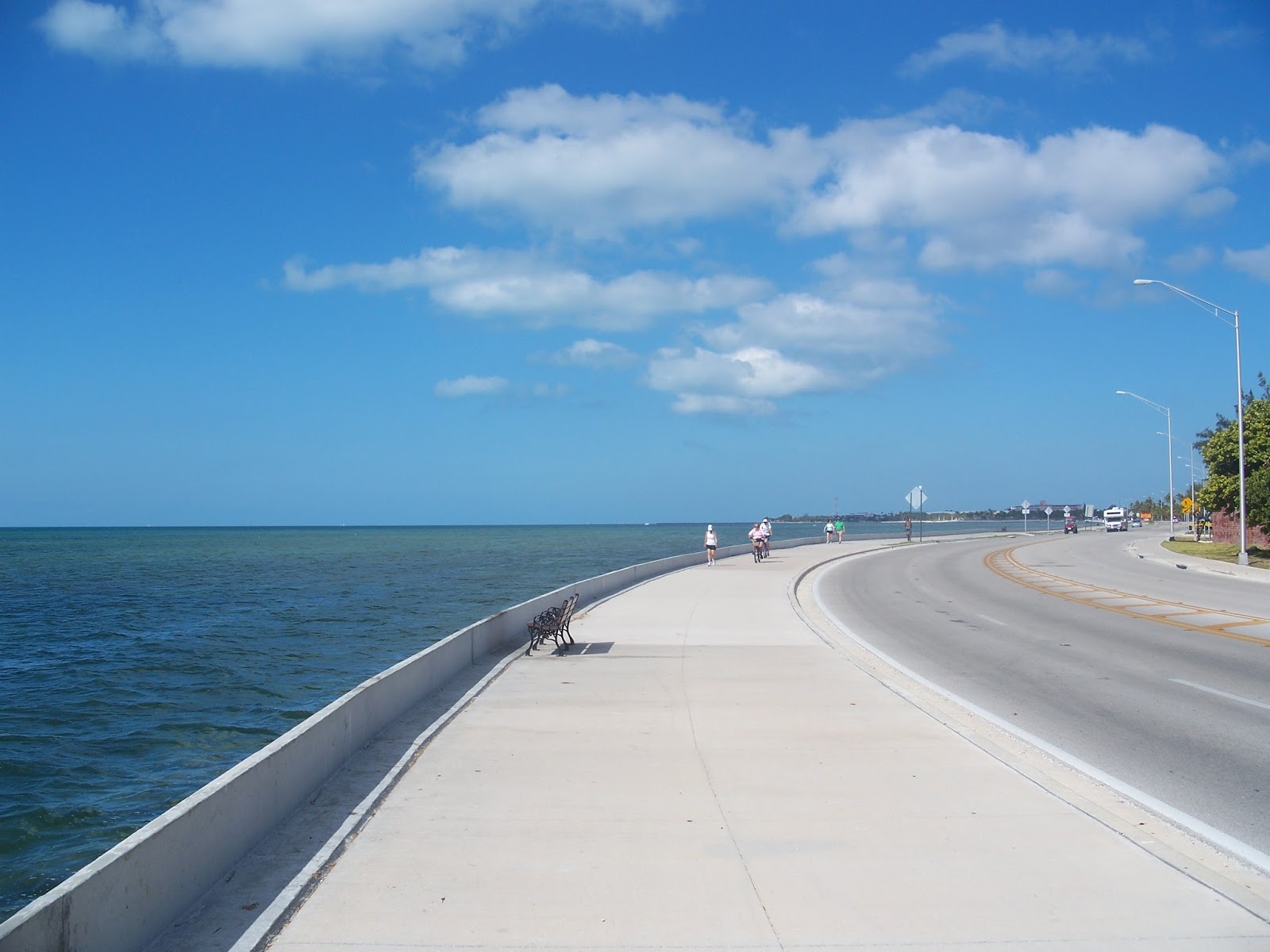
We do make a valiant attempt to burn off some of these calories. A rental company delivers us a pair of single-gear, coaster-braking antiques even more primitive than the fat-tire mountain riders we use at home. "At least the terrain is flat," I mumble to myself, as we roll south through town toward the trail that borders the coastline.

But, turning east, we are met head-on by a steady fifteen mile-per-hour wind that brings us almost to a standstill, as if we are pedaling up a ten-degree incline. For four or five miles we inch forward, balanced between a couple of resorts baking in the midday heat on one side and on the other a sea roiled by foaming whitecaps, until we reach the bight at the end of the island. From there our circumnavigation continues at a gentler pace through a shabby commercial district and a small park back to our hotel.

For more exercise JSG is on a mission: to replace my circa 2000 solid green and navy CVITT (the insignia is on the shoulder) moisture wicking tee shirts with something more fashionable. Up one side of Duval Street and down the other we traipse, peering through windows, shuffling down aisles, sifting through sizes, rejecting one design after another either because it's too expensive (after we've spent $80 for dinner for two) or because the motorcycle, drag racer, catamaran, or leaping swordfish imprinted on the back just doesn't seem appropriate.

We almost strike gold at Blue Heaven, where the logo conveys a message more universal than crass marketing and the pastel color choices are appealing, but walk away foiled when their small size stretches too tightly across my bulging pectorals and their medium hangs limply off my narrow shoulders.

JSG almost talks me into a polo shirt (it would be my first and only) at Banana Republic, but, ever the bargain hunter, finally bestows her blessing on a pair of $9.99 blended tees, one dark blue, one gray, that are on sale for a dollar off. I'm pleased to report that they fit perfectly and are now my Sunday garb of choice.

Every evening thousands of tourists saturate Mallory Square to purchase a souvenir bracelet, painting, or photograph from a street vendor; to wash down popcorn and pretzels with smoothies, lemonade, and key lime tea; to cheer jugglers, tightrope walkers, unicyclists, and fire eaters; to eyeball their bizarre and beautiful fellow travelers; and to jostle each other for prime position and an unobstructed view of Key West's famous sunset.

I'd like to spend more time exploring the Sculpture Garden, where thirty-six men and women who played significant roles in the social, political, and economic history of the island are memorialized in cast bronze busts and biographical inscriptions, but peals of thunder emanating from the crowd are too provocative to ignore.

This is no ordinary busker buffoonery. The globe-trotting Red Trousers dynamic duo has lit up Boston's Faneuil Hall and the Kennedy Center in Washington, D.C., and headlined festivals as distant as Australia, New Zealand, and Pakistan. It's a two-man circus whose gymnastics, dexterity, and running commentary evoke awe, amazement, and raucous laughter from a circle of spectators fifteen rows deep. The talented teammates toss blazing torches and razor-sharp Bowie knives back and forth and tantalizingly close to a dazed five-year-old; balance atop one another feet to shoulders, hand to hand, and head to head; use their noggins to catch a cap thrown like a frisbee; and for the grand finale hold themselves up and out at arm's length like human flags from an extension ladder anchored by four sturdy volunteers.


As for the obligatory main attraction, other than an annoying palm tree protruding from Sunset Key, it's truly a natural wonder: a fiery red-orange orb gradually illuminated in stark relief by the darkening blue-violet hues of the enveloping sky, its reflection glistening in the water as it sinks below the horizon -- although I wouldn't risk life or limb, as many are doing, to capture a proprietary image of it when hundreds are accessible through the click of a mouse or spread out on nearby tables and racks begging for a home.


More entertainment awaits us, and it's not for the straight-laced or faint of heart. "It's the best drag show in town," says our hotelier, "because the performer actually sings rather than lip-sinks." She makes a reservation for us at the historic Hotel La Te Da, an abbreviation of La Terraza de Marti, named after Cuban freedom fighter Jose Marti, who rallied the masses with fiery speeches from an outdoor balcony of what was then a private home shortly after it was built in 1893. Marti was also a poet, journalist, philosopher, and professor -- an impressive resume for a man who died at age forty-two. One of his poems provided the lyrics of the Cuban patriotic anthem "Guantanamera."

We are escorted upstairs to the Cabaret night club, seated at a small table with a mixed-race female couple from New Jersey, and served the first of our two-drink minimum, beers for each of us, more reasonably priced than I expected. The lights dim, sound blasts through the loudspeaker system, and out from stage right steps . . . Bette Midler, who erupts into the staccato rhythm of "Boogie Woogie Bugle Boy." He may not be her, but he's darn close, he being impersonator Randy Roberts, who's nailed not only the costume -- the blonde hair, the mascara, the eyeliner, the lipstick, the silky strapless chemise, the spike heels -- but also the voice, mannerisms, and hip-shaking shimmy.

"I'm a helluva girl; I'm a load of fun: I look good," Bette exults, before expounding in the mode of Sophie Tucker a lengthy convoluted joke about a bashful nun with magical healing powers who is informed by a sister that a blind man has demanded her services. "But I'm in the shower, naked," she protests, then acquiesces when the sister insists she will remain unseen and unblemished. "Nice tits," says the man upon entering. "Where do you want the blinds?"

Randy's impromptu humor is much better, as he sashays through the audience, bantering with members both straight and gay about their relationships, sex lives, home towns, clothes, and jewelry. Up close and personal, he relishes his femininity and is no less alluring. During a brief interlude he describes and demonstrates on film the meticulous process by which he transforms himself from man to woman, then reemerges in boots, red tights, silver spangles, and towering Gothic curls as that most masculine of temptresses, Cher. His pitch drops two octaves as he revisits a few of her greatest hits: "Take Me Home"; "Half-Breed"; and "The Way of Love."


Randy's third act is his own creation: a gorgeous, brash redhead in a sequined gown with foam-enhanced (by her own admission) cleavage who introduces herself as Christine. Her more subdued repertoire -- featuring "A Little More Mascara"; "The Boy Next Door"; and "I'm Still Here" -- is a tenderhearted paean to the androgynous sexuality she exudes and embraces. The transgendering spirals back upon itself when for an encore, in response to the frequently-asked question, "What do you really sound like?" Christine becomes Randy and in a booming baritone unleashes a spine-chilling rendition of Phantom's "The Music of the Night."

While all glorious vacations must come to an end, little do we know that as we bid farewell to this paradisiacal retreat this one is far from over.

Everyone has his favorite travel horror story, which prompts the question, "Should we board every plane anticipating disaster?" Or should we allow a series of uneventful flights to lull us into what will eventually prove to be a false sense of security, especially after considering how our friendly carriers are constantly devising new and creative ways of harassing us?

"Thunderstorms in Atlanta," reads the television monitor suspended above us as we sit in the Key West airport Friday afternoon awaiting our 5:30 departure. Some speedy Weather Channel googling reveals a bright red (translation: severe) line locked into place from northern Alabama to southwestern Georgia. Ever the herald of doom, I flash my phone at JSG and opine, "I wonder if we should even take off."

Thus it's no revelation to me when two hours later our chipper captain interrupts our reveries with the words no lofty landlubber wants to hear: "We've run into some bad weather here in Atlanta, and the controllers have slowed the traffic down to a crawl. We're going to park up here (translation: circle aimlessly) for a while until we get clearance."

Which not long afterward is followed by announcement number two: "Ladies and gentlemen. The Atlanta airport is now closed. We can wait here about thirty minutes longer to see if the conditions improve, but after that we will have to make a decision." (Translation: we're running out of fuel.)

Which in good time is followed by announcement number three: "It doesn't look like we're going to get into Atlanta any time soon. So we're going to hop over to Savannah to refuel. But don't worry. It's called 'Gas and Go.' We just pull up to the terminal, fill 'er up, and head on back. All the flights into and out of Atlanta have been delayed, so we'll be able to get you there in time to make to make your connections." (Translation: start worrying.)

Fifty minutes later we're on the ground in Savannah. It's now about 9:00 PM, an eerie silence blankets the cabin, and no one seems to be in much of a hurry to "gas and go." After about half an hour, an unfamiliar voice booms through the intercom. It's no longer our captain speaking; too embarrassed or too cowardly to acknowledge his disingenuousness, he's abdicated his role as host and commentator and passed the baton to the Delta Terminal Manager.

It's bad news, and more bad news. "Our crew has timed out," he says, "which means they are unable to fly this plane back to Atlanta tonight. We [translation: you] are going to have to lay over in Savannah." People begin to stir in their seats as rumblings of disgust and disbelief roll through the aisle. "And, oh, by the way, we've been checking our local hotel sources," he continues, "and regretfully I must inform you that there are no rooms available within fifty miles." (And no rental cars either, since we've been deposited in the middle of the Masters Golf Tournament.) (Translation: we're going to have to spend the night in the airport.)

Is that water vapor leaking from the climate control system or smoke rising from the incensed brain cells of every passenger? Is this an unavoidable calamity, as I'm sure the powers-that-be will insist, or one that could easily have been averted? Why didn't we stay on the ground in Key West a little longer? Why did we consume precious minutes in a pointless holding pattern? Why did we divert to Savannah when it was certainly no secret that accommodations were problematic? The sheer hypocrisy of the flight attendant's asking us to "please be patient; we're all in this together" when I'm sure she has a warm bed awaiting her and of Delta's purported commitment to customer safety, comfort, and satisfaction, according to its CEO in the video I watched several hours ago, is doubly infuriating.

Once we are deplaned, the anger and frustration of one hundred innocent victims is palpable, as they frantically search their phones for an alternative, without success. Having located a vehicle, one ecstatic fellow dashes to the exit not only to find the prize already leased but security blocking his return to his family since he no longer has a valid ticket -- a patent absurdity since the airport is essentially closed.

The man in charge of this tragicomedy is an officious, beady-eyed, red-cheeked, pot-bellied bureaucrat who refuses to be rattled by the invective hurled his way. "Bad weather I can understand," I confront him with, our noses a mere twelve inches apart. "But there's no excuse for the crew timing out -- and leaving us all stranded." "Are you going to hit me?" is his snide retort. I back away silently, the thought bubble "As much as I'd like to, no. I'm not a man of violence" dancing above my head.

Boxes of Domino's pizzas -- plain cheese or pepperoni -- magically appear, and temporarily distract us from our predicament. Then we're herded like docile sheep to our sleeping quarters, the main lobby of the Savannah Airport, a spacious area sectioned into quadrants and furnished with long benches which are quickly claimed on a first-come basis.

I'm resigned to camping out on the cold, hard floor when I notice several baggage carts being trundled onto the premises by a camouflage outfitted squad who must be from the Georgia National Guard. They offload stacks of large rectangular cartons, and extract from them Delta's feeble attempt at providing a modicum of relief to its weary flock: folding metal army cots. Assembling these contraptions requires an engineering degree -- and more strength than I can muster alone to stretch the green mesh decking from one side rail to the other, so I wave over one of the soldiers to assist me.


It might be possible to catch a few hours of sleep, except that someone forgot to tell the airport manager to turn off the lights. Even more annoying is a recording that, every twenty minutes or so, shatters my eardrums just as I'm about to doze off. Homeland Security has issued an emergency terror alert, and requested all travelers to be on the lookout for any unusual or suspicious activity. Admittedly this place resembles a war zone, but I don't think a few disgruntled insomniacs staggering back and forth to the bathrooms qualifies as much of a threat.

The expeditious processing we were promised the next morning turns into a two-and-a-half hour fiasco as one hundred vagrants must be ticketed back to Atlanta on a flight that doesn't exist and make connections that have long ago been sold out. When it looks like we have no chance of getting to Roanoke until midnight, I beg JSG to let me rent a car, but the thought of riding shotgun for eight hours beside an exhausted, stark-raving maniac is more daunting to her than wasting twice that many in the airport.

Is it conceivable we would get one lucky break during this free fall into Delta's black hole? We're on standby for a noon flight from Atlanta to Roanoke when the agent summons us to the counter. "Are you willing to split up?" she asks. Apparently impressed when I gallantly defer to JSG, she confirms a seat and ushers her to the ramp. Not five minutes later -- as I'm lingering in the vicinity vainly hoping for another no-show -- a strange-looking woman about as wide as she is tall and carrying two oversize bags waddles up and slaps down her boarding pass. The plane is still there; the gate is not closed; yet the agent shrugs her shoulders and mouths those deadly words: "I'm sorry, ma'am. You're too late."

In this case, parting is oh so sweet. JSG retrieves our car in Roanoke, and is at her door by 3:30. We'd already booked ourselves to the next closest city, Greensboro, which enables me to rendezvous with her via one-way rental around 6:00 that evening, only eighteen grueling hours late. And I did discover what probably prevented our fireplug friend from making that earlier flight: a dog which started yapping from her bag while we're waiting together at the gate for Greensboro. Which explains why the attendant checking the roster stopped at JSG's seat and said, "You must be the lady with the dog."

It's been an ordeal which I would never want to repeat, but most certainly will unless I decide never to set foot on another commercial airplane. And if it takes me back to Blue Heaven, I just might volunteer.



Wednesday, December 24, 2014

The Invasion


Make no mistake about it: I love my three children, their two spouses and one significant other, and my two granddaughters. But when they descend upon me en masse, they can stretch those infrangible bonds of filial affection to frightening lengths, like bungee jumpers leaping into the unknown.

The problem is twofold. First I live alone, a condition abhorrent to many, but quite comfortable to me. And I have lots of company -- besides my lovely life partner, recognizable to loyal followers of these musings by the acronym JSG, at whose home about one mile from my own I spend many pleasant hours. According to the most recent demographic statistics available (2013), twenty-seven percent of Americans occupy one-person households, up from seventeen in 1970, with the male percentages rising from six to twelve. The trend is a global one; the comparable overall figure in Sweden is 47%, in Japan 32%, and in Canada 28%.

Is it conceivable that growing economic independence in all age groups is enabling a form of domesticity for which many may have subconsciously yearned but which was not financially viable -- because it was imperative in previous generations that individuals and family members share living expenses? (My eighty-nine-year-old mother contends that there is a primal urge also at work here: the revolution in sexual mores, which has rendered marriage, even cohabitation, irrelevant.) While I acknowledge that for a majority of people constant companionship is a given, I submit that for a sizable segment of the population solitude can be equally satisfying.

I am not the first person -- nor will I be the last -- to catalog any number of perquisites enjoyed by the soloist: rising and retiring at any hour of the day or night; eating whatever and whenever one pleases (although if he can't cook, his options are severely limited, mainly to idiot-proof microwavables); reading for several hours without feeling guilty for ignoring one's mate; engaging in a few vulgar habits better left to the reader's imagination; and walking around the house (or doing any of the aforementioned) naked. Also, when one is alone, he can't do anything wrong -- as opposed to, well, not doing anything right.

An almost empty house -- consisting of one resident and a bare minimum of furnishings and adornments, other than a sprawling library -- is the primary element of danger. Compounding it with a personality type compulsively averse to clutter (but not necessarily grit and grime, since he rarely lifts a broom, mop, or rag) and to any disruptions in his daily routine (early-morning workout, cereal and a banana for breakfast, nine hours in his office or visiting a Schewel store, a quiet dinner at home or with JSG, a few hours immersed in a book, and an occasional social outing) is a recipe for serious queasiness, once the final seasoning of family members is sprinkled in.

And yet, what else is 3800 square feet with five bedrooms, four-and-a-half baths, two family rooms, and a swimming pool good for, other than to play hide-and-seek with oneself? And especially if he is a proud parent and grandparent blessed with the finest brood he could ever hope for, and far better than he deserved, considering he ascribed to and practiced a philosophy of child-rearing by absenteeism. I'll graciously concede to their mother all credit for the mature, independent, and amiable adults who emerged from a nest shredded by divorce.

Around 5:00 PM Wednesday, the first squad rolls in from Ithaca, New York: my daughter Sara, her husband Nate, and their daughter, Lia, all packed into their 2008 Subaru Impreza Outback, along with all the paraphernalia required to transport, sustain, and entertain an eighteen-month-old toddler for six days away from home, including portacrib, toys and picture books, shrunken utensils, and plastic cups with lids. Ithaca is a long way from Lynchburg, about eight-a-half-hours in the best of non-holiday and adults-only conditions, which is why Sara and Nate decided to bivouac one night in Winchester at the Lauberge Provincale Bed and Breakfast, where they encountered an untimely Shenandoah snowstorm.

What I viewed at the time as an unlikely career shift -- Sara's enrolling in a nursing program at the University of Pennsylvania after four years teaching biology at private secondary schools -- proved to be as providential as my entering the family furniture business many decades ago; in retrospect, it was even foreshadowed by her semester abroad assignment to a remote hospital in Cameroon, although I suspect her motivations at the time were refining her French and deploying her National Outdoor Leadership skills.

She tackled her new profession with the same unbridled enthusiasm and total commitment she has regularly demonstrated in her relentless pursuit of adventure: camping in the wilderness for weeks at a time; running the Philadelphia Marathon with her boy friend, who presented her a ring at the finish line; and cycling the mountains of Thailand on her honeymoon. While fully devoted to her patients as a nurse practitioner employed by a hospitalist group at the Cayuga Medical Center, she's retained the critical eye that has always made her wary of incompetent authority figures. A frequent topic of conversation between the two of us is our shared disillusionment with our health care system, the waste, inefficiencies, overutilization, and misaligned incentives of which she now witnesses every day.

Even at her furious pace, Sara has a hard time keeping up with her husband Nate, who, like a mild-mannered Clark Kent, sans spectacles, transforms himself into super-Nate faster than one can utter the words "caped crusader." His Ph.D degree in computer science seems a mere footnote to a curriculum as extensive as the dissertation I perused in his apartment years ago, searching in vain for one comprehensible sentence: securing private and public grants for his Cornell graduate students' research projects; crisscrossing the globe to present papers and attend conferences, including an elite gathering by invitation only of thirty international scholars; running a leisurely twenty miles Saturday afternoon as a warm-up for an upcoming marathon in India; blazing through a three-hundred-page book, King Leopold's Ghost, during a few spare moments over the weekend; and, last Thanksgiving, preparing a tasty vegetable, cheese, and pastry hors d'ouevre after cycling from the Wintergreen turn-off at Rt. 151 to my sister's cabin at the summit of Devil's Knob (in thirty-degree weather).

In a high-energy environment like that, what's eighteen-month-old Lia to do but follow her leaders? She's not astride that bicycle yet, but she chugs up and down my long hallways like her crib bunny on the loose. From her one-hundred-word vocabulary, she likes to enunciate "oushide," then ramble to the door and point a provocative finger toward the wide open spaces. I doubt she'll ever be the bibliophile her "Abba" (or "father" in Hebrew, the name I've chosen to be called) is, but she will sit still long enough to plow through a picture book or two. If she's sufficiently well-mannered to feed herself yoghurt with a spoon, she's quick to scatter her peas and macaroni across the table when she's done. She can count, sort of, responding to Nate's prompt of odd numbers with the next consecutive even one, until he gets to "seven," when she leapfrogs to "nine." All decked out in her favorite colors -- purple, pink, and blue -- and sitting on her front stoop, she beams at me with a mischievous grin every morning from the photograph propped on the bookcase beside my bed.


Sara gets her to sleep in time to make a quick grocery store run (since my bachelor's stockpile is limited to cereal, soy milk, peanut butter, beer, and veggie burgers), and then joins me at the train station to welcome our New York City contingent: my older son David and his partner Mary, soon-to-be a mother herself, in February. "It's a boy," and somewhat of a surprise, as Mary's child-bearing window is closing rapidly, though even I am not so indiscreet as to disclose any statistical details. His name has been chosen, but remains a secret -- in order, I suspect, to deflect any unsolicited advice -- as does the ticklish question as to whether a marriage is in the offing, probably for the same reason.

It will be interesting to see how my forty-year-old firstborn adapts to the fatherhood which will wreak havoc upon a lifestyle both carefree and orderly and upon a temperament I've always regarded as perpetually young at heart; it's a judgment which I submit is applicable to all who follow their adolescent dreams into the entertainment industry. Since even Hall of Fame athletes must eventually hang up their cleats, who among us can forever play the games that so captivated us as innocents -- other than actors, performers, filmmakers, and their ilk -- and be rewarded for it to boot? As I see it, David has never let loose the video camera which he picked up (and I bought for him) thirty years ago at the Schewel store on Timberlake Road; he's only traded it for more sophisticated versions.

His forte is reality t.v., and since striking out on his own in 1997, he's compiled an impressive resume as an editor and an executive producer that features such varied fare as Queer Eye for the Straight Guy, Extreme Makeover, Oddities, Chasing Tail (not the two-legged species, but deer on Long Island), and Guntucky (about a combination gun store and firing range with simulated heavy weaponry shooting experiences). Premiering soon is Hotel Amazon, which depicts the trials and tribulations (some contrived for dramatic effect) of two entrepreneurs developing a resort in the remote jungles of Peru and which required my son to assume the unlikely persona of an intrepid Theodore Roosevelt during two ten-day site visits.

Mary is a willowy blonde who savors her morning Starbucks and her evening vodka gimlets (when she's not pregnant). As a marketing executive with Showtime, she's been on her share of junkets, including several trips to Las Vegas to cover championship boxing matches. She's got an eye for fashion and a flair for design, gradually making over David's wardrobe and his furnishings as their relationship progressed.

When they reached a point where neither her apartment nor his co-op was big enough for two, they hired a consultant to advise them how best to spruce up his place in order to expedite a sale. After they had spent a considerable amount on fees, construction, painting, and commissions, their realtor brought them a buyer: the next door resident, who wanted to remove the adjoining wall and double his own space. Sometimes it pays to know your neighbor, even in New York City.

How quickly one forgets what it's like to have a full house. David tries to heat up some leftover pizza in the toaster oven and melts cheese all over the tray. Tap water with ice -- always good enough for me -- doesn't suit my kids, who insist on giving the cold water dispenser on my refrigerator such a strenuous workout that I'm sure the whole thing is going to break down. Within an hour, every glass in my cabinet is pulled out, sipped from once, and abandoned. I have to run my dishwasher more times in three days than I normally do in a month. Awakening at 2:00 AM to take care of the usual business, I don't have to stumble around in the dark since every lamp is lit, although I do have to be careful not to trip over an obstacle course of littered shoes. My Keurig machine is locked permanently in the "power" and "heating" settings. In fact, so roiled am I by all this tumult that I fail to place my mug under the spigot and spill coffee all over my countertop.

And the third wave hasn't even arrived yet.

Coming from Washington, D.C., my younger son Matthew, his wife Patricia, and their six-month-old daughter Ana Maria, will be joining us the next day at Wintergreen, a sensible arrangement since feeding interruptions can easily expand their three-hour drive into five. A feathery four pounds, eleven ounces at birth, Ana has been on a reverse crash diet since then, and has ballooned into the healthy fiftieth percentile.

A native of the Dominican Republic, her mother is intent on raising her as a bi-cultural, primping her in her own inimitable style (Ana tiptoed into her first Halloween as a frilly ballerina); accentuating her delicate features with sparkling miniature earrings and a beribboned headband, each day of the week marked by its own color; and maintaining a one-way non-stop conversation with her in Spanish. Meanwhile, Ana scrutinizes her strange new surroundings with measured placidity, and practices rolling over.


If Matthew, like Sara, soured on teaching after a short stint, at least he can claim to have mined one jewel from his labors: Patricia, who was engaged in the same bilingual elementary school program as he (although in a different North Carolina school district) and whom he met at a conference. I think her father, Don Julio, an aristocrat, historian, physician, and professor, was initially apprehensive about what species of ugly American she might bring home -- until he met my 6'2" gentle giant, who could converse in Spanish with him on baseball and Latin American history and hold his own with his sons trading ripostes and swilling vodka. Once Julio blessed this Jewish-Catholic union, he celebrated it with a Dominican extravaganza, treating two-hundred-fifty guests to an endless midnight buffet, a pulsating rock band, and a professional dancing troupe.

If Patricia has taken an indefinite leave-of-absence from her pedagogical duties, Matthew's recent promotion to editor of the niche magazine, Inside U. S. Trade, where he was hired as a reporter two years ago -- prevailing over one hundred other applicants -- has meant long hours meeting publication deadlines, on-the-job management training as he adjusts to being the "boss," and no abatement in a rigorous travel schedule that has taken him to Brunei, Bali, Singapore, and, a few weeks ago, Sydney, Australia, in pursuit of international trade commission conferees.

He's been sighted at congressional hearings, diplomatic press conferences, and CNN panels, earned a reputation as a shrewd investigator and interviewer who easily penetrates obfuscation and evasion, and established himself as an expert in a field as esoteric as the calculation of import duties. While I'm sure they may be riveting to the Assistant Undersecretary of the Department of Commerce, two paragraphs under Matthew's byline are enough to send me scrambling to the sports pages.

Our annual family reunion reminds me of Thanksgivings past, not all sixty-six of them, of course, but several that became traditions for a number of years. When I was a youngster -- and up until I entered college -- my two siblings and I would pile into my parents' wood-paneled station wagon, and the five of us would motor to Roanoke -- it seemed so far at the time; the Old Forest Road/Rt. 221 intersection was truly in the country -- where my father's cousin and her husband hosted a multitude of Schewels at their modest mid-century colonial residence.

In a smoke-filled den, several older gentlemen would be engrossed in a high-stakes gin rummy game. From the rear of the house could be heard the clanging of pots and pans and the idle chatter of females (and their black hired help) toiling away. In time they would rotate into the living room, where my father, as usual, held center stage regaling his audience with a joke or tall tale. On balmier days touch football would erupt in the front yard, although my speed, skill, and competitiveness were much inferior to that of my more coordinated kinfolk.

The highlight of these holidays was a group excursion to the VMI-VPI football game at Victory Stadium; the acronym of the latter institution, as defunct as the long-ago demolished venue, has been so expunged from the chronicles of Virginia Tech that it is remembered by only a handful of nostalgic baby-boomers, as is the contest itself, which at the time was the season's grand finale, matching the state's fiercest rivals and two titans of the old Southern Conference.

Back then I was probably more of a football fan than I am today, which isn't saying much, since now I despise the sport; I suspect my father was even less enamored, and dragged us both along in the spirit of camaraderie. Since we had no particular allegiance to either team, we were always in a quandary as to whom to root for, most often landing on the side of VMI, a decided underdog in the waning years of the series, as its foe ramped up its program. On cold and windy afternoons we left at halftime. My motivation for persisting was to catch a glimpse of (and even exchange a word or two with) a girl whom I had met through a Jewish youth organization -- during the game, we parked our cars in her father's junkyard -- and whom I had a crush on; like so many others, it would go unrequited.

After our extended family broke apart -- for reasons too convoluted and unpleasant to recount -- my father conceived a glorious plan to host all his children, their spouses, and his grandchildren for the long weekend at the Sonesta Beach Resort in Key Biscayne, Florida, although he never failed to attribute the hefty funding of these getaways to its proper source: income from my deceased grandparents' trusts. We went to South Florida because my mother's mother was still living in an apartment in Miami Beach, but I can only guess why he chose this particular property. Perhaps on a previous trip he had struck up a friendship with one or more of the staff there -- wherever he went, he always had a burning need to be recognized -- or he may have just been hoping to encounter one of his favorite celebrities, Richard Nixon, who was rumored to haunt the premises.

We sat around the pool, tested the ocean waters, polished our tans -- mainly so we could show them off when we got home -- caught up on our reading (at least I did), overindulged three times a day, and discovered the pleasures of a warm-weather Thanksgiving. I figured a twenty-mile run in eighty-degree heat and ninety-percent humidity would be good training for an upcoming marathon, so I ventured halfway across the causeway to the mainland, feeling like a champion before barely staggering home.

No trip to the Gold Coast was complete without a meal at the world-famous Joe's Stone Crab restaurant, even though we had to stand in line for at least an hour before we could be seated. One evening my mother spotted a gentleman slipping the maitre d' a fistful of cash and rocketing to the head of the pack; I don't know how much it cost my father, but, like magic, our waiting days were over. It was all wasted on me, since the thought of crunching and swallowing a crab shell didn't really titillate my palate; I was probably the only person in the place who opted for the mahi mahi.

Thirty years later I'm still pounding the pavement, although at a much diminished frequency, speed, distance, and gracefulness. Four days ago, Sunday, I'm cruising comfortably down Rivermont Avenue, reveling in my total recovery from the fractured fibula that hobbled me for six weeks back in June, when a grossly protuberant section of the sidewalk conspires with a senescent inability to lift one's legs more than a few inches off the ground to pitch me violently forward. Even though I jerk my my hands out in front to break the fall, both knees strike the pavement, the left one with brutal impact. Bruised and bloodied, I regain my footing, limp along for a few hundred yards, and -- of course -- jog the remaining three-and-a-half miles of my circuit. Within a couple of hours, my knee is purple, bulging like a softball, and too painful to permit me to contract it fully.

Since my ankle episode cost me about $800 in orthopedic devices and examinations, I decide to shun, at least temporarily, the greedy jaws of the health care digestive system and consult Dr. Internet. Barely able to walk, I initially fear the worst: a sprain, even a tear, of either the anterior or posterior cruciate ligament. Then, miraculously, on Wednesday, the pain dissipates, the swelling subsides, and the range of motion is almost one-hundred percent -- just in time for the Thanksgiving morning HumanKind (formerly Presbyterian Home) five-kilometer Turkey Trot.

Sara and Nate were the first to enlist back in 2011; the next year, after JSG, her daughter Annie, and I signed on, Sara added insult to injury by not only trouncing me by several minutes but also by announcing that she had done it while three months pregnant. Now she needs a baby sitter, and convinces David that this is as good a time as any to inaugurate parenthood.


The course is not an easy one -- none in Lynchburg is -- east on Main Street for five blocks, up the imposing Thirteenth Street hill, along Church Street to Fifth, across the John Lynch Bridge and back, and then following Church Street to Thirteenth Street before looping down Main to the finish. I think I'm in trouble when, in the midst of the city's fittest three thousand, it takes me a minute to get to the starting line; I know it for a fact when I spot first Nate and then Sara streaking toward me when I'm only halfway across the bridge. Amazingly, my twenty-eight-and-a-half minutes are good enough for third in my age group, all but two of whom must have been burdened by more creaking parts than my gimpy knee.

The cold dawn drizzle -- which abated just as the 9:00 AM race commenced -- is a sure harbinger of harsher conditions atop Devil's Knob, where the temperature is always ten degrees cooler than at the base. By the time we reach the summit, around 1:00 PM -- eleven of us, JSG, her three children, Mary, Sara, Nate, David, Nanee, Lia, and me, all shoehorned into JSG's minivan and my Genesis sedan -- the falling snow has accumulated to four inches, making the uphill climb treacherous and parking along the narrow road problematic. We risk it, though Donna's son, Jordan, warns that the Wintergreen's finest, always on the lookout for lawbreakers, are likely to ticket, or worse, tow us (which I find hard to believe, even assuming they're working today). If he's a habitual crisis monger, Jordan's also in his emergency response mode; he's cleared the driveway, and hops in his Jeep to shuttle Nanee down the steep incline to the house.

This affair is quality time par excellence, especially for the next generation, who reacquaint themselves with each other after long hiatuses (other than their Facebook connections which, not being a subscriber, I tend to ignore), as twenty-two of us, confined to a single large living and dining area, sit, stand, meander, mingle, chat, chuckle, gossip, drink, snack, feast, and even steal a guilty glance at a muted football game.

Jordan, hunkering down for the Apocalypse, flourishes his newest rifle magazine in one hand and his sharpest blade in the other. Julie, an instantly mature freshman at Loyola of Baltimore, regales us with her latest exploits on the tennis court, which has kept her too busy to contribute her superb culinary skills to today's banquet. Bert, full-time graduate student, part-time Schewel salesman, shares a worrisome tale about a whistle-blowing incident. Hannah models her latest body art, hints at a future in nail decoration, and bemoans the plight of the Palestinians. Esther, having fled her boring birthplace (and Schewel employment) for the marvels of Manhattan, quietly surveys the scene, while visions of mathematical equations dance in her head. The three G's, George, Gus, and Annie (plus one girl friend, Sawyer), mirror their mother's gleaming smile and maintain their "cool" amidst all this familial frenzy.

Two popular activities of past conclaves are noticeably forgone: a rousing game of "Apples to Apples," either because the cards have been lost or it's suddenly regarded as too juvenile; and an after-meal hike along the golf course, too daunting without snowshoes for even this hardy bunch, for which I am extremely grateful.

But there's a new happening, borne of last year's quirky Hebrew calendar, which uprooted Hanukkah from its traditional proximity to Christmas and replanted it adjacent to Thanksgiving, a serendipitous convergence which inspired David to append to the festivities a "Secret (Ecumenical) Santa" gift exchange. Thus, even though Hanukkah has reverted to form, we haven't; the large square cocktail table in the middle of the room is overflowing with colorful bags and packages just waiting to delight (one hopes) their surprised recipients.

David, the proverbial camp counselor, having assigned each person his or her mate, is insistent we proceed by the rules: a name on a tag is read; seductive wrappings are torn away; exclamations of great joy are heard; and only then is the identity of "Santa" revealed. But because my offerings to Nanee are rather obscure, I am compelled to foil his best-laid plans, peremptorily to declare myself, and to explain each of them: two bottles of wine (which she despises); a half-liter of Chivas Regal (which she swears by, and in fact has already sampled, since she left hers at home); a gift card to Starbucks, where she's never been; and $100 in cash, her own special gift of choice to one and all on every occasion (and for which she profusely thanks me, seriously, since she likes money, and this is a first).

And then, one by one, all secrets are laid bare: Things That Matter, by Charles Krauthammer, to Jack from Donna, who remembers his second most revered conservative oracle (after Rush Limbaugh); super non-stick frying pans, to George and Gus from the ever-practical JSG; high-tech running/cycling attire, to Nate from Patricia; a gift certificate for a five-star Baltimore restaurant, to Donna from Nate, which she can use when visiting Julie; a gorgeous bracelet, to Esther from Nanee, whom Patricia claims as her Santa for next year; and the Downton Abbey Season Five DVD (arriving January 25th) to yours truly, who forgets to ask whom it's from, evoking an outcry from Matthew, "Don't you even want to know?"

Meanwhile, Jack has been back and forth to the basement, attending to the turkey nestled in the deep fryer purchased a few years ago just for this annual ritual. Finally, it's ready, tender, moist, plucked, sliced, and spread out on the counter, along with its customary consorts: salad, stuffing, a trio of mashed potato, sweet potato, and bean casseroles, and lo and behold, gravy. Having forgotten some ingredient, Jack sent me an SOS, but thirty minutes after I had left home; apparently, he located a store in the vicinity where a suitable substitute could be obtained. And if we're not already sinfully satiated, a surfeit of desserts awaits us: two pumpkin pies, one pecan, and a huge bowl of banana pudding, homemade by a devoted friend, who presented it to us at a rendezvous at Clifford on our way here.

Allocating seating for the ride home, I'm counting on one additional in Matthew's car (also a Genesis, my old one, circa 2008), when I hear that he, Patricia, and Ana are planning to spend the night at Donna's. That doesn't make much sense until someone whispers the real reason: Patricia doesn't trust Matthew on these slippery, winding roads in the foggy darkness. She will go only if I take the wheel. Now that's the consummate irony; obviously, she hasn't read my blog "Car Talk," which detailed a harrowing legacy of wrecked vehicles, nor heard JSG and my ex-wives elaborate on my eccentric driving habits.

Before the advent of Ana and Lia, taking the clan out to eat was the simple recourse for one who subsists on frozen foods. But nap time, feeding schedules, equipment transport, and the irrepressible energy of an eighteen-month-old pose severe complications.

Friday we run a lunch tag team to the Cavalier, where, besides enjoying beer, burgers, dogs, and spicy fries, Lynchburg expatriates like David and Sara can usually reconnect with fellow travelers home for the holiday. Saturday midday everyone scatters, a problem of sorts, since David wants to head to Roanoke to film an adult cheer-leading team; it's for a pilot he's been trying to sell to a network for ten years. When Nanee reneges on loaning him her car (which rarely budges from her garage), what's a father to do but hand over his? She makes amends that night, however, treating us all, plus Donna's foursome, to some exquisite Boonsboro Country Club cuisine, as both sets of parents cheerfully lug along their babies, who exhibit their best behavior. Sunday morning JSG invites the stragglers to her house for a smoked salmon, eggs, and bacon brunch.

That leaves Friday's dinner. Nate says his favorite restaurant is King's Island, which he's never actually been to, but only experienced vicariously through the accolades bestowed on it by us natives. We're close to touch-toning for carry-out when the mood abruptly shifts, and a chef materializes from the woodwork; who else but Super-Nate, with Mary in a supporting role? Faster than a speeding bullet, he rips through Kroger, and within thirty minutes my kitchen looks like it's been churned by a tornado: pots boiling; pans sizzling; platters baking; long-neglected bowls, knives, mixers, and measuring cups exhumed; real food in various stages of preparation strewn over every surface. So incongruous is this scene that Sara deems it worthy of commemoration and snaps a photo.

Similarly, my dining room is awakened from its own somnolence. Yes, buried in my massive buffet and hutch are a dainty tablecloth on permanent loan from Nanee and enough china, silver, and crystal for all eight of us (three couples plus Nanee and me). No sooner is the table set than a sumptuous feast is laid before us: mixed greens with cherry tomatoes, apricots, and Nate's special dressing; pasta shells in a creamy mushroom sauce; grilled asparagus; roasted chicken; toasted French bread; and fresh berries baked in a crust. And to top it off, the kids wouldn't even let me help clean up.

In fact, as the last car -- bearing Matthew, Patricia, and Ana -- pulls out of the driveway around 2:00 PM Sunday, what minor lingering evidence of the invasion is easily tidied up: three beds stripped and remade; one load of sheets and towels laundered and dried; the den hastily vacuumed (before the maids conduct a thorough housecleaning on Tuesday); the dishwasher cycled one more time; and a lonesome sock and three tiny stuffed animals ferreted out and stored in a safe place until such time as their rightful owners return to claim them.

Which I hope won't be too far off. Because, as I make a final inspection of my vacant house, I'm missing them. It's much too quiet here.


Thursday, November 20, 2014

A House Divided


By February 23, 1898, three trials had evolved from the discovery that a traitor in the French Army was selling information to German diplomats; each had yielded a verdict that, backed by the full weight and influence of the General Staff, was inevitable yet problematic, as the reliability of the evidence became increasingly suspect.

December 23, 1894: Thirty-five year old Captain Alfred Dreyfus, a Jew, is convicted of having composed the telltale bordereau recovered from the German embassy and is sentenced to life imprisonment on a remote South American island.

January 12, 1898: Commandant Walsin Esterazy is acquitted of the same crime, despite an unsavory history of deceit, depravity, and indebtedness, and a handwriting, according to most observers, identical to that of the bordereau.

Six weeks later: A jury finds novelist Emile Zola guilty of libel, since he could never prove that Esterhazy's judges had exonerated "on command" a defendant whom they knew to be a spy; the accusation was as true as all the others Zola had fired from his explosive pen denouncing the government and the military establishment for malfeasance and miscarriage of justice.

Zola's J'Accuse ignited a civil war in the salons of Paris.

A cadre of journalists from La Revue Blanche began gathering signatures from well-known academics, writers, scientists, poets, and artists for petitions first condemning "the violation of judicial norms in the 1894 trial and the iniquities surrounding the Esterhazy affair" and second requesting "the preservation of legal guarantees for ordinary citizens." (Bredin, p. 276)

Publishing the former in L'Aurore under the title "Manifesto of the Intellectuals," Georges Clemenceau thus popularized what had been an obscure, pejorative term applied by their adversaries to men of letters and science who had the audacity to opine on public issues. One distinguished critic raged that "to designate as something in the order of a noble caste people living in laboratories and libraries is . . . one of the most ridiculous foibles of our era." (Bredin, pp. 276-277)

If the pro-Dreyfus faction ("Dreyfusards") were trumpeting their autonomy and defending justice and law, the anti-Dreyfusards had their own legion of intellectual mouthpieces who rallied in support of the established order, the Church, the Army, and res judicata. (Bredin, p. 278)

It was a house divided; almost everyone succumbed to the madness, certain in his heart that "France could be saved only by damning Dreyfus or rescuing him," and ultimately becoming so consumed by the battle that in time the fate of the victim faded into irrelevancy. (Lewis, p. 221)

"The struggle was now against institutions, against hierarchy, against military authority, and against the Catholics as much as it was for Alfred Dreyfus dying on Devil's Island . . . At stake was a moral cause, a society in which justice and equality would reign." (Bredin, p. 284)

Similarly, the anti-Dreyfusards had nearly forgotten their traitor, depersonalizing him into a symbol of all the social and intellectual types who threatened the stability and unity of their country: Jews, Protestants, socialists, liberal priests, emancipated women, and striking workers. (Bredin, p. 284)

Activism in the world of letters would reverberate far beyond the printing presses and Parisian parlors. If in February 1898 the bureaucrats and legislators were uniformly anti-Dreyfusard, by the end of the year they had begun to realign themselves. By elaborating for the first time in French history the role of intellectuals in the body politic, Zola had revealed their capacity to influence the nation's governors. (Bredin, p. 285)

The Dreyfusards' elation in June 1898 at the elevation to Prime Minister of Henri Brisson -- a distinguished republican whom his colleagues in the Chamber of Deputies regarded as an antidote to the reactionary right -- promptly vanished when he rewarded the Nationalists who had voted for him by appointing Godefroy Cavaignac Minister of War. Like one of his predecessors, Auguste Mercier, Cavaignac was tall, solemn, arrogant, and ambitious, passionately anti-Dreyfusard, steadfastly loyal to the Army, and domineering enough to rule the cabinet. (Lewis, pp. 238-239)


Cavaignac's rigorous examination of the Secret Dossier (which now housed three hundred documents) confirmed for him that the Army's case was ironclad. If he harbored doubts about the handwriting of the bordereau, which resembled that of Esterhazy, he resolved the dilemma by theorizing that, since the bordereau contained gunnery information which only Dreyfus would have been privy to, the pair had collaborated. (Chapman, p. 211)

Determined to bury the Affair forever, on July 7 Cavaignac strode to the rostrum and announced to the Chamber, "I am completely certain of Dreyfus's guilt" -- acknowledging, however, that an officer whom he did not mention by name, the true author of the bordereau, had been acquitted in error and would be "stricken tomorrow with the punishment he deserves." (Chapman, p. 212; Bredin, p. 309)

Then, attesting their "material and moral authenticity," he produced three documents: the April 1894 letter written from Schwarzkopppen to Panizzardi in which he spoke of receiving "master plans of Nice" from "scoundrel D"; the letter of 1896 in which Commandant Henry had changed the date to March 1894 and the identification of a person bringing Panizzardi "a number of interesting things" from P to D; and the decisive proof, the forgery to which Henry had attached Panizzardi's "My dear friend" salutation and "Alexandrine" signature. Finally, Cavaignac claimed possession of an affidavit from Captain Lebrun-Renault's verifying Dreyfus's confession. (Lewis, p. 232)

When he fell silent, the entire Chamber rose in acclamation. A motion was overwhelmingly ratified to have the speech printed at public expense and posted in the thirty thousand communes of France. (Lewis, p. 232)

Two days later the valiant Colonel Georges Picquart -- the former head of Counter-intelligence who had fingered Esterhazy as the real culprit and had been demeaned and demoted by his superiors for his efforts to bring the truth to light -- wrote to Prime Minister Brisson (and communicated to the press) that "the two documents dated 1894 cannot be applied to Dreyfus and the one dated 1896 has every appearance of being a forgery." (Bredin, p. 316)

Cavaignac was furious. He ordered Picquart arrested on the grounds of divulging official secrets, and stunned the Prime Minister's Cabinet by threatening to file suit before the High Court of the Senate against a host of prominent Dreyfusards -- among them Auguste Scheurer-Kestner, Socialist leader Jean Jaures (who had written his own open letter to the Minister of War refuting his evidence and conclusions), Georges Clemenceau, and Mathieu Dreyfus. The Cabinet, seeking to disprove Picquart and Jaures and to validate their War Minister, initiated an expert review of the Secret Dossier. (Lewis, p. 233)

Indeed, it was already in progress; as instructed by Cavaignac, Captain Louis Cuignet had been meticulously sifting through the file for the past month. On August 13, scrutinizing the faux Henry for the first time, Cuignet noticed two shocking peculiarities. "The heading and the signature appeared on paper whose lines were bluish gray; the body of the letter on fragments whose lines were pale violet." Nor did the measurement of the graph lines match. The principal piece condemning Dreyfus -- which Cuignet's friend, Commandant Henry, claimed to have obtained from the German embassy -- was a forgery, and it was placarded all over France. (Bredin, p. 324)

On August 30, Cavaignac summoned Henry to his office, and interrogated him in the presence of Chief of Staff Boisdeffre and Deputy Chief of Staff Gonse. Henry initial response was to lie, to deny any tampering or fabrication, until gradually his "remonstrations weakened, contradicted themselves, and finally collapsed." After an hour of intense badgering, when challenged with, "So this is what happened. You received in 1896 an envelope with a letter of no significance. You destroyed the letter and you manufactured the other," he weakly conceded, "Yes." (Lewis, p. 237; Chapman, p. 224)


When asked who had put the idea in his head, Henry explained: "My superiors were worried and I wanted to calm them. I said to myself: 'Let's add just a sentence; if we had a piece of evidence in this situation, we're in! Nobody knew anything about it . . . I acted solely in the interests of my country.' " (Lewis, p. 237)

Chief of Staff Boisdeffre took a sheet of paper from the Minister's desk and resigned, stating his trust in his Chief of Counter-intelligence was no longer justified. (Bredin, p. 328)

Imprisoned in Mont-Valerian, Henry took up his own pen. He solicited a visit from General Gonse, and protested disingenuously to his wife, "My letter is a copy and there is no touch of forgery." At three o'clock in the afternoon in the stifling heat he took off his clothes, stretched out on his bed, and slit his throat. Three hours later an orderly bringing his supper found the bloody corpse. (Chapman, p. 226)

Having risen from his peasant origins to the General Staff and earned the respect and confidence of gentlemen, perhaps Henry feared that, by living, he might cause irrevocable harm to the honor of the Army he loved. (Lewis, p. 240)

Upon hearing of Henry's suicide, Esterhazy shaved off his mustache, boarded a train for Mauberge, and crossed the Belgian border on foot. From Brussels he fled to London and settled under the name of de Becourt. (Bredin, p. 336)

The next domino to fall was Minister of War Cavaignac. Obstinately adhering to his warped paradigm, he was left with no choice but to step down when his colleagues in the Cabinet voted over his objections to consider Lucie Dreyfus's request for a reopening of her husband's case. (Lewis. p. 241)

The anti-Dreyfusards transformed Commandant Henry into a martyred patriot. In a series of articles entitled "The First Blood," Charles Maurras, an obscure poet and journalist, advanced the fanciful thesis that Henry had acted with "intellectual and moral nobility" for the public good and that his "unlucky forgery will be acclaimed as one of the finest deeds of war." (Chapman, p. 228)

La Libre Parole launched a national subscription campaign on behalf of Madame Henry and her children; its goal was to safeguard the reputation of the "French officer killed, murdered by the Jews." Week after week it published the names of the donors, who numbered 25,000 and filled a seven hundred page book, and the sums collected, which totaled 130,000 francs. (Bredin, p. 350)

Virulent anti-Semitic commentaries accompanied many contributions. Poverty, exploitation, and unemployment were blamed on the Jews. Lumped together with Protestants, Freemasons, republicans, and intellectuals, they were perceived as agents of social upheaval and polluters of moral values who ranked no higher on the biological ladder than insects, toads, reptiles, and monkeys. Among the remedies proposed for eradication of this scourge were vivisection, roasting, massacre, and "converting their flesh to mincemeat." (Bredin, pp. 352-353)

On September 26, Prime Minister Brisson's Cabinet voted (by a majority of two) to forward Lucie Dreyfus's application to the High Court of Appeals, specifically the Criminal Chamber (there were also a Civil Chamber and a Petitions Chamber), which was presided over by the courageous and incorruptible Justice Louis Loew. Four weeks later the jurist assigned to investigate, Maitre Alphonse Bard, presented his findings. In a masterly report that weighed every shred of available evidence and adduced the truth with inflexible logic, he concluded that revision was justified and that the Criminal Chamber should hear the case in plenary session. (Lewis, pp. 248, 253)

By now the country had a new Prime Minister and Minister of War. In Central Africa at Fashoda, futilely attempting to block access to the south, a French force of two hundred under Captain Jean Baptiste Marchand stood face-to-face with Lord Kitchener's 30,000-strong Anglo-Egyptian Army. In Paris an odor of insurrection permeated the streets as several hundred laborers walked off the site of the upcoming World's Fair; shortly they were joined by 20,000 construction workers and a union of railway employees. (Bredin, pp. 342-343)

To maintain order Cavaignac's successor, General Charles Chanoine, summoned to Paris 70,000 troops, whom militant nationalists and anti-Dreyfusards embraced as potential allies. On October 25, Chamoine marched to the Chamber, proclaimed Dreyfus's guilt, and abruptly resigned. With that, the majority center abandoned Prime Minister Brisson, and he followed suit. (Lewis, pp. 251-252)

If Chanoine had hoped his betrayal of Brisson would drive his panicked countrymen into the protective clutches of the Army and halt the revisionist movement, he was quickly disillusioned. With the Republicans in the Senate and the Chamber insistent on sustaining the supremacy of civilian government, President Felix Faures invited Charles Dupuy, who had been Prime Minister at the time of Dreyfus's conviction, to return to the office. Attuned to the political winds, Dupuy recalled a former Minister of War but a private citizen who had been in retirement for six years, Charles de Freycinet, to the post. (Bredin, p. 359)

Meanwhile, the parade of familiar figures before the Criminal Chamber of the High Court proceeded apace. Four War Ministers -- Mercier, Billot, Cavaignac, Chanoine -- all affirmed Dreyfus's guilt. Mercier attempted to prove it. "He admitted that he had secured no confession from Dreyfus through Du Paty, but he accepted Lebrun-Renault's statement. Asked why, in that case, he had not made a report, he answered, 'It was a closed case. It could not be foreseen that a whole race would later line up behind Dreyfus.' Asked about the communication of the Secret Dossier at the trial, he claimed that since Mme. Dreyfus's application had not mentioned this, the matter was irrelevant, and he refused to say yes or no." (Chapman, pp. 239-240)

"Colonel Picquart, removed from prison, told in detail all that he knew. His calmness, his precision, and his moderation, in contrast with the passions agitating the previous witnesses, made a deep impression on the magistrates." (Bredin, p. 360)

One of the seven judges in the 1894 court-martial, Martin Freystaetter, now believed the verdict was wrong; he testified that one of the critical documents, the scoundrel D letter, had never been discussed in open court. (Lewis, p. 262)

Esterhazy was granted safe-conduct to give his deposition. He lamented having been deserted by his cowardly and ungrateful superiors; as for the bordereau, since the first court-martial had attributed it to Dreyfus and the second had absolved him, he had nothing more to add. (Chapman, p. 251)

Anticipating defeat, the anti-Dreyfusards devised a daring strategy. Unofficial polling of the thirty-three members of the Civil and Petitions Chambers suggested that they strongly opposed revision and that, sitting with the Criminal Chamber, they would outvote its sixteen judges. The accusation by Civil Court Judge Quesnay de Beaurepaire that Justice Loew had interviewed and coached Colonel Picquart before his testimony, coupled with the nearness of national elections, gave the anti-Dreyfusards the wedge they needed. They pressured Dupuy into introducing a bill on January 28, 1899, requiring adjudication by the united branches of the High Court rather than the Criminal Chamber in cases of treason. (Lewis, p. 262)

Such a dispossession of a high court just days before its expected judgment was unheard of and in defiance of the law. In the Chamber of Deputies, Renault-Morliere, a former appellate attorney, charged his colleagues, "You are killing in this nation the very idea of justice." In the Senate, celebrated sage Rene Waldeck-Rousseau attacked "the suspect and feeble measure as a violation of legal principle and an outrage to conscience." (Bredin, pp. 371-372, 377)

The bill became law on March 1, and effectively canceled the Criminal Court's February 9th nullification of Dreyfus's 1894 conviction. The legal drama now had to replayed before the entire High Court of Appeals. (Lewis, p. 262)

It took three months. On May 29, the Court heard the arguments of counsel: Manau, the Procureur-General; Ballot-Beaupre, the rapporteur; and Henri Mornard, for Lucie Dreyfus. All three concluded that the bordereau had been written not by Dreyfus but by Esterhazy, but, bowing to the wishes of the Dreyfuses -- who wanted Alfred's name cleared by his peers -- and a majority of the judges, conceded that a new element had emerged -- the secret transmittal of the "scoundrel D" letter -- which mandated a retrial. (Chapman, pp. 262-264)

Thus, on June 3, the Chief Justice read to a silent assemblage: "The Court hereby rescinds and annuls the verdict rendered on December 28, 1894, against Alfred Dreyfus, and sends the accused before the Court-Martial at Rennes." A special ship, the Sjax, was dispatched to bring home to France the man who had been imprisoned on Devil's Island for more than four years. (Lewis, p. 267)

En route he would topple yet another administration. The death of Felix Faure on February 16 had enabled Dreyfus sympathizer Emile Loubet to ascend to the presidency. One day after the High Court's decision, while attending the steeplechase at Auteil, he was loudly derided by a crowd of rowdy royalists, then physically assaulted by one brandishing a walking stick. A week later, as thousands of citizens marched in homage to Loubet, the Chamber of Deputies "resolved to support only those governments intent on defending vigorously the institutions of the Republic and maintaining public order." By a vote of 296 to 159, Charles Dupuy was repudiated. (Bredin, p. 387)

Hoping to unite the disparate sects of republicanism -- Socialists, Progressives, and Radicals who were now bereft of leaders and policies -- Loubet appealed to the soft-spoken yet prestigious Rene Waldeck-Rousseau, "a parliamentarian whose intelligence, seriousness, and integrity were widely recognized." He would govern for three years, "almost by himself, keeping his president . . . at a distance and demanding of his ministers an unprecedented degree of submission." (Bredin, pp. 391, 393)


He made an exception only for his old friend General Gaston de Galliffet, whom he named Minister of War in order mollify the Army. Galliffet was tall, haughty, flamboyant, and caustic. If the republicans loathed him for his bloody suppression of the Paris communes in 1871, their fears were assuaged by his commitment to Dreyfus's innocence and his scorn for "conspiring generals." (Chapman, p. 272; Bredin, p. 396)

After three weeks at sea, the debilitated, emaciated Alfred Dreyfus arrived at the military prison at Rennes, where he was reunited with his loyal wife Lucie. "Hands entwined, mute, they cried. 'Their feelings were too intense to be expressed by human speech,' Dreyfus said simply." (Lewis, p. 274)

His team of attorneys -- the elderly, tactful, conservative Edgar Demange and the youthful, fiery, aggressive Fernand Labori -- came to prepare him for his trial. "Of all the literate persons on the planet, Dreyfus was probably the most ignorant of the Affair. From Demange he heard the name Esterhazy for the first time. He learned of Picquart's discovery of the petit bleu and of the Army's attempt to conceal the document. He strained to comprehend Zola's tempestuous intervention, Henry's suicide, Boisdeffre's resignation . . . the mustering of the intellectuals and politicians for and against him, and the worldwide passion aroused by his plight." (Lewis, p. 274)


The court convened on August 7, Colonel Albert Jouast presiding. The entrance of the accused evoked a gasp from the spectators; in his decrepit condition, he was a disappointing icon for the tumultuous firestorm that had rent the nation's fabric: "a little old man -- an old, old man of thirty-nine, a small-statured, thick-set old man in the black uniform of the artillery" who had the "gait of an Egyptian mummy," wrote one journalist. (Chapman, p. 288; Lewis, p. 281)

Colonel Jouast's opening interrogation was brutal, harsh, and adversarial. If Dreyfus tried to expound upon his one-word "No" or "Never" replies, Joust sharply reprimanded him: "That is unnecessary talk. Do you deny or don't you?" (Bredin, pp. 405-406)

When handed the bordereau, Dreyfus spurned it and insisted, "I am innocent. I have tolerated so much for five years, my Colonel, but one more time, for the honor of my name and that of my children, I am innocent." He lost his composure only once. When confronted with his putative confession, he lashed out: "It's iniquitous to condemn an innocent man! I never confessed anything! Never!" (Bredin, p.405, Lewis,p. 283)

In fact, his stoicism provoked one partisan to complain, "What was needed was an actor, and he was a soldier." (Bredin, p. 406)

For four days the court studied the Secret Dossier in closed session, and found, as had so many who preceded them, no proof of treason, but merely "innuendo, abuse, irrelevance, duplication, and one or two forgeries." (Lewis, p. 283)

The spectacle wore on, as a marathon of witnesses repeated their tired war stories. Former President Casimir-Perier disputed the vicious rumor that he had promised the Dreyfus family an open trial. Cavaignac reiterated the alleged confession. Billot castigated Picquart for wasting secret service funds on frivolous projects. Freycinet was outraged by the thirty-five million francs the Dreyfusard syndicate had imported into France. Gonse refused responsibility for anything, lied to cover his errors, betrayed his associates, and finally admitted he had falsified testimony. Picquart, the defrocked soldier who had been released from prison, "without hesitation or confusion, explained the case for seven hours and a half." Ten handwriting experts contradicted themselves. (Chapman, pp. 289-291)

Two well-known personages did not appear. Esterhazy pled poverty from his London asylum, while Du Paty, armed with medical certificates, stuck to his sickbed. (Chapman, p. 292)

The most dominating presence -- and the most devastating to Dreyfus -- was Minister of War Mercier. He now regarded himself as the nation's savior by virtue of his resourceful conduct back in 1894. He titillated his listeners with gossip implying that the Kaiser himself was actively involved in espionage and had personally corresponded with his master spy, Captain Dreyfus. His most sensational revelation was that on the evening of January 6, 1895, he, the President of the Republic (Casimir-Perier, who ridiculed the tale), and the Prime Minister had waited four and a half hours at the Elysee in excruciating suspense to learn if peace or war would ensue from an exchange of notes. (Chapman, p. 292)

"Mercier droned on, mechanically removing document after document from his leather portfolio for the clerk to read to the court," acknowledging and justifying the Secret Dossier passed to the judges in 1894 while shifting the blame to the deceased Sandherr, obfuscating, distorting, and inventing facts to reinforce his entrenchment -- until finally, after four hours, he turned to Dreyfus and said: "I am an honest man and the son of an honest man. If the slightest doubt had crossed my mind, I would be the first to declare and to say before you, to Captain Dreyfus, that I was mistaken in good faith." Dreyfus rose and cried, "That's what you ought to do. It's your duty." (Lewis, p. 287; Chapman, p. 294)

Mercier had thrown down the gauntlet. The court-martial must choose either him or Dreyfus. (Chapman, p. 294)

When it came time for each side to give its summation, the Dreyfusards believed that their best chance for an acquittal was to muzzle the irrepressible Labori. Three weeks earlier he had narrowly escaped death from an assassin's bullet -- it had missed his spine by a millimeter and stopped just short of a lung -- but was now prepared to deploy his considerable theatrical talents to emphasize the travesty of Zola's trial, to elucidate the motive of Henry's suicide, and to flourish the incontrovertible proof of Esterhazy's guilt. (Lewis, p. 296)

But he acquiesced to the wishes of his client, and deferred to his partner. Demange spoke for seven hours, persuasively, respectfully, eloquently. His plea was "a masterpiece of logic and clarity . . . solid, clear, prudent, moderate, imbued with honesty, common sense, and compassion," wrote two observers, yet perhaps too patronizing for Labori, who cringed at the words, "I am sure doubt will at least have entered your minds, and doubt is enough for you to acquit Dreyfus," because, for him, there could be no doubt. (Bredin, p. 425)

That same day, September 9, after deliberating ninety minutes, the tribunal returned to the courtroom. "Scarcely able to master his voice," Colonel Jouast delivered the verdict -- by a majority of five to two, guilty of treason with extenuating circumstances. Instead of life, Dreyfus was sentenced to ten years confinement, five of which he had already served. (Chapman, p. 298; Lewis, p. 297)

Prime Minister Waldeck-Rousseau may not have been surprised, but he was surely distressed. He yearned for a resolution that would put an end to the Affair, satisfy justice, reconcile Frenchmen, and restore public tranquility. Even if Dreyfus's petition for an appeal were accepted, a third court-martial, in the words of Galliffet, "would condemn him six to one, a fourth unanimously," so intransigent was the Army. (Bredin, pp. 429-430)

 The only means of extrication was a pardon, and an immediate one, so as to avoid its being perceived as an act of pity. But would Dreyfus even accept a pardon which would entail a dual sacrifice: his personal honor for his freedom and his advocates' universal principles for expediency? And would not his own clemency predestine a general amnesty for all the military officials who had been embroiled in the controversy? (Bredin, pp. 430-431)

In the end he yielded -- sensitive to the anxieties of his wife and children and recognizing that the precarious state of his health might prevent his surviving further incarceration. Granted his freedom on September 19, 1899, he pledged, "Liberty is nothing without honor. From this day forward I will continue to seek amends for the shocking judicial wrong of which I am still a victim." (Lewis, p. 303)

"As a deportee Dreyfus could cause displeasure to no one. As a free man, he accumulated the rancor of many." For most Dreyfusards, he was at best a neutral, emotionless hero, at worst an egocentric, aloof ingrate. (Bredin, p. 436; Lewis, p. 304)

The idealist Charles Peguy wrote bitterly, "We might have died for Dreyfus, but Dreyfus would not have died for Dreyfus" -- which was a variation of Theodore Herzl's "One can't even guarantee that he would have been on the side of the victim if someone else had suffered the same fate in his place." (Lewis, p. 304)

Labori was even more vituperative, excoriating his client as beneath the cause he embodied and incapable of fulfilling the role to which he was destined. He wrote: "Alfred Dreyfus . . . may . . . prefer his freedom to his legal honor. But in doing so . . . he is acting purely as an individual, not as a member of the human collective, in solidarity with his fellow men. However great the role he may have played, he is no longer representative of anything." (Bredin, pp. 436, 448-449)

Georges Picquart never forgave Dreyfus for the pardon which facilitated amnesty for Mercier and other criminals. Waldeck-Rousseau introduced the bill in the Chamber in January 1900 and nurtured it to passage almost twelve months later. In nullifying charges against Du Paty, Esterhazy, and Mercier, it denied Picquart, who had been disgraced by accusations of forgery and dereliction of duty, any opportunity of judicial exoneration. (Lewis, p. 309)

On April 6, 1903, Socialist leader Jean Jaures rose in the Chamber of Deputies, ostensibly to argue against the seating of a young Nationalist. Within minutes the Affair was rekindled, as Jaures recounted the cabals of generals, ministers, leagues, and clerics, and unveiled startling new evidence that might allow the case to be reopened: the photograph of a bordereau referring to Dreyfus and annotated by Kaiser Wilhelm himself which Mercier at Rennes had claimed to have in his possession. The Chamber declined to take action, but the Minister of War, Louis Andre, ordered an administrative inquest. (Bredin, p. 461)

Assisted by his aide-de-camp, Major A. L. Targe, Andre embarked upon his task with resolute thoroughness. The two immediately confirmed two forgeries: (1) the letter by Panizzardi in which Henry had changed "P . . . had brought him many interesting things" to "D . . . had brought him many interesting things"; and (2) another letter discussing railroad information in which Henry had torn off the original date (March 28, 1895, when Dreyfus was already on Devil's Island) and replaced it with August 1894. Archivist Gribelin, who worshiped Henry, nonetheless confessed how his boss augmented Picquart's expense account in order to implicate him for squandering funds. (Bredin, pp. 461-462)

Based on Andre's report, which was submitted on October 19, the Minister of Justice solicited from Alfred Dreyfus and his attorney, Henri Mornard, a request for a revision of the Rennes court-martial. On December 25, Public Prosecutor Manuel Baudouin was assigned to present the case to the Criminal Chamber of the High Court of Appeals. "Baudouin worked with extreme diligence, became fully acquainted with the immense file, and was gradually persuaded of Dreyfus's innocence." (Bredin, pp. 462-465)

For eight months, from March to November 1904, the Criminal Chamber plodded through the mountain of paper, then summoned once more to the stage all the veterans of the drama -- those who were still alive -- and a few ingenues. Nearly all recited verbatim their well-rehearsed scripts, although for some the fire was diminished. (Lewis, pp. 315-316, Bredin, p. 467)

Mercier clung to Dreyfus's guilt and dismissed the annotated bordereau as "a completely inexact fable." Gonse denied everything and sought refuge in amnesia. Du Paty, clearly unstable, finally surrendered the original draft of the commentary he had prepared in 1894. Picquart's deposition was his usual precise mastery of the facts. Madame Bastian -- half-witted, illiterate, anti-Semitic -- added comic relief as she bemoaned the loss of her job at the German embassy and her livelihood. (Lewis. p. 316; Bredin, p. 467)

Finally, a committee of artillery experts swore that no gunner could have written the bordereau and that the famous secret manual was in fact not confidential. And two mathematicians and a scientist debunked Alphonse Bertillon's system of handwriting analysis and established Esterhazy as the author of the bordereau. (Chapman, p. 347)

On November 19, 1904, in accordance with the dispossession law of 1899, the Criminal Chamber forwarded the case to the Combined Chambers of the High Court. Beset by international and domestic crises that would eventually turn him out of office -- a conflict with Germany over Morocco, protests by peasants and the Army over implementation of Separation of Church and State laws, worker strikes -- Prime Minister Maurice Rouvier prevailed upon the Court to delay its session -- for nineteen months. (Lewis, pp. 316-317)

Beginning June 18, 1906, the united courts met to hear the three reporting judges. On this occasion there was no first-night crowd, only a few family members, lawyers, and journalists. The police were conspicuously absent. (Chapman, p. 350)

Rapporteur Claude Moras asserted that Dreyfus had not written the bordereau and had not confessed, that the annotated bordereau was a myth, and that the Foreign Office version of the Panizzardi telegram (which Henry had doctored) was authentic. Thus revision was justified. (Chapman, p. 350)

Public Prosecutor Baudouin, speaking with passion and vehemence, indicted all who had impeded the work of truth, and asked for annulment without further adjudication. (Bredin, pp. 476-477)

Attorney Mornand was appearing before the High Court on behalf of his client for the fourth time. He argued that, the bordereau having been invalidated, the confession discredited, and the forgeries exposed, no criminal charges remained pending against Dreyfus and thus the prescribed condition for forgoing a new trial had been fulfilled. (Bredin, p. 478)

"On July 12, 1906, Chief Justice Ballot-Beaupre announced the Court's decision: the Rennes verdict was annulled and Dreyfus absolved of all charges by unanimous vote; by majority vote there was to be no referral of the case to a military tribunal." (Lewis, p. 317)

"It had taken twelve years for France to vindicate an innocent man." (Bredin, p. 481)

The following day the Chamber passed two bills reintegrating Dreyfus and Picquart into the Army. Picquart regained all his seniority and became a brigadier general retroactively as of 1903. Dreyfus was awarded the cross of the Legion of Honor and promoted to major and squadron chief, effective on the date of the promulgation of the law. Hence he was deprived of any chance of attaining those higher ranks to which he had always aspired. (Bredin, p. 482)

When, during the debate, Minister of War Mercier, now a Senator, professed that his conscience did not allow an affirmative vote, he was riposted by an early Dreyfusard: "If we desired to extend our need for justice, there is one man who should take the prison cell of the honorable victim whose innocence, after long and terrible sufferings, was yesterday confirmed. That man, sir, is you." (Chapman, p. 353)

Dreyfus left the Army in 1907. He returned to active duty as a lieutenant colonel in 1914, served on the same front at Verdun as his officer son, and retired after the war as a colonel in the reserves. He spent the last years of his life in quiet seclusion writing his memoirs, almost reliving his captivity. His ordeals had ruined his health, shrinking a diligent, ambitious officer into a withdrawn and unoccupied old man. "He retreated into himself," wrote his son, ". . . and scarcely knew any longer how to communicate his emotions to others. He had simply lost the habit of expressing them." He died after a long illness following surgery on July 12, 1935. (Lewis, pp. 319-320)


Dreyfus the man declined to assume the mantle of a Dreyfusard. He never saw or described himself as a hero or martyr. "I was only an artillery officer whom a tragic error prevented from following his course," he told a friend. "Dreyfus as a symbol of justice is not me; that Dreyfus was created by you." (Bredin, pp. 489-491)

His heroism consisted solely of enduring the terrible conditions to which he was subjected, fortified by courage and the invincibility of his convictions: a passionate patriotism, a quasi-religious faith in the virtues of his country, and a belief in the ultimate triumph of truth and justice. (Bredin, p. 495)

If the Affair can be explained as accentuating differences between Dreyfusard and anti-Dreyfusard; between two schools of thought, two systems of values, two ethics; between those who do battle for justice, truth, and freedom and those who fight on behalf of prejudices, established order, recognized organizations, and prior verdicts; between those who make the individual the measure of all things and those who revere entities higher than the individual, such as the Nation, the Army, the Party -- differences that also perpetually agitate human consciousness -- Alfred Dreyfus may have been one of those rare persons in whom such internal contradictions cannot be detected. (Bredin, pp. 532, 541, 543-544)

By his natural disposition, he seamlessly melded both traditions. He was content in every hierarchy in which he found himself. Similarly, without any discord, he made freedom and truth, the virtues of republicanism, his honor and his ideal. "The patriot's nation and the rights of man converged for him, and in him." (Bredin, p. 544)

His unified soul enabled him to mobilize the incredible resources necessary for his survival. Yet, upon his return to civilization and a house divided, the clash of the values he cherished and their bifurcation into irreconcilable hostile forces would enfeeble his body and darken his spirit. They were afflictions from which he would never recover. (Bredin, p. 544)

REFERENCES

Bredin, Jean-Denis. The Affair: The Case of Alfred Dreyfus. Trans. by Jeffrey Mehlman. New York: George Braziler, Inc., 1986

Chapman, Guy. The Dreyfus Case: A Reassessment. New York: Reynal and Company, 1956.

Lewis, David L. Prisoners of Honor: The Dreyfus Affair. New York: William Morrow & Company, 1973.