Wednesday, September 4, 2013
Hold Your Nose and Vote
Because this is a real stinker.
Reading the news these days, I'm reminded of the old joke about the rabbinical graduate who, upon assuming his first pulpit, is confronted by the sudden death of an elderly congregant. With the funeral scheduled for the next day, he scrambles to unearth a few poignant memories in order to prepare a proper eulogy, but learns that the man had few friends and left no family survivors. After delivering a brief sermon based on a handful of platitudinous Biblical verses, he calls for volunteers to step forward and share some kind words about the deceased. Once, twice, three times, he is met with stony silence. Finally, after a fourth desperate appeal for "someone to say something nice about poor Mr. Cohen," a voice is heard from the rear of the sanctuary: "His brother was worse."
Only in this case I'm not sure either of our subjects rises to a level of lesser opprobrium.
Because whether one's traditional loyalty or current credo leans left or right, the emerging consensus among a helpless Virginia populace -- as reported in the press or inferred by anecdote -- is that they are the victims of vast double-edged conspiracy, which will culminate on November 5, when they will be compelled to cast their gubernatorial ballot for either the slimy Ken Cuccinelli or the slippery Terry McAuliffe.
But don't take my word for it. Every person out of two dozen interviewed by National Journal at Dunkin' Donuts Shops in Northern Virginia on August 6 expressed dissatisfaction with the nominees, castigating one or the other as "a jackass," "a dirty politician," and "sketchy," and both as "just not good candidates." "Honestly, I don't care for either one," said Mike Figgs, a forty-year-old purchasing agent, exhibiting an admirable politesse.
Frustration with a Hobson's Choice of unpalatable electoral alternatives is hardly a novel sentiment, and surely dates back to the dawn of the Republic, along with its corollary, the relentless ferocity with which each campaigner lambastes his opposite number. Character assassination, distortion of voting records and policy positions, quotations taken out of contest -- these are all negative tactics whose effectiveness is evidenced by their persistent and widespread utilization and the quiet complicity of the party faithful. Lost amidst all the clamorous sound bites is the extent to which each side's vitriol merely counteracts the other's and chases the dutiful, yet confused and undecided, citizen to the sidelines.
Sadly, both aspirants to the state's highest office carry the kind of baggage that's like fresh meat to a ravenous dog -- tasty and easy to chew -- and like a Warren Buffett trust fund to its lucky beneficiary -- a gift that keeps on giving. Even the professional mudslingers must be nonplussed at the ease of their charge, which requires only the scraping away of a thin crust of dirt in order to reveal a crater of sludge. Laughing all the way to the bank, they simply toss a few shovelfuls up against the television screen, and see what sticks.
Other than darkening the shadows under each villain's eyes and deepening his wrinkles, little embellishment is necessary; the grim facts speak for themselves.
How did the noble Commonwealth -- mother of such luminaries as George Washington, Thomas Jefferson, James Madison, the Harry Byrds, and Linwood Holton -- land in this predicament?
Actually, considering the deplorable condition of the body politic, should anyone be surprised that this race has devolved to one pitting against each other gross caricatures of its predominant currencies -- intolerant pedantry and influence peddling? For just as Mr. Cuccinelli has staked his claim to power in the anti-federalist fulminations and social reactionary platform of the Tea Party, so has Mr. McAuliffe's rise to prominence been fueled by his rain-making prowess, his crony capitalist Clintonian connections, and his crass opportunism.
Cuccinelli quickly established his conservative credentials upon his initial election to the Virginia Senate in 2002 -- although approbation by his Fairfax County constituents was hardly universal, as he fended off a challenge from Democrat Janet Oleszek in 2007 by a slim 92-vote majority out of 37,000 cast.
He sponsored bills to toughen the licensing standards and regulatory oversight of abortion clinics, to require doctors to anesthetize fetuses undergoing late-term abortions, and to grant the unborn legal status by defining life as beginning at conception. He introduced legislation urging Congress to revoke the citizenship rights of the U.S. born children of illegal immigrants and to make non-fluency in English grounds for denying unemployment benefits. He earned endorsements from the National Rifle Association by advocating the state's recognition of concealed handgun permits from other states, the shielding of handgun application data from Freedom of Information requests, and the repeal of the state's prohibition on possession of a concealed handgun in a restaurant or club.
Although his Party held the majority in the Senate, only one of these measures passed. When asked about Cuccinelli, one Republican colleague called him "uncompromising," while another, Dave Albo, said, "Ken and I have different ideas on what your job as a representative is. I think Dave Albo is not supposed to go to Richmond to do what Dave Albo wants to do, but to do what his constituents want him to do. Ken's view is, 'Here what I think is right, and my job is to convince my constituents I'm leading them the right way.' "
Following the Obama ascension in 2009, which augured the threat, soon fulfilled, of a Washington, D.C. beyond restraint, Virginia's political winds tilted sharply starboard, and swept into office Governor Bob McDonnell, Lieutenant Governor Bill Bolling, and Attorney General Cuccinelli, who immediately embarked upon an unprecedented campaign of legal activism. He made no secret of his mantra, declaring, "I believe right now the battle of our time is the battle of liberty against the overreach of the federal government. I wouldn't pick any other four-year period to be in this office."
Within months, citing the 2002 Virginia Fraud Against Taxpayers Act (FATA), he served a Civil Investigative Demand on the University of Virginia seeking a broad range of documents related to five grants awarded by the Commonwealth to climate researcher Michael Mann, a former assistant professor there from 1999 to 2005. While Mann's methodology had been attacked by global warming skeptics, the National Academy of Sciences and Penn State University, his current employer, had absolved him of any wrongdoing.
Cuccinelli's action prompted a flurry of criticism from a variety of sources, who labeled it by turn an "echo of McCarthyism" (nineteen professors at Old Dominion University), a "blatantly political investigation" (Union of Concerned Scientists), a "fishing expedition aimed at discrediting Dr. Mann's conclusions" (American Civil Liberties Union), an "ideologically motivated inquisition" (the science journal Nature), and a "war on the freedom of academic inquiry" (Washington Post).
In requesting dismissal of the demand, the University of Virginia noted that its vague, non-specific nature exceeded the Attorney General's statutory authority, that more than one-third of his brief was devoted to debunking Dr. Mann's research, and that four of the grants were received from the federal government, and the fifth before the FATA was enacted.
On August 30, 2010, Albermarle Circuit Judge Paul Peatross ruled that while the Attorney General could investigate state grants to scientists, Cuccinelli and his staff did not demonstrate that such action was warranted in this case, a decision that was subsequently upheld on appeal to the Virginia Supreme Court. By this time, the University of Virginia had expended $350,000 defending its position.
Cuccinelli elevated himself onto the national stage when, not five minutes after President Obama signed into law the Patient Protection and Affordable Care Act in March 2010, he sent staffers to the nearby federal courthouse to file suit against its implementation. While thirteen other states challenged its constitutionality on the grounds that it violated the Tenth Amendment by imposing costs on them without adequate reimbursement, Cuccinelli chose to go it alone; he argued that the federal government lacked the authority under the Interstate Commerce Clause to compel citizens to purchase health insurance or to fine or penalize them for failing to have coverage, invoking a recently-passed Virginia law protecting them from such a mandate.
He hit the talk-show circuit, polishing his notoriety as a conservative folk hero with such pronouncements as, "I don't think we've seen in my lifetime one statute that so erodes liberty as this health care bill . . . We view our lawsuit as being not merely about health care. That's actually secondary to the real important aspect of the case, and that is to protect the Constitution as we define the outer limits of federal power. If we lose, it's very much the end of federalism as we've known it for 220 years."
Although U.S. District Judge Henry E. Hudson agreed with Cuccinelli and allowed his law suit to continue, the U.S. Supreme Court refused his petition to expedite its hearing of the case, and bounced it back to the Fourth Circuit Court of Appeals. On September 8, 2011, that court ruled that Virginia lacked standing to sue and thus avoided having to address the merits of the matter. Judge Diana Gribbon Motz wrote that Supreme Court precedents only allow states to contest federal laws that hinder their ability to regulate their citizens' behavior or administer a state program. By contrast, "the only apparent function" of Virginia's new law was "to declare its opposition to a federal insurance mandate."
Nine months later the Roberts Court upheld Congress's power to enact most provisions of Patient Protection and Affordable Care Act.
Cuccinelli's thirst for controversy was hardly quenched. One month after taking office, he requested that the Environmental Protection Agency reconsider its 2009 finding that unregulated greenhouse gases pose a danger to human health and safety, stating, "We cannot allow unelected bureaucrats with political agendas to use falsified data to regulate American industry and drive our economy into the ground" -- a challenge unanimously rejected by the U.S. Court of Appeals for the District of Columbia.
He attempted to purify the two-hundred-year-old Seal of Virginia by distributing lapel pins to staffers on which the formerly exposed left breast of the Roman goddess Virtus was covered by an armored breastplate.
He sent a letter to state universities advising them that they could not adopt policies that prohibit discrimination based on sexual orientation, "absent specific authorization from the General Assembly," which one Democratic state senator likened to "turning back the clock on civil rights in Virginia." Governor Bob McDonnell supported Cuccinelli's legal reasoning, but issued an executive order to state agencies emphasizing that discrimination against any protected category, including sexual orientation, would not be tolerated.
In June, after the Fourth Circuit Court of Appeals struck down a Virginia anti-sodomy law -- upon which a 47-year-old man was convicted for soliciting oral sex from a 17-year-old girl -- he appealed to the U.S. Supreme Court, claiming that its 2003 decision invalidating a similar Texas law applied only to acts between consenting adults and not to those between adults and minors. Naturally, and perhaps justifiably, positioning himself as sexual watchdog exposed him to ridicule and to charges of prudishness and homophobia.
Which he would probably consider a compliment rather than a slander. In 2009, during his campaign for Attorney General, he vehemently reiterated the spurious distinction so often voiced by those who would portray themselves as semi-compassionate: "My view is that homosexual acts, not homosexuality, but homosexual acts are wrong. They're intrinsically wrong. And I think that in a natural law based country it's appropriate to have policies that reflect that . . . They don't comport with natural law. I happen to think that it represents (to put it politely; I need my thesaurus to be polite) behavior that is not healthy to an individual and in aggregate is not healthy to a society."
More recently, while addressing a conference of the pro-life Family Foundation in June 2012, Cuccinelli trumpeted one of the movement's stock rallying cries, comparing anti-abortionists to abolitionists. "Over time the truth demonstrates its own rightness, and its own righteousness," he said. "Our experience as a country has demonstrated that on one issue after another. Start right at the beginning: slavery. Today, abortion." Putting aside the patent absurdity of the analogy -- which posits an equivalence between a woman's control of her own body and the subjugation of one human by another -- I would suggest that states' rights firebrands like Cuccinelli and his ilk would most likely have been the peculiar institution's most ardent apologists.
Last year, after the State Legislature imposed stringent new regulations on abortion clinics -- subjecting them, at an exorbitant expense, to the exacting design standards of hospitals -- Cuccinelli flexed his Attorney General muscles to expedite compliance. When the Board of Health, whose purview it was to implement the regulations, voted to exempt existing facilities, he threatened to deny its members the legal services of his office, which represents state agencies and boards should they be sued for failing to submit to his recommendations. Duly intimidated, the Board reversed its position.
Cuccinelli has also thrown the weight of his office into the complicated wrangling between coalbed landowners and two coal companies -- EQT Production and Consol Energy -- over methane gas royalties. In 2010, he issued an opinion that the state's regulatory board had no new authority under a recently-passed law to resolve these disputes, a big win for the deep-pocketed companies, who could continue to strong arm the landowners into favorable settlements. Consol rewarded him with $140,000 in contributions. In June, U.S. Magistrate Pamela Meade Sargent criticized Cuccinelli's assistant, Sharon Pigeon, for offering the energy companies' attorneys advice on how to combat the class action lawsuit filed by the landowners, and referred the matter to the state's inspector general for investigation.
While his besieged cohort, Bob McDonnell, struggles mightily to salvage his reputation and the waning months of his governorship from the repercussions of $150,000 in unreported gifts, loans, and investments, courtesy of the flamboyant Terry McAuliffe wannabe, Jonnie R. Williams, and his lightweight nutritional supplements purveyor, Star Scientific, Cuccinelli maneuvers to avoid the fallout. He initially failed to disclose his own $10,000 stock holdings in Williams's company -- which occurred during a period when it was suing the state over an $860,000 tax assessment -- and $5000 (out of total of $18,000) in non-monetary trips, dinners, and lodgings provided him by Williams.
Thus, shadowed by the McDonnell scandal, and tainted by his own technical lapses, he emerges more sanctimonious than virtuous, skewered by his opponent as a chief law enforcement officer above the law. And unlike six of his predecessors, each of whom resigned his Attorney General position to run for governor, he stubbornly clings to power, demeaning it as a part-time job and flirting with conflict-of-interest entanglements.
A friend of mine claims that if the McDonnell indiscretions had erupted a few months sooner, the backlash would have doomed Cuccinelli, but I disagree. Regardless of where the majority of its constituents might stand on abortion, gay rights, gun control, or immigration -- and most polls suggest a 50-50 split -- the state Republican Party is firmly under the thumb of those elements who either subscribe to extreme right-wing positions on social issues as a matter of principle, or adopt them expeditiously as the surest route to electoral victory. And while Democrats may triumph in statewide gubernatorial and national senatorial and presidential races -- where voter turnout, especially that of minorities, is larger -- gerrymandering and conservative energy have thrust the Republicans into the cockpit of the State Legislature, where their pious preachments have become self-fulfilling prophecies.
Thus, once the nominating process was placed in the hands of the convention stalwarts, any hope for the investiture of a long-suffering loyal moderate, like two-term Lieutenant Governor Bill Bolling, was a fleeting fantasy. Lest anyone doubt the Party's desire to resurrect the fifty-year-old Goldwater-ism, "Extremism in the defense of liberty is no vice," witness the embarrassing tirades of Bolling's aspiring successor, E. W. Jackson, vilifying welfare ("It's harmed more African Americans than slavery."), Planned Parenthood ("It's killed unborn black babies by the tens of millions."), President Obama ("He has a Muslim perspective."), yoga ("It makes unsuspecting people susceptible to satanic possession."), and gays and lesbians ("They're very sick people psychologically, mentally, and emotionally.")
Heeding the wisdom of political guru Larry Sabato, who admonished, "If he is identified in the fall as the social issues candidate for governor . . . he's going to lose," Cuccinelli has undertaken a furious extreme makeover -- expunging all references to abortion, homosexuality, immigration, and gun control from his web site, replacing them with rather innocuous commentary on the usual suspects, like jobs, education, taxes, energy, and health care, and trying to divert attention from his controversial track record by focusing his campaign rhetoric on economic issues. But when he hoisted a tattered Republican banner advertising yet another tax cut, it was met with resounding indifference. Even Sabato acknowledges it's difficult for a leopard to change his spots --"I think it's more a matter of omission than moderating," he said -- and I suspect only those Virginians recently awakened from a ten-year coma will be fooled.
At least Cuccinelli has principles -- as odious as they might be -- and at least he has held elected office -- if only to promote a self-indulgent, moralistic agenda -- which is more than I can say for Terry McAuliffe.
The Democratic Party actually harbored a couple of reasonable, respectable, and electable gentlemen, former incumbents Mark Warner and Tim Kaine, now eligible for return to the statehouse after the prescribed four-year hiatus. Both, however, chose the putative higher honor, the black hole of the U.S. Senate, into which they leaped with great fanfare, boasting of their ability to make a difference; banished to the rear of their ninety-eight colleagues' queue, they have rarely been seen or heard from since.
Having previously confined his flesh-eating propensities to inside the Beltway, like a razor-toothed shark lurking beneath the Potomac, Terry McAuliffe surfaced in the wake of Kaine's sunset in 2009, entering the gubernatorial primary alongside Bath County State Senator Creigh Deeds and Arlington Delegate Brian Moran. Blinded by his Washington tentacles and insider reputation, the pundits tabbed him an early favorite. Voters, on the other hand, proved to be surprisingly astute; suspicious of his flagrant carpetbagging, his crafty capitalism, and his rookie status, they rejected him (and Moran) in favor of the down home Deeds, who hung his hat on a heartbreaking 300-vote loss to McDonnell in the 2005 Attorney General's race. This time around, however, he got swamped 59% to 41%.
The flames of ambition kindled, McAuliffe set about burnishing his image, which would be no simple task, considering his resume.
While frequently lampooned as the unscrupulous procurer who traded sleepovers in the Lincoln bedroom for six-figure checks, the circus performer who wrestled an alligator for a $15,000 campaign contribution, and the cad who left his wife in the delivery room to attend a celebrity party, McAuliffe's golden touch, for himself and his political clients, is no laughing matter. "The greatest fundraiser in the history of the universe," said Al Gore of him in 2000, after guests at a Democratic National Committee barbecue at the MCI Center coughed up $26.5 million, eclipsing by 25% the record take at a Republican gala one month earlier.
By that year, McAuliffe had raked in $300 million for the Clintons alone, including $75 million for their library, $8 million for legal bills, $5 million for Hillary's Senate campaign, and $17 million for the President's millennium celebration. Displaying the kind of generosity that would make the McDonnell family salivate, he interrupted a golf game to sign off on a $1.35 million mortgage guarantee for the Clintons' purchase of a home in New York's Westchester County, an offer they subsequently turned down after it sparked a firestorm of criticism.
He's a hyperactive, non-stop energizer bunny, a self-described hustler, matchmaker, dealmaker, pitchman, and showman, owner of a rolodex with 18,000 names, "more wired than your local power plant," according to Hillary, who "could talk an owl out of a tree," according to Bill. "He seems to me like a guy [with attention deficit disorder] who's overdosed on caffeine," said Katherine Clark, co-founder of a Reston technology company. "He's a bit fiery. He's a lot of things. I think that people . . . might think he's a slick-talking sales guy," once they recognize his penchant for drama and exaggeration.
Like the 1300 homes built by one of his companies which shrunk to 800 upon impartial scrutiny. Or the five business he claimed to have launched in Virginia which turned out to be investment partnerships, with no employees, registered to his residence in McLean. Even his buddy Bill said that while he would jump on a new car in Terry's lot, he'd have to think twice if it was a used one.
No exaggeration, however, is the tremendous wealth amassed by McAuliffe during his thirty-year career as a banker, real estate developer, home builder, telecommunications speculator, hotel owner, credit card marketer, venture capitalist, and political operative. While I begrudge no man the fruits of his labor and intellect, McAuliffe's path to prosperity seems to have detoured through an impenetrable jungle of financial intrigue, legal chicanery, perverse ethics, and corrupt favoritism.
McAuliffe started making money at age fourteen by sealing his Syracuse neighbors' driveways with tar. Sixteen years later he was elected the youngest chairman of a federally chartered bank in U.S. history, the Washington-based Federal City National Bank. By then he was already raising millions for the Democratic National Committee and presidential candidate Richard Gephardt, to whom, incidentally, his bank made a $125,000 unsecured loan, a potential violation of federal election laws. When the bank was later cited by regulators for unsound business practices, McAuliffe negotiated a merger with Credit International Bank, securing for himself the vice-chairmanship, a quid pro quo rather disconcerting to a bevy of fleeced shareholders.
In 1991, McAuliffe structured a deal for the International Brotherhood of Electrical Workers (IBEW) pension fund, in which it would acquire five apartment complexes and a rundown shopping center near St. Petersburg, Florida, for $38.7 million, $10 million less that the appraised value -- with McAuliffe retaining a 50% equity stake for a mere $100 down payment. His contact with the union was its former secretary and current co-chairman of the fund, Jack Moore, whom he had met while working for Gephardt.
Why the deep discount? Because the owner of the properties was the Resolution Trust Corporation, by way of the Orlando-based American Pioneer Savings Bank, which it had rescued from insolvency at a taxpayer expense of $500 million. And American Pioneer's principal stockholder? None other than Richard Swann, Terry McAuliffe's father-in-law, whose $2 billion real estate empire had collapsed along with his bank, driving him into bankruptcy.
In 1992, the IBEW pension fund loaned McAuliffe $5.8 million to purchase Country Run, an Orlando subdivision of mostly unimproved lots which had also belonged to Swann's bank, holding as additional collateral McAuliffe's half-ownership of the St. Petersburg properties -- collateral that evaporated when McAuliffe sold his share of those properties back to the pension fund (for $2 million). When sales of the Country Run lots stalled, McAuliffe defaulted; the fund, however, never foreclosed. Instead, after three years of non-payment, it unloaded the Country Run loan and the St. Petersburg properties in a package to a new company, American Heritage Homes, which eventually became one of the largest home builders in Florida. Its owners? Terry McAuliffe and Carl Lindner (now deceased), wealthy entrepreneur and dependable angel to both political parties.
Jack Moore was later sued by the Labor Department for mismanagement of the IBEW pension funds.
In a letter dated March 18, 1993, Prudential Insurance agreed to pay McAuliffe $375,000 if the Pension Benefit Guaranty Corporation would sign a 15-year $187-million-dollar lease to occupy an office building it owned in downtown Washington. Since such fees are illegal under the Competition in Contracting Act, the Justice Department sued Prudential after it falsely certified that it had not hired anyone to influence the bidding process. McAuliffe said he was paid only to deflect Congressional objections. Prudential denied all wrongdoing, and settled the case for $317,500.
While unfairly maligned as "an unindicted co-conspirator in a union election money laundering case" by Mr. Cuccinelli, McAuliffe was called to testify in the 1999 federal trial of Teamsters' consultant, Martin Davis, who admitted devising an illegal scheme, never consummated, to move large donations to the Democratic National Committee through the union in return for contributions to the reelection campaign of union president Ron Carey. McAuliffe was also questioned about the lucrative commission he earned lobbying AFL-CIO leaders to switch their members' affinity credit card to the Household Financial Group.
In 1997, McAuliffe met Gary Winnick, who hired him to make political contacts and find deals for his billion-dollar venture capital fund, Pacific Capital Group. McAuliffe failed to turn over any rocks, but before severing the relationship Winnick offered him an investment opportunity in a telecommunications start-up, Global Crossing Holdings, whose grand design was to link North America and Europe with fiber optic cable. McAuliffe was prescient enough in 1999 to cash out most of his stock (for which he had paid $100,000) for $8 million, three years before the company filed for bankruptcy, costing its shareholders $54 billion. There's no crime in timely profit-taking, of course, only a modicum of hypocrisy, when McAuliffe's windfall is compared to his scathing denunciation of the Bush administration for its cozy connections to the scoundrels who masterminded the demise of Enron.
Another technology enterprise that didn't survive the internet boom, Telergy, put McAuliffe on its board of directors in 1999, and paid him a $1.2 million bonus when he successfully solicited Winnick for $40 million. Winnick also gleefully pledged a million dollars for the Clinton library when McAuliffe arranged a golf game with the president.
One would think that Mr. McAuliffe, in primping for his prime time premiere, would clean up his act -- or at least try to suppress any and all evidence of his past sordid shenanigans. Instead, he grievously miscalculated, and, in a frantic attempt to bolster his backstory as a job creator extraordinaire, became embroiled in a shady venture which merely epitomized and highlighted the greed, graft, and cronyism that have always greased his printing presses. Appropriately, he named it GreenTech.
In 2009, after his loss in the Democratic gubernatorial primary, McAuliffe founded GreenTech as an instrument to purchase a Hong Kong electric car manufacturer, Hybrid Kinetic Automotive Corporation, which he did in May 2010 in partnership with Capital Wealth Holdings, a British Virgin Islands-based investment firm. McAuliffe retained twenty-five percent of GreenTech, was named its CEO, and promised to create thousands of jobs. "I'm going to put it right in the heart of Virginia," he told a local Boilermakers Union. "And we're going to have 2000 folks down there -- all of them union members -- and show that when you do it right, everybody benefits, including the state of Virginia."
McAuliffe's business plan called for the establishment of an EB-5 regional center, which would recruit, approve, and collect, for a ten percent fee, foreign investments of at least $500,000 per individual in exchange for visas allowing foreign nationals to immigrate to the U.S. But when Jeffrey Anderson, CEO of the Virginia Economic Development Partnership, reviewed GreenTech's application for then-Governor Tim Kaine, he expressed doubts as to whether the company could "put enough folks to work quickly enough to satisfy the requirements of the the EB-5 program [that is, ten for every $500,000 within two-and-a-half years]," whether the program funding could meet the capital needs of the company, and whether the company could be competitive, given its unproven technology and cost structure. Anderson also stated that the closely-aligned ownership structure of GreenTech and the regional center created a conflict of interest.
Spurned by his adopted state, McAuliffe reached across the aisle and buttonholed fellow hack, former Republican National Committee chairman, and then governor of Mississippi, Haley Barbour, to ask for a bailout. Answering to Barbour, the Mississippi Development Authority proffered a decade of "growth and prosperity" tax exemptions, and $8 million in grants, loans, free land, and employee state income tax rebates provided GreenTech secured an additional $50 million in capital and hired 350 workers in economically distressed Tunica County by the end of 2014.
Most of that capital was supposed to flow through the EB-5 regional foreign investment center, which was organized as Gulf Coast Funds Management, headquartered in McLean, Virginia, and managed by a Bill Clinton clique that included his brother-in-law Anthony Rodham, his IRS commissioner Peggy Richardson, and the former Democratic governor of Louisiana Kathleen Blanco -- a line-up heavy enough to muscle its way into the corridors of power. In an effort to accelerate the visa approval process, and generate cash, on December 15, 2010, McAuliffe himself wrote to Homeland Security Secretary Janet Napolitano, charging that the U.S. Citizenship and Immigration Services (USCIS) was "standing in the way of creating thousands of jobs for U.S. workers." In September 2011, a vigorous lobbying effort including direct emails from Rodham persuaded incoming Deputy Secretary of Homeland Security Alejandro Mayorkas to reinstate the issuance of visa petitions to EB-5 GreenTech investors, overruling career officials who had suspended it for security reasons in July 2010.
The amount of money that GreenTech has accumulated at this point is unclear; some estimates run as high as $40 million, including the Mississippi taxpayers' portion. But a few other facts are undisputed. Only about $10 million has been spent -- on a 100-acre tract of land in Tunica County, on site work which has consisted mostly of mowing the grass, and on equipment stored in a rented Lake Horn, Mississippi plant. No cars are being produced, and the facility employs about one hundred people. Mayorkas is under investigation by the inspector general of the USCIS for allegedly giving special treatment to GreenTech, as is Gulf Coast Funds Management by the Securities and Exchange Commission for guaranteeing to repurchase each investor's stock should the company fail to go public within five years, a violation of EB-5 rules. And last December McAuliffe quietly resigned as chairman of GreenTech Automotive.
Like his opponent, McAuliffe has scrubbed his web site of troublesome biographical data, including his tenure as chief treasure hunter for the Democratic Party and Clinton consiglieri; now it touts him as a "businessman, entrepreneur, and dad" who has "worked with and led numerous businesses in diverse sectors of the economy." Also sacrificed to pragmatism were his formerly principled positions on several key issues.
In 2007, he emphatically insisted "you've gotta shut the borders down" and deport illegal immigrants "to the countries they came from." Now he supports "a reasonable path to earned citizenship." During a 2009 primary debate he asserted, "As governor I never want another coal plant built. I want us to build wind farms, biomass, biodiesel, and solar." But in May of this year, after visiting the Bristol, Virginia, headquarters of Alpha Natural Resources, which contributed $10,000 to his campaign, he told reporters, "I was over at Alpha Natural Resources talking about what they need done to make sure we have a healthy work force of coal, that coal can continue . . . We need to make sure . . . this vital industry here in Virginia continues to grow." Also since 2009 he's "learned more about offshore drilling from experts in Virginia," enough to convince him to reverse his previous opposition to it.
In a campaign dominated and ultimately determined by negativity on the airwaves, McAuliffe's recent surge in the polls -- Quinnipiac puts him ahead 48% to 42% -- should be attributed to his proven ability to rattle more trees and outspend his rival, by a wide margin. As of the last reporting period, he had raised $12.7 million compared to Cuccinelli's $7.7 million, had purchased $1.9 million of television time compared to Cuccinelli's $1.1 million, and had on hand $6.0 million, more than twice Cuccinelli's $2.7 million. The future of the Commonwealth is now at the mercy of the almighty dollar.
So, which door does one choose? The uncompromising ideologue who abused the powers of his office or the heartless bagman who always managed to stay one step ahead of the sheriff? As for me, when the day of reckoning comes, rather than giving either one the satisfaction of having bought another constituent or casting a meaningless vote of protest for Libertarian Robert Sarvis, I intend to stand by my cynicism and arrange conveniently to be out of town. Because in reviewing this diatribe, I find that the title was too optimistic; it should have been, "Hold Your Nose and Hide."
Thursday, August 1, 2013
Easy Rider
For a person who mounted a two-wheeler only once in a near fifty-year span between adolescence and senior citizenry -- stationary machines excepted, of course, on which the reading is easy -- is it possible that a pair of week-long cycling excursions, one in the Fruili Region of Italy, the other in Ireland's Connemarra, featuring eighty-kilometer loops, twelve percent inclines, harrowing traffic, and brutal rainstorms, could have created a veteran as jaded as the title suggests?
In fact, the hardest riding JSG and I encounter on our recent European journey to the Czech Republic, Bavaria, and Austria is of the motorized variety, hardly a revelation to anyone familiar with the vagaries of air travel or prearranged group transport. And much more strenuous than pedaling the placid trails along the Vltava and Danube Rivers is our courageous but futile attempt to reconnoiter on foot every major attraction of the two glorious cities which bookend our itinerary, Prague and Vienna, in the meager ten hours allotted to each.
One subscribes to either the theory that "We're here, and we might as well take advantage of it," or "Ten days is long enough to be away from home," and, as JSG gently reminds me one weary evening, it was I who proffered the latter as grounds for swiftly dismissing both optional two-day add-ons.
Considering his time constraints, surely a seasoned traveler heading overseas for about the tenth time would surrender to common sense and peruse the preparatory materials provided for his edification, sample the recommended literature on his destinations, or research any of a multitude of web sites available at the click of a button. But habits die hard, and not even my embarrassing recollection of purchasing a glossy illustrated guide to the history, culture, and artifacts of ancient Egypt upon exiting the country and of enjoying Jan Morris's Trieste and the Meaning of Nowhere and The World of Venice weeks after they could have been of real value can overcome my inertia.
Finally, two days before liftoff, insistent prompting by JSG compels me to print out a three-page list of Prague Sights and Attractions A-Z and stuff it my all-purpose duffel bag. The crucial question is whether we will arrive in time to see any of them.
Since this is an all-inclusive package, economics has placed us at the mercy of our tour company for our flight bookings; an apparent concession from Delta Airlines routes us from Richmond (an inconvenient two-and-a-half hours from home, not to mention the cost of extended parking) through JFK and overnight to Prague with a scheduled arrival at 11:00 AM. Our one stroke of good fortune is that our arrival and departure gates at JFK are nearly adjacent to each other; the bad news is that we are at the far end of the terminal, where there are only about one hundred seats in the waiting area to accommodate three hundred and fifty passengers.
We find ourselves submerged in a sea of yellow tee shirts, small, medium, and large, all flaunting the imprint of the "Foster Family 50th Anniversary Celebration." Grandpa and Grandma are treating their son, daughter, spouses, and grandchildren to two weeks in Prague, Vienna, Naples, and Rome, and one aboard a Mediterranean cruise ship. "My son-in-law is a Foster," I proclaim to the patriarch. "Maybe we are related."
Nearby, an animated group of Jewish preteens sporting their own NFTY apparel (National Federation of Temple Youth, of which I was once a member) catches our attention, an ominous foreshadowing. Because just as we are settling into our Boeing 767 seats, where the leg room is scarcely more generous that that of our all-too-familiar Dash 8 commuter prop jets, our pilot politely reports that one of those youngsters has misplaced his passport; not only will he not be allowed to board, but his luggage must be located in the storage compartment and banished as well.
By the time we are able to taxi out on the runway, we are far back in the pack. "Just twelve planes ahead of us," exudes the captain," only twenty-five minutes to takeoff," which, after seven-and-a-half cramped hours in the air, will deposit us in Prague exactly one hour late.
Emerging from our cocoon bleary-eyed yet, like distance runners, invigorated by a second wind, we are greeted by Barbara, our stocky, rough hewed, local contact, who shepherds us onto a van and merrily launches into a Czech math lesson. Flush with euros supplied to me by a frequent European flier, I am disappointed to learn that they are as useless as monopoly money -- although the native currency, the koruna, once purchased, at the rate of twenty per dollar, does offer the illusion of wealth. "Now, how much is sixty korunas worth?" quizzes Barbara. Whipping out my Droid calculator, I announce, "Three dollars," to which one of my companions quips, "That's a lot of Mexican beer."
And just who might this presumptive comedian be, who will continue entertaining us with his extensive -- often informative, occasionally trivial -- monologues for the next week, as well as serving as our resourceful and relentless guide with assistance from the omnipresent Rick Steves?
Deploying her infectious enthusiasm, JSG actually recruited three other hometown couples to join the party. One had a scheduling conflict, but liked the idea of researching their German roots (and practicing the native tongue) so much that they scored a two-month jump on us, returning with glowing testimonials, particularly the hard-core husband, who modestly recounted speeding to the daily destination before doubling back to meet his wife for a more leisurely finale. Another fellow succumbed to a balky hip -- postponing the inevitable replacement and too prideful ever to expose himself to the sag wagon should pain incapacitate him.
Which leaves us in the capable hands of the indefatigable GWD -- retired hospital executive, cancer survivor, prolific raconteur, amateur historian, wine connoisseur, master chef, budding artist, gentleman farmer, accomplished skier, durable cyclist, imaginative photographer -- and his elegant wife RCD. GWD's reputation as a micro-manager is well-deserved; he attacks sightseeing with the same analytical precision, exhausting deconstruction, unabashed gusto, and authoritative demeanor which defined his forty-year reign as visionary, architect, and impresario of Central Virginia's renowned health-care system.
In fact, as he leads us from our hotel toward the Charles Bridge, which I'm glumly focused on in the distance ahead, his eagle eye spots a bright red garbage truck emblazoned with the insignia "Centra," a photo op he cannot resist forwarding to his former associates under the caption: "One of America's (or the Czech Republic's) top one hundred heart hospitals."
When I told my daughter-in-law I was in Prague, she asked, "Did you see the Astronomical Clock?" "Well, no," I said (although, on second thought, yes; I just didn't know that's what it was). "Did you see the Jewish Museum?" (And she's Catholic.) "Well, no," I said again (although, actually, we did, but arrived moments after it and the adjacent cemetery, where graves are stacked to eight levels, locked their doors).
Four curiosities even I can't overlook are the "Before I Die" mural, a thirty by thirty metallic chalkboard upon which passers-by inscribe their bucket wishes, the most memorable of which is "I want to eat KFC"; a couple of faceless, creepy, crawling, oversized black marble babies, the work of the famous sculptor, David Cerny; a gold-plated Porsche, obviously not endemic to Prague but nevertheless a first for me; and the Michael Jackson inspired jazz cruise boat "Beat it."
As we stroll back and forth across the sixteen arches of the ancient cobblestone bridge commissioned by King Charles IV in 1357 (although not named after him until 1870), browse the water colorists and jewelry vendors thirsty for korunas, toss a coin to a sidewalk quartet, and pay homage to the thirty saints whose Baroque statues (mostly replicas of the originals) are mounted to the balustrade in two rows, GWD, guidebook in hand, directs us to St. John Nepomuk. Poor St. John was thrown into the river by his king, Wenceslas IV, when he refused to disclose the Queen's confession. We dutifully rub the bronze plaque depicting the execution, adding to its shine and hoping it will bring us a promised dose of good luck.
Four famished folk foraging for sustenance in a foreign city are as dysfunctional as three siblings trying to run a family business. The menus exhibit a depressing similarity; each restaurant is either filled to capacity or uncomfortably vacant; we're in a tourist neighborhood, yet we prefer to avoid the masses. After several false starts, RCD, JSG, and I are happy to defer to the decider, and indeed GWD lands us under an awning in the Lesser Town Square in the shadow of St. Nicholas Church, surrounded by pubs, shops, and Baroque buildings, and fascinated by the quiet, smokeless trams gliding over the cobblestone streets.
And the food is good, too. I opt for pizza, the others salads, but the piece de resistance is a cheese plate featuring camembert and four other varieties, enough for a meal, and we have ordered two. The surfeit prompts a youthful reminiscence from GWD about ordering a cup of soup at a cafe in Chartres and being swamped by a huge pot.
In spite of having been provided with an all-day transportation pass, we choose to make the long trek up the steep hill to the Prague Castle -- founded in 870, the largest such complex of Medieval Europe, covering eighteen acres of courtyards, gardens, churches, alleyways, and palaces that would take days to penetrate. At this point we have about one hour. Almost every building seems to be closed, except the St. Vitus Cathedral, a Gothic triumph and the spiritual symbol of the Czech state, commissioned by Charles IV in 1344 but not completed until 1929 -- a time requirement that reminds GWD of Lynchburg's interminable Combined Sewer Overflow Project. Regaining his solemnity, he rotates one-hundred-eighty-degrees and points up to the resplendent stained-glass rose window over the entrance which I would surely have missed, so entranced am I by the grandiose interior.
Back outside, circling to the rear, we marvel at the massive buttresses and delicate gargoyles decorating the exterior, and are amused by a virtuoso version of "YMCA" pounded out on a beer-bottle xylophone by a duet of heavy drinkers.
On our downhill jaunt, we pause at several vantage points for panoramic views of the City with a Thousand Spires and ten times as many red-tiled roofs sheltering a veritable Lego land of muted colors rendered in classical Gothic and Renaissance designs. It's a city of juxtapositions -- relaxed yet cosmopolitan, traditionally religious yet increasingly secular, an historic fortress softened by its bohemian temperament.
What could be a more fitting sunset to our abbreviated sojourn than a classical chamber concert in the old world atmosphere of the Romanesque St. George's Basilica on the Castle grounds -- even though, after another uphill trudge and a water closet detour that causes me to miss the first piece, it's not easy to maintain consciousness; after all, we've been awake thirty-six hours. The ambiance enchants while the strings and soprano deliver soaring interpretations of Dvorak, Handel, Mozart, and Brahms. Forte would be proud of me.
We finally try the tram on our way home, and at a nearby recommended restaurant RCD and I trump our meat-eating mates with our delicious vegetarian pot pies (more like a mixed salad of arugula, tomatoes, zuchini, and squash on baked flat bread). GWD, after expounding on the origins of pilsener (not far from where we are sitting), is more intent upon which local beer is most highly regarded, and before the evening is done has sampled the three prime contenders: Pilsener Urquell, Essenberg, and Budweiser (not the Bud we know, although Anheuser-Busch seems to have stolen the formula and the name.)
Our next morning's destination, by bus, is the Czech Republic's second most visited: the picturesque town of Chesky Krumlov. Nestled in a double horseshoe bend of the Vltava River, its magical realism, natural beauty, romanticism, crooked pathways, and slanting terrain -- to quote our pleasantly sardonic guide Stanislaw -- are emblematic of a Czech character that is flexible, creative, and soulful. Displaying a subtle, self-deprecating humor, he touts his own baldness, beer belly, and perpetual frown as its physical template.
Like a passing thundercloud, a lingering regret for "what might have been" casts an occasional shadow over our Czech hosts and easily justifies their stoic disposition. Having suffered mightily under the Nazis -- 350,000 slain, hundreds of thousands more sent to prisons or concentration camps -- they merely traded one malevolent regime for another in 1945, when U. S. troops on the outskirts of Prague were compelled by prior agreement to watch helplessly while first the Germans quashed an insurgency and then one day later the Soviets liberated the city. Within months an Iron Curtain descended with somber finality, leaving the innocent populace ruthlessly quarantined from its Westernized German and Austrian neighbors and the victims of a half-century of Communist political repression and economic mismanagement.
Stanislaw's ninety-minute walking narrative is seasoned with such tidbits as: "The average Czech consumes 137 liters of beer (and seventeen books) a year"; "Look for the linden tree, which like the Czech nation, is almost indestructible, and consumes large quantities of liquids"; "If you get lost, just think of horny, as in Horni Street"; "Our country is Prague-o-centric, so whatever you see here, no matter how beautiful, comes in second"; "Fine dining consists of carp, potatoes, and duck swimming in your stomach (beer)"; "No foreigners ever conquered us until the Japanese invaded with their cameras"; "Since the fall of Communism in 1989, real estate prices have risen by a factor of fifteen," which is understandable, considering the pristine spectrum of color and design shimmering around every corner; and "Now I leave you on your own -- the best part of the tour."
But not for long. Because for our late afternoon activity we are handed off to a younger version of Stanislaw, who illuminates for us the three grandest galleries in the former Rosenberg family castle perched atop the town -- the mirrored Library, housing 40,000 volumes; the Dancing Hall, the walls and ceiling of which are lacquered with a mural of one-hundred-thirty-five eighteenth-century revelers; and a still-operational Baroque Theater, the proscenium of which, when viewed from the balcony where we stand, appears deceptively deep due to the perfect optical illusion of its painted background. Fifteen hundred original props and costumes have been preserved as well as the amazing mechanism of pulleys and gears below the stage which, as demonstrated to us, enabled scenes to be retracted and replaced in ten seconds.
The highlight of our thirty-mile ride that day is -- what else -- lunch in the village of Plav at pink house number 16, the Rial family farm, actually a well-furnished inn, where we savor spicy goulash and superb apple strudel with vanilla creme sauce, admire the outdoor frescoes painted by the proprietor's father-in-law, wander past a vegetable garden and open-air bedroom toward a bubbling creek, try to keep the allergic GWD away from the honeybee hives, and compete against each other in a friendly game of Czech bowling, in which the pins are toppled from the rear by swinging a rope-suspended ball in a gentle arc -- not as easy as it sounds.
The two low lights are having to dismount for a short walk up a twelve percent incline and the embarrassing scenario which prompts GWD's limerick of the day: "There was a biker Marc Schewel, who thought riding ahead was so cool; until reaching the town of Radostice, he went where he was not supposed to be, and ended up as far back as a mule."
Later on, as we slake our thirst back at the hotel bar, like a magician with an endless bag of tricks, he extracts the joke of the day, the one about the prim and proper British gentleman who, having refrained from intimacy throughout courtship, begins to disrobe in front of his presumed virgin on their wedding night. Exposing his gnarled toes, he attributes them to an attack of "tolio," not polio. Baring his wrinkled knees, he blames them on being stricken with "kneesles," not measles. And thus, when his full nakedness is revealed, what should his bride riposte but, "I see you've got a bad case of smallcox."
That evening we ingest a full serving of local color and cuisine at "The Jail," where we are lured by the sizzle, scent, and smoke wafting from the exposed grill dominating the dusky interior. We sit outside where, while I am forswearing my pseudo-vegetarian vows and engorging myself on a beef, pork, and chicken combo, we spy cam on a dance of debauchery at the next table. A gang of rowdy Czech men are taking turns making overtures to a pair of comely Asian females half their age -- buying drinks, soliciting phone numbers and emails, rubbing shoulders, and infatuating themselves with their one-way conversations.
Mystified by the girls' patience and calmness, I begin to wonder who's seducing whom.
Our next day's ride is the sweetest of all -- despite three wrong turns and, when I make an ill-advised downshift accelerating uphill, a jumped chain which JSG repairs like a pro. Twisting and turning through the lakes, peat bogs, and primeval forest of the Czech Sumava Park, I almost forget the one hundred korunas burning a hole in my pocket, and so we pause at a roadside cafe for an espresso and cappuccino, leaving a generous tip.
Only a few kilometers further, everyone poses beside the "Willkommen in Deutschland" greeting for a border crossing opportunity, except me. "Germany's not my favorite place," I mumble. "Just shoot me from the other side" -- perhaps a poor choice of words -- beside the "Vitejte v Ceske Republice" sign.
From there, in a matter of hours, we delight in the kaleidoscopic variety of the Bavarian landscape, hardly breaking a sweat as we pedal along a ridge surrounded by dense greenery from above and below, climb gentle slopes leading to breathtaking vistas of rolling hills and isolated settlements, and cruise through scattered villages populated with an occasional shop, a busy pub, and a whitewashed church. A sumptuous buffet lunch at a family tavern includes a homemade vegetable soup that earns a unanimous five stars from everyone in our group.
Our destination is Passau, a warren of colorful Baroque-style townhouses set at the confluence of three rivers -- the Danube, the Inn, and the Ilz -- and the site of some notable ancient and modern history. The town's heyday occurred during the Renaissance, when sword manufacturing made the local burghers quite prosperous. But just last month five hundred years of devastating floods, the crests of which have been duly delineated on the wall of a prominent waterfront building, were eclipsed by the most recent one, which rose to a level at least ten feet higher than its closest predecessor.
Dare I confess that cycling along the Danube -- aside from its breadth, blueness, and barge traffic -- reminds me of Lynchburg: the flat, monotonous Blackwater Creek Trail coupled with the familiar mud, potholes, and detours left behind by the receding flood waters. After all, we pass a dam, a power plant, a campsite, a university, a golf course, and some serious construction equipment.
It must be these parallels -- as well as visions of euros converted to dollars -- that germinate a seed of entrepreneurship in the fecund brain of GWD. "I have an idea," he says, "BS (for Bike South) Tours. Experience the heritage and beauty of Central Virginia at a fraction of the price of a European adventure. Relax in luxury at the Craddock-Terry Hotel; dine in style at the Dawson Family Mini-Farm; explore the wonders of the James River, Poplar Forest, the Blue Ridge Parkway, and Appomattox. Bikes, helmets, and rail transportation included. Group discounts available." "Sounds like BS to me," shouts a voice from the rear.
Back in town, at the advice of some friends, we hike up to another cathedral, St. Stephen's, whose luminescence shines a few shades brighter than the last two we have seen (including one surprisingly planted in the fields of Vornbach) yet is destined to be surpassed, or maybe it's simply a matter of the newer model being better. Whatever the rationale, I leave with a jaw sore from a sudden six-inch drop and a neck strained from peering skyward at the gorgeous frescoes and the world's largest organ, which, I whisper to GWD, JSG definitely does not want to miss.
Since one cannot live on superlatives only, we descend from the celestial to the mundane, and, enticed by the catchy slogan "You'll never wok alone," find acceptable fare at Sensasian (Is this an international chain?), where we conclude our pun-filled day.
Beware to the traveler who fails to read his handbook, in which it clearly states: "Some things may not always go exactly according to plan . . . at which times it's best to draw on one's sense of humor." And thus our spectacular Wachau Valley River cruise is foiled by some nasty lock operators who decide to stage a twelve-hour mini-strike but at a most inopportune time for us. Our consolation prize is a sixty-minute meander up and down the Passau shoreline, the most interesting part of which is watching the captain employ the intersecting currents to navigate his two-hundred-foot vessel through a three-hundred-sixty-degree turn.
An even grimmer snafu awaits us the next day after another leisurely riverside junket, during which we pass through a summer retreat of cabins and tents bordered by immaculately groomed postage-stamp lawns and gardens, stop in Aschach for a pastry and coffee snack (since we're now in Austria), and finish up with beer and gelato under the shadow of the church tower in the cobblestone town square of Ottensheim.
Weary and warm, we clamber aboard our motor coach, lean back, relax, and reach up to adjust the overhead vents, only to realize that the hot air blasting through them is not abating, nor will it for the two-hour duration of this insufferable interlude, nor will any relief be provided by the side windows, which are sealed shut tighter than a coffin. Alas, even the most resilient optimist is at pains to make Kool-Aid out of this lemon.
Once again, though, our nimble guides have arranged worthy recompense for our sauna trauma (so labeled by one witty passenger). We are in the charming village of Weissenkirchen for a two-night stay, and, after checking into our spacious manor house suite, we amble around the corner to a hueriger for a private tasting festival, in which three varieties (with increasing alcohol content) of home-fermented white wines are speedily consumed along with plentiful plates of salami, bread, and cheese. It's just a prelude, however, to a family-style feeding frenzy a few blocks away, as copious quantities of beef, chicken, ravioli, boiled potatoes, squash, and broccoli pour forth from the kitchen of a Renaissance inn.
Thus, we are well-fortified for our final ride of the week, and it is a most satisfying one -- challenging, scenic, adventurous, and enlightening.
About six miles (actually eleven kilometers) down the road (actually the ubiquitous Bike Trail 6), our route instructions direct us to TR (turn right), park, and walk up the stairs to view the Venus of Willendorf, a life-size replica of a limestone Palaeolithic statuette unearthed on this very spot in 1908. Having outpaced my mates once again, I miss the signage (after all, it's in German) and pedal uphill an extra kilometer before reversing course and rejoining them at the obscure shed which serves as a museum.
According to archeologists, certain features of the Venus -- omitted face, tapering legs for implantation in the soil, female traits realistically replicated -- identify her as a skillful work of Stone Age art and possible symbol of fertility. Others, I'm afraid -- gross obesity, protruding hips and belly, heavy breasts, shortened thighs and legs -- merely predate by about 25,000 years the lamentable epidemic which is sweeping across America.
From here it's ten miles to a Danube River crossing and the site of the majestic Benedictine abbey at Melk, now primarily a museum but also utilized as public secondary school. An articulate former student is well-qualified to give us what can be considered no more than a cursory introduction to this Baroque masterpiece.
A four-hundred-ninety-six room (one more than GWD's unconscious guess) residence with a collection of priceless treasures seems a little extravagant for a handful of monks sworn to the credo, "Pray, work, and read," although in all fairness Empress Maria Theresa demanded adequate accommodations for her three hundred courtiers when she deigned to pay her respects. If what we see is any indication, she should have had no complaints: the palatial eastern facade, crowned by the Melk Cross and flanked by the apostles Peter and Paul; the six-hundred-forty-three foot long Imperial Corridor, lined with portraits of the Austrian rulers; the Blue and Green Rooms, showcasing exquisite historical and religious objects; the (faux, mostly stucco) Marble Hall, covered by a marvelous ceiling fresco depicting the wisdom and moderation of the Hapsburgs; the Library, housing 100,000 volumes in bindings sewn to match the inlaid wood bookcases; and finally, unbelievably, the most magnificent Church we have yet seen, a Baroque orgy of religiosity, executed in a thousand shades of intricate gold woodwork, marble, stucco, metal, and glass.
On our next leg -- about fifteen miles with no turns -- I'm primed for an intense workout, or as intense as it can be for a sixty-four-year-old novice. I settle in behind Dave, now unleashed as his wife Rachel has opted for the van, whereas I, obviously, have no qualms about leaving JSG to fend for herself. Pedaling hard, I shift to the higher gears, which enables me to keep pace until we reach a natural rest stop. "You go ahead," says Dave, after which he proceeds to fall in about six feet behind me, the precise distance for him to benefit from a perfect draft, according to racing authority GWD. Blinded by this spurious competition, I can only nod in mute concurrence with JSG's subsequent glowing reviews of the terraced vineyards, lush apricot groves, and luxuriantly flowered cemetery beds that draw her eye and camera.
Spying our green barn marker and the conspicuous blue church spire on the far bank of the river, Dave and I pull off the road to await the arrival of the rest of our crew, whereupon all ten of us, bicycles in tow, step gingerly aboard a ferry no bigger than a raft. Poor Jim can't swim, and is totally unnerved by this precarious water crossing, although it deposits us within minutes safely on the opposite shore at Durnstein. JSG and I set out to scale the steep incline leading to the ruined castle which towers overhead -- where Richard the Lionhearted was imprisoned in 1193 -- but lose our way, perhaps by design, search fruitlessly for the highly-touted Schmidl bakery, and end up wandering for an hour through the another maze of pastel pink, lime green, and sun-kissed yellow buildings before heading home for our farewell dinner.
As if a restored wine cellar isn't authentic enough, our two precocious escorts -- young enough to be our offspring yet wise beyond their twenty-something years -- have donned some traditional Bavarian garb, lederhosen for him, a dirndl for her, although she, with a twinkle in her eye, advises us not to put much stock in the central placement of her sash's bow, signifying the wearer's virginity.
Other than her being a smart blonde, Hana's petite vivaciousness, innocent maturity, engaging chatter, and determined gait remind me of my brilliant brunette stepdaughter ASB. "I love Americans," she gushes on our first evening together, "because they smile a lot, and everything they see is awesome." She gained an appreciation for their culture while spending a year in Denver as a fifteen-year-old exchange student -- and admittedly shocked her host family with her Czech tales of smoking, drinking, and staying overnight at her boyfriend's house. Now she wants to share the beauty and customs of her own country with visitors like us.
She's a law student with an exceedingly inquisitive mind, and fluidly converses with us on a plethora of subjects, ranging from health care to slavery to Communism to merchandising a furniture store. And after having that discussion, why do I feel she knows more about my business than I do?
More reserved, yet equally knowledgeable, is Jan. His standard remark after every one of his partner's exhaustive soliloquies -- "Well, Hana has just about covered everything there is to say" -- captures in a nutshell the difficulty of following another person never at a loss for words: GWD.
Jan has traveled widely, and worked at such jobs as manhandling freight in Scandinavian dockyards. One would never guess he's a software programmer for the international firm AVG -- and may in fact be sniffing out viruses on this very computer as I write -- but his real loves, he says, are history, literature, and the eighteenth-month-old daughter he sorely misses after eight days absence. He's no naif when it comes to wine either. He reveals a poignant intellect when I half jokingly inquire why he declined to join us for the Melk Abbey tour. "It all seems too ostentatious and costly for a religious order committed to asceticism and simplicity," he says.
Over the past week a congenial covey of strangers has bonded into a polished peloton: Bill the banker, whose most audacious loan was to finance a race horse; his wife Chris, a former magazine publisher now selling clothes for "women who weren't born yesterday," who was disappointed to learn that her retail margins would be only ten percent (about twice mine); Dave and Rachel, mates since their Princeton undergraduate days, now twin executives at elite private schools, although fortuitously not competitors, as one is all-male, the other all-female; another Chris, the chiropractor, a back savior of sorts, which may explain the roster (and name badge) typo erroneously christening him "Christ"; his wife Pam, a psychologist investigating the incipient dementia of senior cyclists; Jim, a Wisconsin family doc and Packer backer, who whips out a miracle anti-bacterial salve to treat a minor ankle scratch I incurred from a fall while trying to avoid a front-end loader; his wife, Jane, a health care consultant whom Jim is trying to convince to purchase the specs she no longer needs after cataract surgery because, he says, he's always liked women with glasses; their daughter Allison, who valiantly endures her parents' unwavering resolve to climb every mountain (including the one in Durnstein) and follow every byway so as not to miss a single sight in Northern Europe; Gladys, a speech therapist, who stays in practice by coaching Hana on the proper pronunciation of the "t-h-r" phoneme; and finally, another Rachel, a schoolteacher in search of an audience, who rolls along blithely lecturing to herself.
The next morning, after a shuttle to Vienna, we are all off on our separate ways, to see who can absorb the most culture in the remaining ten hours -- and we four Lynchburgers, once again under the firm guidance of GWD, will not be denied. "Look for the McDonald's," he says, "then turn left, and head uphill," toward, predictably, another church, St. Stephen's Cathedral. Haven't we seen this one before? Well, no, that was in another country and was Baroque, while this one's Gothic, a repository of eight centuries of architectural history, all massive gray masonry walls, pillars, towers, vaults, and buttresses accentuated with sandstone and clay sculptures and stained glass mosaics.
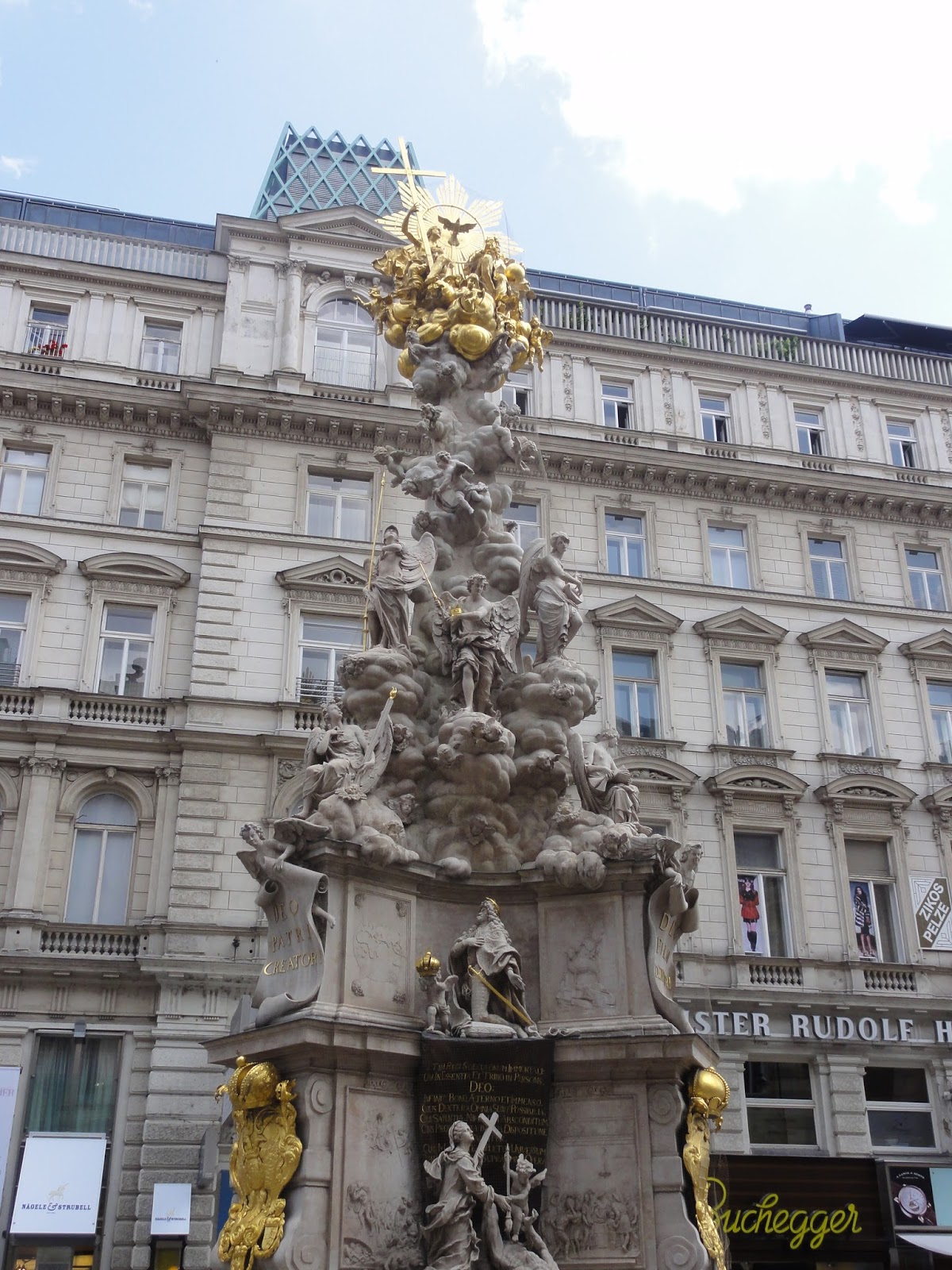
Soon we're strolling through the Graben, Vienna's hub, half street, half square, where GWD is looking for a toilet -- actually the famous underground Art Nouveau marble-paneled gilded cubicles built by Alfred Loos in 1905 -- while I'm in dire need of caffeine. Both are temporarily postponed until we locate the important Plague Monument and the statue of a humbled Emperor Leopold I kneeling in gratitude to the heavens for having exorcised the Black Plague of 1679 (after it had taken 75,000 lives).
Further on I pay a modest premium to sit beside the boulevard in the Julius Meinl coffeehouse and sip rather ordinary espresso while my companions lose themselves in the endless aisles of this international gourmet supermarket.
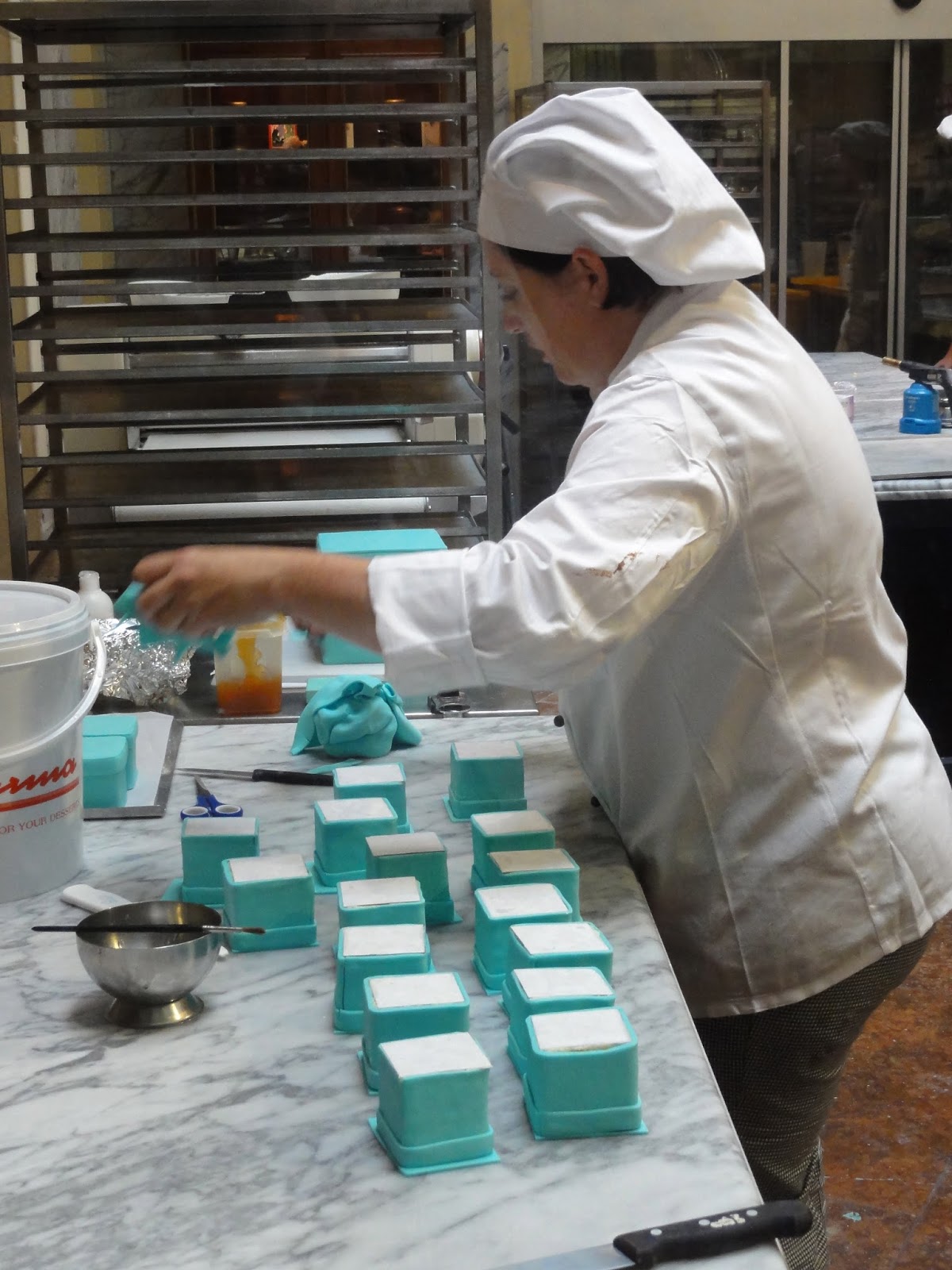
Moving along to window shop the luxurious boutiques lining the pedestrianized Kohlmarkt, is it likely we would resist the sugary confections beckoning from the shelves of the Demel Konditorei, once the Royal pastry cook's and now Vienna's most elite cafe? As if the gauntlet of strudels, cakes, and tortes weren't tempting enough, one is allowed to watch the master bakers hand-crafting their Tiffany boxed cupcakes and other proprietary delicacies in a glass-enclosed kitchen. Maintaining our diets, dignity, and discipline, we emerge on an imaginary high.
We make our way to the Imperial Palace -- it's not that hard to find, comprised of eighteen buildings housing 2600 rooms sprawled over fifty-nine acres, although I'm surprised to learn that one vast wing was constructed by Franz Joseph only twenty years before his empire's demise and that he was outraged when a brash financier erected a very contemporary office building opposite his Herculean Michael Gate almost simultaneously. I have little sympathy for the excessive vanities and stubborn pride of the Hapsburg monarchs, whose ill-conceived retaliation for the assassination of their heir in 1914 sparked a conflagration which can rightly be deemed the prime source of the woes which have afflicted Western Civilization ever since.
Disappointed that the Spanish Riding School is on summer break, and declining to ogle any Royal bedchambers, we traverse a couple of the campus's nineteen courtyards to reach Maria-Theresien-Platz -- in the center of which, bordered on two sides by semi-palaces, now museums, sits the Empress herself atop a huge pedestal -- before doubling back across the Ringstrasse for a light lunch almost under the gaze of another memorialized Viennese luminary, Mozart.
What trip to Europe would be complete without at least two hours of great art contemplation? Leaving GWD and RCD to scope out the Opera House, JSG and I, intrigued by its reputed collection of Dutch Masters, retrace our steps to the Kunsthistorisches. The architecture alone is significant; no expense was spared either in materials or interior embellishment despite the state's near insolvency during the period of construction (1871-1891).
With our time limited, we choose to spend it in the Picture Gallery -- foregoing even a glimpse of the Egyptian-Oriental, Antiquities, Sculpture, and Coin Collections. While I am no connoisseur, one cannot help but be impressed, even awestruck, by the tableaux on display, grand works by Vermeer ("The Art of Painting"), Bruegel the Elder ("Children Playing," "The Tower of Babel," "The Peasant Wedding"), Van Der Weyden ("Crucifixion Triptych"), Van Dyck ("Samson and Delilah"), and Rubens ("The Little Fur Coat," "The Calydonian Boar Hunt," "Stormy Landscape with Philemon and Baucis") -- although after all this immobile concentration, I'm thinking I'd rather be cycling.
GWD proceeds to flush out a pair of young lovers engrossed in their raging hormones by rudely planting himself at their table, leaning over, and licking the girl's ear (or so he claims). After several circuits of the premises, I suggest Indian to JSG; it's close, and rather than trying to decipher the menu one can simply point to his choice of the four curry selections -- lamb, chicken, veggie, or combo -- sizzling before him, all very tasty.
And once the headliner turns up the volume -- he's a middle-aged hard-rocking accordionist/singer named Hubert von Goisern, who apparently has quite a following in these parts -- we contrive respectable impersonations of free-spirited minglers having a good time.
Walking back to our hotel, we pass scores of restaurants, cafes, and stalls catering to a late-night crowd, which convinces me that the preeminent characteristic of this city -- or at least the one I will carry home -- is not music, history, architecture, or treasure; it's food, all the varieties, flavors, and national specialties we've eyeballed this evening -- from curries to burgers to fries to sausages to noodles to pasta to rice bowls to shish kabob to pastries to pizza to crepes to gelato, ad infinitum, not to mention hundreds of finer dining establishments known only to the sophisticates.
Our travels the next day are a travail. Arriving at the airport at 6:00 AM, we are panic-stricken when Austrian Airlines cannot locate our reservation; it's been made by Delta, but the two don't talk to one another. We hold our breaths while the agent attacks his computer with a vengeance. "I'm a genius!" he exclaims, and produces a pair of tickets, but only as far as Paris, where we must traipse from Terminal Two to Terminal Three (about a mile), find an equally competent representative to check us in again, but only as far as JFK, and be re-screened for explosives, weapons, and hand lotion.
If we manage to nap any on our eight-hour trans-Atlantic flight, we awaken to the nightmare that is JFK: frustrating baggage retrieval, interminable immigration and security (for the third time) lines, shuttling from Terminal C to Terminal E when the signage is non-existent, and four commuter flights funneled through the same gate at the same departure time.
We make it to Richmond on schedule, and if there have been any recurring themes in this travelogue, the perceptive reader will recognize that it ends as it begins. Because upon landing it's time to eat, and GWD knows just the place -- Whole Foods in Short Pump. I'll have to admit it's an inspired choice, but he'll have to admit, for once, countermanding his instructions, I drive us there by the shortest route. And that's no BS.
Tuesday, July 16, 2013
Pseudo-Extrovert
Almost lost amidst the profusion of contemporary advertisements and photographs decorating the large bulletin board in my office is a reproduction of a clipping from a vintage edition of the Crest, the annual yearbook of E. C. Glass High School, from which I graduated in 1965. It's the Debate Club for that year (or perhaps the prior one), and all eight members are perched precariously along the auditorium's orchestra rail in a perfect tableau of that bygone era.
There are five males sighted and only three females, a ratio I'm sure would be reversed, if not obliterated, on today's roster, assuming one still exists. The girls are primly attired in skirts and cardigans, the boys in jackets and ties, except for one hopeless holdout -- skinnier than his partners' rep stripes, grinning sheepishly through his thick black eyeglass frames, his wrinkled pants' legs riding high above his bony ankles. (Some things haven't changed.)
The topic that year honored a long tradition of irrelevance and dreariness for a teenager, regardless of his purported intellect: international trade policy, the pros and cons of protectionism versus tariff-free markets, which should whet the appetite of my son Matthew, who now reports on these matters weekly for a specialty publication. With the internet having yet to be conceived, for research we traipsed to the old Jones Memorial Library, buried ourselves in back issues of Current History magazine, and took copious notes on obscure monographs composed by diplomats and bureaucrats for each other's edification.
Somehow I presumed that my straight "A" report card and obsession with the printed word -- I was always reading, cereal boxes, comic books, newspapers, children's books, schoolbooks, history books, novels -- guaranteed my competence as a debater. But the proof is in the posturing. And while I no doubt had on hand scores of facts diligently recorded on index cards and organized into case statements and refutations -- which I sorely needed since I would have been destitute without them -- how effective could they have been when delivered by a confirmed introvert who would rather have been standing before a firing squad than a panel of judges?
And who indeed remembers attending a regional conference at the University of Virginia and sitting silently in his seat, never contributing a single word, while his peers volleyed arguments back and forth all day long like nimble tennis players -- a shutout which, when reported to his coach, earned him an embarrassing reprimand.
Back in those days of painful adolescence, I would probably have characterized myself as shy and, even if I had known the meaning of "introverted," would have assumed the two terms interchangeably denoted a personality that was reserved and reflective, like mine; to disinterested observers, the concepts appear to be the same. And while it is true that many introverts turn to further reclusiveness as a refuge from their socially-driven anxieties and a perceived public bias against behavior that is cerebral and quiet, technically and psychologically, there is a distinction. (Cain, p. 12)
As defined in Susan Cain's 2012 groundbreaking study, Quiet: The Power of Introverts in a World That Can't Stop Talking, shyness is a fear of social disapproval or humiliation, while introversion is a preference for environments that are not overstimulating. (Cain, p. 12)
And if maturity coupled with the demands of running a family business -- and its attendant involvement in community affairs -- finally wrenched me from the throes of the oppressive shyness which prompted my father to lament that "he always has his head in a book," and my mother to wonder if "he'll ever come out of his shell," I'm now comfortable as an introvert who can emerge from both of those pleasant places when it becomes necessary and desirable, mingle with the gregarious and garrulous at festive gatherings (and leave most of the talking to them), and even enlighten and entertain roomfuls of people with a potpourri of gravitas and humor, always from a prepared script, of course.
Yes, amazingly enough, during a four-week period earlier this year, that formerly mute youthful debater had the honor of presiding at three civic events -- the National Home Furnishing Association Retailer of the Year Banquet, the James River Council for the Arts and Humanities Awards Ceremony, and the William F. Quillian 100th Birthday Celebration.
Cain's work sheds considerable light on how an introvert like me is able temporarily to cross over to the other side, or morph into a persona which she labels "pseudo-extrovert."
If my highly-reactive amygdala -- the potent organ in the brain which controls heart rate, blood pressure, finger temperature, and other properties of the nervous system -- initially fuels an apprehension and uneasiness upon social immersion, a sensation Cain compares to stepping on a high wire, my rational neocortex quickly kicks into action telling me to calm down, extend a handshake, and smile. (Cain, pp. 101, 118)
Cain could be quoting me when she says of herself: "By now I've had so many thousands of social experiences that I've learned that the high wire is a figment of my imagination, or that I won't die if I fall. I reassure myself so instantaneously that I'm barely aware I'm doing it." Researchers have described high-reactive people as inhibited, "and that's what I feel at some dinner parties," along with an urgency to leave only minutes after arriving, she says. (Cain, pp. 119-120)
Years ago, when I wanted to hone my public speaking skills, and repair a self-esteem battered by divorce, I signed up for a Dale Carnegie course. Carnegie (originally spelled Carnagey, but changed by its owner to evoke the master industrialist Andrew) himself was an insecure high school student -- "skinny, unathletic, fretful," worried about "thunder and lightning, going to hell, and being tongue-tied at crucial moments"-- whose meteoric career mirrored the nation's turn-of-the-century cultural evolution from emphasis on the character of an individual to glorification of his personality. (Cain, p. 19)
As a college student, Carnegie identified a correlation between accomplished oratory and anointed leadership. Entering and losing contest after contest, he persevered, practiced, and eventually transformed himself into a speaking champion, campus hero, and speech trainer. (Cain, p. 20)
The booming new economy which greeted the graduate in 1908 -- in which Ford, J.C. Penny, Woolworth, and Sears Roebuck were rapidly becoming household names -- called for a new kind of man -- "a social operator, someone with a ready smile, a masterful handshake, and the ability to get along with colleagues while simultaneously outshining them." After a few grueling years selling beef for Armour and Company, Carnegie conducted his first public speaking class at a YMCA night school on 125th Street in New York City. It was an overnight sensation, and the impetus for him to found the Dale Carnegie Institute, "dedicated to helping businessmen root out the very insecurities that had held him back as a young man." (Cain, p. 20)
If I gleaned anything from Dale, it was that the best way for a speaker to engage his audience, and put himself immediately at ease, is to tell a story, particularly about himself, since, after all, it's a subject he should be familiar with, and one which surely is fertile ground for the revelation of some amusing self-deprecating foible. But since I never won any weekly prizes for telling the truth about my own stultifying routine, in the ensuing years I've employed liberal poetic license in embellishing those narratives as well as in grafting other lies (actually jokes, both canned and original) onto familiar individuals, a technique I learned from an expert in the field, my father.
According to Cain, the process by which introverts reinvent themselves is a little more complicated, and biological, than that.
She writes about Esther, a tax lawyer at a large corporate firm, whose favorite parts of the day were walking alone to her bus stop and digging into work that she loved behind her closed office door. Periodically, however, she and her four teammates were required to make oral reports to the other members of the firm. Esther was fine if advised of the meeting beforehand and given the chance to prepare, but uncomfortable and flustered when asked to speak extemporaneously. Even as she became more well-versed in the intricacies of tax law, her state-of-mind failed to improve. (Cain, pp. 121-122)
Esther's problem is related to her aversion to overstimulation, to excessive input from the outside world -- whether it be noise, crowds, flashing lights, or even the unexpected ringing of a telephone.
In the late 1960's research psychologist Hans Eysenck hypothesized that human beings desire "just right" levels of stimulation -- not too much and not too little -- and that extroverts prefer more stimulation than introverts, which explains their divergent behavior. (Cain, p. 122)
Eysenck speculated that the brain's ascending reticular activating system (ARAS), which includes both excitatory and calming mechanisms, "regulates the balance between over- and under-arousal by controlling the amount of sensory stimulation that flows into the brain." In introverts, said Eysenck, the ARAS functions to open up information channels, causing them to be flooded with stimulation and over-aroused; in extroverts, it operates to constrict those channels, making them prone to under-arousal. Consequently, the over-aroused introvert out on the town senses too many impressions coming at him at once and looks for an excuse to head home, while the under-aroused extrovert feels restless and sluggish in solitary confinement and seeks an outlet for his cabin fever. (Cain, p. 123)
Even the simplest one-on-one conversation requires the participant to process an abundance of short-term information without becoming distracted or overly stressed, including interpreting what the other person is saying, reading body language and facial expressions, alternating talking and listening, assessing how well he is being understood and received, and calculating how to improve the situation or extricate himself. While the extrovert's brain functioning is well-suited to this sort of multitasking, amplify the equation by a factor of ten or twenty, and the introvert finds himself overwhelmed. (Cain, p.237)
In a famous study, while playing a challenging word game during which they were exposed to random bursts of sound, introverts and extroverts were asked to adjust the volume of their headphones to their optimum level. The former chose fifty-five decibels; the latter seventy-five -- at which levels both were equally aroused and performed equally well. But when each group was asked to work under the conditions favored by its counterpart, the introverts were over-aroused by the loud noise, the extroverts were under-aroused by the comparative quiet, and both saw their scores decline thirty percent. (Cain, p. 124)
Over-arousal interferes with attention and short-term memory, which are key components of extemporaneous speaking. Thus introverts like Esther and me are likely to find themselves distracted and forgetful when they are suddenly called upon to take the stand, and hard-pressed to retrieve any of the vast data stored in their brain cells. It's a quandary for which, in most cases, there is a remedy, and that is to provide them with as much notice as possible -- so they can either write out their material in entirety (as I do), make some judicious notes, or steel themselves mentally for their presentations. (Cain, p. 126)
Thus fortified, like the author herself, I've come to embrace the power of the podium -- treating every speech as a creative project, preparing well in advance, so that I have time to edit and practice, reminding myself that I've done this many times before, reassuring myself that I have a relevant message sure to delight and educate my listeners, and eagerly anticipating the palpable rush generated by their high energy feedback.
The case of Professor Brian Little further elucidates how individuals "born and culturally endowed with certain personality traits -- introversion, for example -- can and do act out of character." His own biography lends impressive credibility to a theory he conceived in a field of study he invented. (Cain, p. 209)
Little is a "former Harvard University psychology lecturer and winner of the 3M Teaching Fellowship," the equivalent of the collegiate Nobel Prize. "Short, sturdy, bespectacled, and endearing, he has a booming baritone, a habit of breaking into song and twirling about onstage," and a penchant for enlivening his lessons with rollicking good humor. "His classes at Harvard were always oversubscribed and often ended with standing ovations." (Cain, p. 205)
But there's another side to Brian Little. "He lives with his wife in a tucked-away house in the remote Canadian woods, visited occasionally by his children and grandchildren, but otherwise keeping to himself. He spends his free time scoring music, reading and writing books and articles, and e-mailing friends long notes he calls 'e-pistles.' When he does socialize, he prefers one-on-one encounters. At parties, he pairs off into quiet conversations as soon as he can or excuses himself 'for a breath of fresh air.' " (Cain, pp. 205-206)
In 1980, after delivering a talk to a group of senior officers at the Royal Military College Saint-Jean on the Richelieu River, Little was asked to join the top brass for lunch. Horrified at the thought of having to make small talk for an hour and half -- which would literally exhaust him before another address scheduled for later that afternoon -- he announced to his hosts that he had a passion for ship design, politely excused himself, and spent the interlude strolling along the river pathway. Years later, when the college moved to a land-locked location and Little lost his cover story, he resorted to racing to the restroom and hiding in a stall, even propping his feet on the walls to avoid detection by an untimely intruder. (Cain, p. 208)
"Little believes that personality traits are real, that they shape our lives in profound ways, and that they are relatively stable across our lifetimes." But he also believes -- as articulated in his original Free Trait Theory -- that fixed and free traits coexist, that people can exhibit behavior contrary to their innate temperaments under certain specific conditions. (Cain, pp. 206, 209)
"According to Little, our lives are dramatically enhanced when we're involved in core personal projects that we consider meaningful, manageable, and not unduly stressful, and when they are supported by others . . . Thus, introverts are capable of acting like extroverts for the sake of work they consider important, of people they love, or of anything they value highly." (Cain, p. 209)
"That's why Professor Little, the consummate introvert, lectures with such passion. Like a modern-day Socrates, he loves his students deeply," an admiration that's shared by them. Every year he was asked to write hundreds of letters of recommendation. "Brian Little is the most engaging, entertaining,and caring professor I have ever encountered. I cannot begin to explain the myriad ways he has positively affected my life," wrote one. The effort required for Little to stretch his natural boundaries is justified by his seeing his core personal projects -- opening his students' minds and attending to their welfare -- come to fruition. (Cain, pp. 209-210)
Cain describes another pseudo-extrovert, Edgar, a New York socialite who with his wife hosts or attends fundraisers or similar events seemingly every weeknight. "I love politics, I love making things happen, I want to change the world in my own way," he says. "But I'd much rather sit at home and read and think about things than talk to people." (Cain, pp. 212-213)
So he compensates through artificiality. "I don't really like being the guest at someone else's party, because then I have to be entertaining. But I'll host parties because it puts you at the center of things without actually being a social person," he says. Edgar used to record jokes and anecdotes on index cards and refer to them at cocktail parties when his over-stimulated short-term memory failed him. (I once considered doing the same thing.) He's now grown so comfortable in his extroverted role-playing that he is able leave his verbal crutches at home. (Cain, pp. 212-213)
Sooner or later introverts (or extroverts) acting out of character need to return to their true selves, and will create places enabling them to do so, which Professor Little calls "restorative niches." These places can be physical, like an isolated path beside a river or one's bedroom when all his children are back in town, or they can be temporal, like quiet breaks between a series of sales calls. They can even be cerebral, like choosing where one sits during a meeting and when and how he participates. (Cain, p. 219)
Balancing an introvert's pseudo and authentic personae involves negotiating Free Trait Agreements -- with an extroverted spouse, for example, who wants to go out every Saturday night when her husband needs to unwind at home from a hectic workday, but more importantly with oneself. A recently divorced introvert craving an intimate relationship may push himself to join the crush at a neighborhood bar or cocktail reception, but only for the number of events he can comfortably tolerate -- whether it be twice a week or once a month. Once he's met his quota (or a pleasing partner), he's earned the right to stay home without feeling guilty. (Cain, pp. 221-222)
Introverts and extroverts often complement each other in their natural modes. In an experiment conducted by developmental psychologist Avril Thorne at the University of California, Santa Cruz, conversations between twenty-six pairs of "dispositional opposites" revealed a surprising degree of mutual appreciation. Introverts reported that talking to extroverts was easier, like a "breath of fresh air," and more centered on "cheerier" subjects. Extroverts said they could relax more with introvert partners and felt freer to confide their problems. (Cain, p. 239)
Thorne's research explains how a stereotypical introvert like Jon Berghoff -- lean, wiry, bespectacled, thoughtful, and quiet -- can be a standout salesman. (Cain, pp. 237-238)
A socially awkward high-schooler who hid in the library during lunch, Jon began selling Cutco kitchen products door-to-door as a junior in 1999. In eight weeks he sold $50,000 worth of knives; within a year he generated $135,000 in commissions and broke twenty-five national and regional sales awards. By 2002 he had recruited, hired, and trained ninety other representatives, and increased territory revenues 500 percent. Shortly thereafter he launched his own personal coaching and consulting business, eventually reaching over thirty thousand clients. (Cain, p. 238)
Doesn't salesmanship imply glibness, joviality, and persuasive charisma? Not according to Jon. His affinity for meaningful dialogue rather than idle chit-chat turns his prospect encounters into therapeutic counseling sessions. "I discovered early on that people don't buy from me because they understand what I'm selling. They buy because they feel understood," he says. (Cain, p. 239)
Jon also benefits from a tendency to ask lots of questions. "I got to the point where I could walk into someone's house, and instead of trying to sell them some knives, I'd ask a hundred questions in a row. I could manage the conversation just by asking the right questions," he says, concluding that the number one component of successful selling is the ability to listen well. (Cain, pp. 239-240)
Just as it was for Jon Berghoff, the school structure of adolescence can be highly unnatural -- and intimidating -- "especially from the perspective of an introverted child who loves to work intensely on projects he cares about, and hang out with one or two friends at a time." In the morning, the bus discharges him into a noisy, jostling mess. His "classes are dominated by group discussions in which a teacher prods him to speak up. He eats lunch in the cacophonous din of the cafeteria, where he has to jockey for a place at a crowded table. He has little time to think or create." (Cain, p. 253)
Somehow, this "geeky" kid emerges from this one-size-fits-all situation, and blossoms into a secure, happy adult. But maybe it's not so much he who changes but his environment. As adults we get to select the careers, spouses, and social circles that suit us. We don't have to persist in a culture alien to us. "Research from a field known as 'person-environment fit' shows that people flourish when . . . they are engaged in occupations, roles, or settings that are concordant with their personalities." (Cain, pp. 253-254)
As a dedicated bibliophile, I always imagined I was destined for an academic career, and indeed had my bags packed for postgraduate study in English literature at Columbia University when a summons to appear for a draft physical -- the Vietnam War was in full fury -- sent my father and me scurrying first for a high school teaching position, and, when that proved almost more stressful than a battlefield, an opening in the local Naval Reserve unit. Having abandoned the classroom, I pulled rank to secure temporary employment at Schewel Furniture Company while I waited for a call to active duty, which never came. By a remarkable stroke of good fortune, almost on the same day, I was the grateful recipient of a voluntary discharge -- the Navy had over-recruited and had no use for an educated enlisted man -- and a high draft lottery number.
What's an introvert to do -- cast adrift in an overstimulating retail arena, bombarded continuously by flak from cantankerous customers and curious coworkers, shouldering the burden of a family member's expected competence? I heard whispers that "He's stuck up" and "He never smiles," and was even chastised by my cousin for failing to bid him "Good morning," when it was all merely a matter of not having much to say -- of not yet having apprehended Dale Carnegie's proven formula for winning friends and influencing people.
I stayed with it, intrigued by the multifaceted nature of the business, all so novel to me, and by the realization that it contained myriad opportunities for even the introverted soul, while acknowledging that, as the boss's son, I had the advantage of targeting those departments where I was most comfortable and my inner-directed work ethic most useful -- merchandising, buying, advertising, inventory control.
As my father gradually invested me with more responsibility, enabling me to assume leadership of the company at his death in 1989, I made two other important discoveries: first, that I could easily hire managers who would help the organization thrive by contributing the skills and ebullience I might be lacking; and, second, that in a growing number of situations I was becoming more adept at acting like an extrovert -- addressing groups of employees, coaching and mentoring them for success, conducting meetings.
As Professor Brian Little defined the term, what core personal project could more effectively motivate a classic pseudo-extrovert than the promotion of his proprietary enterprise -- especially knowing he retained the luxury of retiring to his "restorative niche," his private office or the pages of a mediocre book, when the task at hand was completed?
Like a snowball rolling downhill, I soon found myself adopting more core projects -- serving on community boards, rotating into chairmanship positions, accepting speaking engagements, masquerading as Elvis Presley at special events -- all of which have broadened my horizons and enriched my life. Yet those roles are only temporary, and when the curtain falls, as always it must, I'm quite content to slough off my costume, and reappear as my true, fulfilled, introverted self.
Anais Nin wrote: "Our culture has made a virtue of living only as extroverts. We have discouraged the inner journey, the quest for a center. So we have lost our center and have to find it again." (Cain, p. 264)
And Cain, in her postscript, offers these homilies to her readers:
"The secret of life is to put yourself in the right lighting. For some it's a Broadway spotlight; for others a lamplit desk. Use your natural powers -- of persistence, concentration, insight, and sensitivity -- to do work you love and work that matters." (Cain, p. 264)
"Respect your loved ones' need for socializing and your own for solitude (and vice versa if you're an extrovert)." (Cain, p. 265)
"Spend your free time the way you like, not the way you think you're supposed to. Stay home on New Year's Eve if that's what makes you happy . . . Read. Cook. Run . . . Make a deal with yourself that you'll attend a set number of social events in exchange for not feeling guilty when you beg off." (Cain, p. 265)
"If your children are quiet, help them make peace with new situations and new people, but otherwise let them be themselves. Delight in the originality of their minds . . . Don't expect them to follow the gang. Encourage them to follow their passions instead." (Cain, p. 265)
"If you're a teacher, enjoy your gregarious and participatory students. But don't forget to cultivate the shy, the gentle, the autonomous . . . They are the artists, the engineers, the thinkers of tomorrow." (Cain, p. 265)
"If you're a manager, remember that one third to one half your workforce is probably introverted, whether they appear that way or not . . . Make the most of their strengths; they can help you think deeply, strategize, and solve complex problems." (Cain, p. 265)
"Bear in mind that appearance is not reality. Some people act like extroverts, but the effort costs them in energy, authenticity, and physical health. Others seem aloof or self-contained, but their inner landscapes are rich and full of drama. So the next time you see a person with a composed face and a soft voice, remember that inside his mind he might be solving an equation, composing a sonnet, designing a hat. He might be, that is, deploying the power of quiet." (Cain, p. 266)
REFERENCE
Cain, Susan. Quiet: The Power of Introverts in a World That Can't Stop Talking. New York: Broadway Paperbacks, 2013.
Subscribe to:
Posts (Atom)